Bulb · Iridaceae
Garden Gladiolus
Gladiolus × hortulanus
Set the corms in spring and gladiolus repays it with tall spires of color from late summer to fall.
Full sun
Every 5–7 days
41–86°F · 5–30°C
60–90 days
Overview
Gladiolus is the familiar florist's spike, a single tall stem bearing funnel-shaped florets that open acropetally, from the base upward. A member of the iris family, it grows from a corm, a compressed underground stem that functions as a storage organ much as a true bulb does. The rigid, sword-shaped leaves account for the common name sword lily, and a planted row remains a summer standard in temperate gardens.
These are warm-season geophytes raised from spring-planted corms. Once soil warms past the last frost, the plant reaches bloom 8 to 12 weeks later, a predictable interval that supports succession planting at weekly intervals for a continuous display. In zones 7 to 10 the corms are hardy enough to remain in situ over winter, whereas in colder zones they are lifted each autumn and held dry until spring.
Cultural requirements are modest, chiefly full sun and consistent moisture. The recurring failure point is the corm, which decays in saturated soil and can harbor thrips if stored without inspection. Provide sharp drainage and support for the tallest spikes, and the plant yields abundant material for cutting.
Care
The short version: set the corms in full sun in rich, well-drained soil after the last frost, hold even moisture at roughly an inch of water a week, and lift the corms for winter in freezing zones.
Light
Gladiolus performs best in full sun, ideally six or more hours daily, which supplies the energy for erect, self-supporting spikes. It tolerates light afternoon shade, but under low light the stems etiolate, lean, and bear fewer florets.
Water
Hold the soil evenly moist through vegetative growth and flowering, equating to about an inch of water a week, because steady moisture drives full spike development. Yet the corm rots under saturation, so drainage is as critical as supply.
Soil
Grow in fertile, well-drained loam amended with organic matter, and avoid heavy clay that holds water against the corm and encourages rot. A near-neutral pH of 6.5 to 7.0 suits the crop.
Temperature
The plant grows across a broad band, about 41°F to 86°F (5°C to 30°C), once the season has warmed. It is frost-tender, so corms go in only after the final cold snap and are recovered before the ground freezes hard.
Humidity
Ambient outdoor humidity is adequate and no target is given. Air movement through the stand matters more, since stagnant, humid conditions favor botrytis and corm rot.
Feeding
Gladiolus is an average feeder best fed to a soil test with a balanced fertilizer. Apply once at planting and again as the flower spikes form, supporting both the inflorescence and the corm accumulating reserves below.
Pruning
Cut the spent spikes after bloom so resources are not diverted to seed set. Retain the foliage until it yellows and senesces naturally, because those photosynthesizing leaves replenish the corm for the following year.
Repotting
In cold zones, lift the corms each fall and replant in spring rather than exposing them to a freeze. Where they overwinter in place, dig and divide congested clumps every few years to maintain bloom size.
Size & spacing
Depending on cultivar, spikes reach 1 to 6 feet (30 to 180 cm), with the tallest warranting a stake. Each plant occupies only 12 to 24 inches (30 to 60 cm) of spread, permitting fairly close spacing in rows or blocks.
When to plant
Gladiolus is frost-tender and keyed to the warm season. Plant the corms in spring once the soil has warmed, repeat at weekly to fortnightly intervals to extend the display, and expect spikes from late summer into early fall.
Northern hemisphere
Southern hemisphere
Typical months for a temperate climate: start earlier in warm zones, later where spring frosts linger.
- Plant: Spring, after the last frost once soil has warmed; plant in succession 7-14 days apart for continuous bloom.
- Harvest: Late summer into early fall, about 8 to 12 weeks after planting.
Hardiness
USDA hardiness zones: 7–10
Temperature: down to -18°C
Troubleshooting
Most gladiolus disorders originate below ground or arrive on the corm, so vigilance at the base and on the lower foliage pays off. Detect the early expressions and you can intervene before a planting is lost. Match the symptom below, then act while intervention still changes the outcome.
Chlorotic tops with corms decaying internally
Wilting, stunting, and soft brown corm tissue point to fusarium wilt or corm rot, soilborne pathogens that thrive where drainage is poor and the corm sits in saturated ground. In cool, wet spells, botrytis or crown rot can add basal decay on top of that. The pathogens cannot be cured within the corm, so remove and destroy affected stock, correct the drainage that let the fungi persist, and rotate to fresh ground with only firm, healthy corms.
Fix:
- Remove and destroy affected corms and plants
- Improve soil drainage
- Rotate planting location
- Plant only firm, healthy corms
Silvered foliage and flowers that abort in bud
The silvering and flecking are feeding scars left by gladiolus thrips, which rasp the epidermis and lodge inside the flower bracts where the tissue is soft. Because they overwinter and travel on the corms, symptoms often appear before any adult is visible above ground. Cull the worst spikes, deploy sticky cards to gauge the population, and treat or discard suspect corms so an infestation does not carry into storage and next season.
Fix:
- Remove and destroy heavily infested flower spikes
- Use yellow or blue sticky cards to monitor
- Apply an appropriate insecticide labeled for thrips if needed
- Treat or discard infested corms before storage
Toxicity
Gladiolus is toxic to pets and grazing animals, and the concentration of irritant is highest in the buried corm. Foliage, flowers, and corms all carry the compound, which on ingestion produces drooling, vomiting, and lethargy. Exclude animals from the beds and secure corms during planting and storage, when they are most accessible.
Toxic to
Cats · Dogs · Horses · Rabbits · Livestock · Birds · People
Cats Mild
A cat ingesting foliage typically responds with hypersalivation and vomiting, then a period of lethargy as the gut irritation settles. Because the irritant concentrates in the corm, a cat that unearths one faces the largest dose.
Dogs Mild
In dogs the usual picture is drooling, gastric upset, and loose stool within a few hours of ingestion. A dog that consumes a stored corm takes in the highest concentration of the compound.
Horses Mild
Grazing horses may salivate, go off feed, and appear dull as the irritant acts on the gut. Since the corms hold the most, exclude them from beds and open planting trenches.
Rabbits Toxic
The same irritant compounds disturb a rabbit's sensitive digestive tract, producing drooling and inappetence. Site the leaves, flowers, and corms where a rabbit cannot browse them.
Livestock Toxic
Cattle, goats, and sheep can develop scouring and listlessness after grazing foliage or ingesting turned-up corms. Fence stock from plantings and dispose of lifted corms securely.
Birds Toxic
Birds that peck foliage or dislodge a corm risk drooling, vomiting, and lethargy from the same irritant. Regard every part of the plant as unsuitable for them.
People Caution
No part of the gladiolus is edible, and the corm in particular can irritate the mouth and gut if swallowed. Keep young children away from corms during planting and storage.
Keep corms and bulbs out of reach of pets, especially during planting and storage when corms are accessible.
Helpline numbers

United States
ASPCA Animal Poison Control: (888) 426-4435 (fee applies)
Poison Control: (800) 222-1222



Canada
Poison Centres: 1-844-764-7669
Varieties
Most garden gladiolus are hybrids marketed by color rather than epithet, yet a few discrete species merit attention for their fragrance and cold hardiness.
Gladiolus murielae
This species is the fragrant Abyssinian or peacock gladiolus, distinguished by white blooms centered on a deep purple throat.
Gladiolus × byzantinus
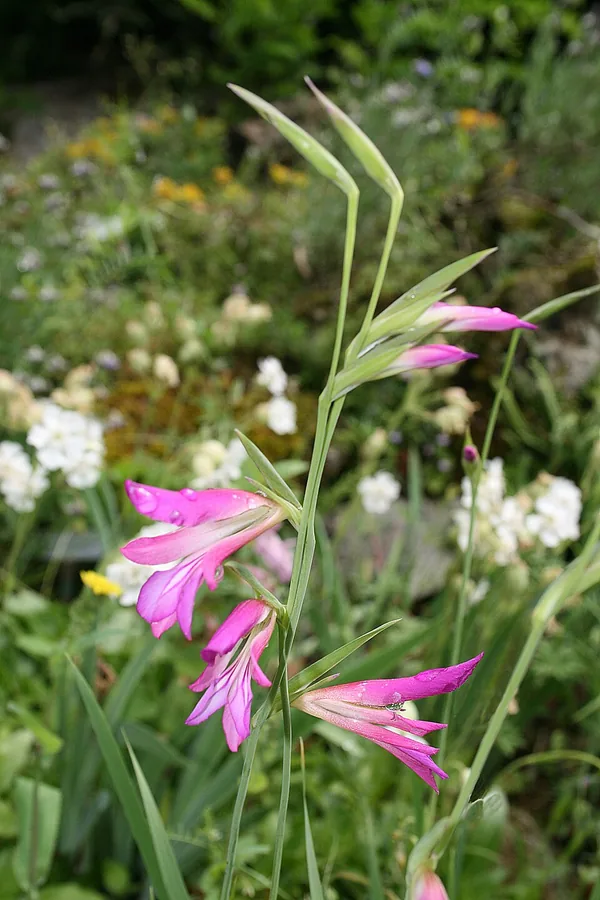
This hardy Byzantine heirloom bears magenta flowers and persists reliably to roughly USDA zone 6.
How to propagate
Gladiolus increases readily through its own corm biology, so the autumn lift is also the simplest route to additional plants for the following year.
Bulbs & cormsEasy
Spring at planting; lift and separate in fall · One growing season
The standard method exploits the corm's natural cycle: each parent renews itself by forming a replacement corm at its apex, usually with a ring of small cormels at the base. Lift the corms in fall and replant the following spring, and the full-sized corms flower again within a single growing season.
DivisionEasy
Fall when lifting corms · One growing season
At lifting, detach the cormels from the base of the parent to increase your stock. The full-size corms bloom the next season, whereas the smallest cormels require a year or two of vegetative growth to accumulate the reserves needed to flower.
SeedModerate
Spring · Two to three years
Seed propagation is slow and mainly of interest to breeders developing new color forms. Sow in spring and allow two to three years for each seedling to build a corm of flowering size.
Myths
Gladiolus flowers and leaves are safe for pets to nibble.
The record does not bear this out. All parts of the plant contain an irritant, and the ASPCA classes it as toxic to cats, dogs, and horses. Ingestion produces drooling, vomiting, and lethargy, and the toxin concentrates in the buried corm, which is the most hazardous part. Exclude pets from the foliage and, above all, the corms.