Ornamental · Asteraceae
Globe Thistle
Echinops ritro
Site it in full sun and lean, dry soil, and globe thistle returns steel-blue globes that bees work through summer.
Full sun
Every 7–14 days
USDA 3–8
3–4 ft · 0.9–1.2 m
Overview
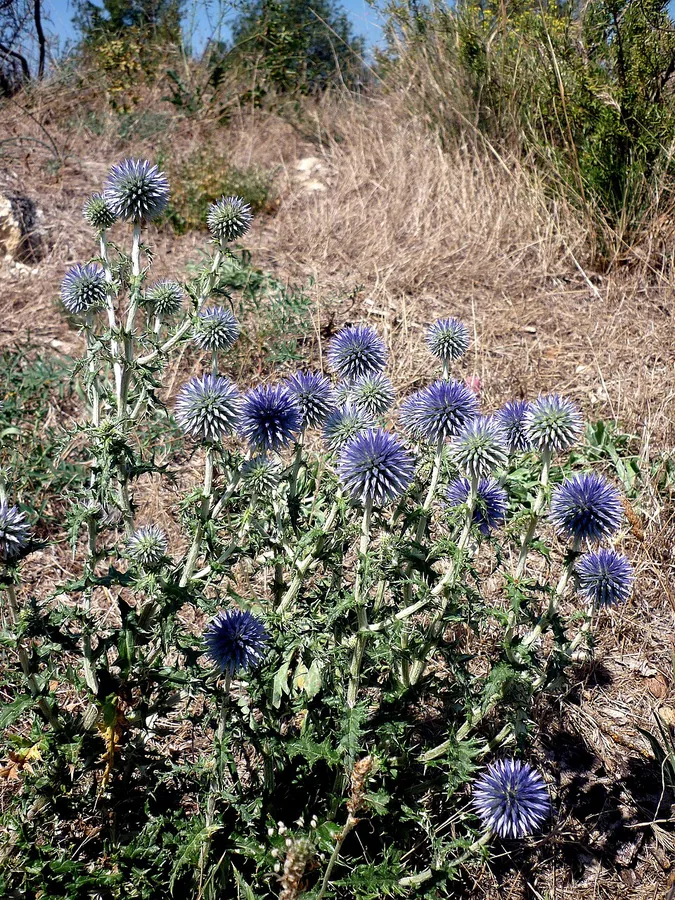
Globe thistle is named for the spherical, steel-blue flower heads it raises in midsummer. A hardy perennial in the Asteraceae, it is adapted to full sun and poor, dry ground, and that adaptation is why it withstands heat, drought, and browsing by deer and rabbits that take softer plants. The spiny foliage and bristly globes give the clump a strong architectural presence in the border.
Its low demand follows directly from its origins on lean, dry sites. Grown in poor soil with sparing water, it anchors a deep taproot and asks little further attention. The flowers supply nectar to bees and butterflies over several weeks, and the heads retain their form after cutting, which is why they hold up as dried material.
The plant is genuinely easy provided the conditions stay austere. Rich soil and shade produce lanky, floppy stems, and excess water induces root rot, both being failures of over-provision rather than neglect. Match the site to its dry, sunny preferences and globe thistle persists for years with minimal input.
Care
The short version: full sun, lean and well-drained soil, and restrained watering. Fertilize rarely, leave the deep taproot undisturbed, and deadhead the spent globes to moderate self-seeding.
Light
Site globe thistle in full sun, which the species requires for firm, upright growth. It tolerates light shade, but reduced light drives the stems to stretch and lean, so the most exposed position in the bed serves it best.
Water
This is a drought-adapted plant that prefers dry to medium soil once established. Allow the upper half of the profile to dry between waterings, on the order of every 7 to 14 days, and always err toward less. Sustained moisture is the direct cause of root rot in this species.
Soil
Grow it in poor to average, well-drained ground, the leaner the better, because low fertility keeps growth compact and self-supporting. It accepts clay, loam, sand, and shallow rocky soil at a pH of 6.0 to 6.5, whereas wet or rich organic soil produces floppy stems and encourages rot.
Temperature
Cold hardiness is a defining trait, with the plant surviving winter lows to -29°F (-34°C) and summer highs to 90°F (32°C). That span accommodates the great majority of temperate gardens without protection.
Humidity
Ambient outdoor humidity is sufficient, so no target figure applies. Air movement is the governing factor, since stagnant, crowded conditions at the leaf surface favor powdery mildew.
Feeding
Fertilize only rarely, as the species is adapted to nutrient-poor soil. Rich feeding drives soft, floppy, lanky growth that requires staking, whereas a lean regime keeps the stems firm and self-supporting.
Pruning
Deadhead the spent globes to tidy the clump and limit self-seeding, since ripening heads are the seed source. Cut stems back to the basal foliage after flowering or in late fall, and harvest heads for drying while they are still young.
Repotting
The species rarely needs repotting and performs best in open ground where the deep taproot can descend. Under container culture, watch for reduced vigor or roots circling the pot, which indicate the plant has exhausted its space.
Size & spacing
Mature plants reach 3 to 4 feet (91 to 122 cm) in height with a spread of 24 to 30 inches (61 to 76 cm). Allow that spacing so air circulates through the clump and the foliage dries promptly.
When to plant
Globe thistle is a cold-hardy perennial that regrows from its crown each year. Sow seed indoors in late winter, transplant outdoors after the last spring frost, and expect the steel-blue heads to open from midsummer through September.
Northern hemisphere
Southern hemisphere
Typical months for a temperate climate: start earlier in warm zones, later where spring frosts linger.
- Sow: Late winter to early spring, 6-8 weeks before last frost
- Plant: After last spring frost
- Harvest: Mid-summer through September
Hardiness
USDA hardiness zones: 3–8
Temperature: down to -40°C
Troubleshooting
Globe thistle ranks among the most trouble-free perennials, and nearly every disorder arises from over-provision rather than neglect. Look for softened roots, floppy stems, or a powdery film on the foliage. Match the sign below and correct the underlying site condition before it progresses.
Foliage collapse and yellowing above decayed root tissue
This pattern points to root rot, and on a species adapted to drought and lean ground, excess moisture is the driver almost every time. Waterlogged or heavy, rich soil deprives the roots of oxygen until the tissue softens, browns, and decays. Withhold water so the profile dries, correct the drainage or relocate the plant to leaner, sunnier ground, and remove any specimen too far decayed to recover.
Fix:
- Reduce watering and allow soil to dry out
- Improve drainage or relocate to a well-drained, sunnier site
- Remove and discard severely rotted plants
Elongated, weak stems that sprawl outward
Floppy growth traces to two conditions this species is not built for: insufficient light and excess soil fertility. Shade drives etiolation as the stems stretch toward light, while rich soil pushes soft, lush extension that the stem cannot hold upright. Relocate the plant to full sun, withhold fertilizer to keep growth firm, and stake the tallest stems where lean persists.
Fix:
- Move to full sun
- Avoid feeding and grow in lean soil
- Stake taller stems if needed
Gray-white powdery growth developing on leaf surfaces
Powdery mildew colonizes foliage where air movement is poor, a condition typical of crowded or shaded plantings. Because the fungus depends on stagnant, humid air at the leaf surface, thinning and spacing to restore circulation is the primary control, supported by removing the most heavily coated leaves and siting the plant in full sun. The infection remains cosmetic and does not threaten a well-established clump.
Fix:
- Improve air circulation by spacing and thinning plants
- Remove affected foliage
- Site in full sun
Distorted shoot tips with sticky residue and minor insect activity
Aphids account for most of the small-insect activity, with leaf miners, thrips, and slugs or snails appearing far less often. Damage stays minor because the species is inherently pest-resistant and rarely troubled by any of them. Dislodge aphid colonies with a strong jet of water, remove slugs and snails by hand, and tolerate the light feeding that remains.
Fix:
- Hose off aphids with water
- Hand-pick slugs and snails
- Tolerate minor damage as the plant is generally pest-resistant
Toxicity
For households with pets and children the verdict is favorable: globe thistle is not poisonous. NC State Extension reports it as non-toxic to cats, dogs, and horses, and no part injures people through ingestion. The only genuine hazard is mechanical, so use gloves around the spiny leaves and bristly flower heads.
Safe for
People · Cats · Dogs · Horses · Rabbits · Livestock · Birds
Cats None
The plant carries no compounds toxic to cats. The sole concern is mechanical, as the spiny foliage can prick an inquisitive mouth or paw.
Dogs None
Ingestion produces no toxic response in dogs. The stiff, bristly leaves and flower heads pose only a physical deterrent, and a sharp prick generally ends the encounter.
Horses None
No toxins affect horses, so the species is safe in pasture and border alike. Most animals avoid the prickly growth without prompting.
Rabbits None
No toxic principle affects rabbits, and the spines serve as a natural browsing deterrent that keeps them at a distance.
Livestock None
Grazing stock can browse in proximity without toxic risk. The coarse, prickly foliage functions as a physical barrier that discourages most from feeding.
Birds None
The species is non-toxic to birds, which frequently forage the dried seed heads. The flowers also supply nectar for the bees and butterflies for which the plant is valued.
People None
No toxic hazard applies to handling or proximity for people. The practical risk is mechanical, so use gloves when cutting or arranging, since the spiny leaves and bristly globes abrade bare skin.
Wear gloves when handling; the spiny leaves and prickly globe-shaped flower heads can scratch or prick skin.
Varieties
The straight species predominates in gardens, but several named selections merit attention for their coloration and stature.
Veitch's Blue
A more compact selection at 3 to 3.5 feet, it produces darker steel-blue flowers and a longer, more prolific flowering period than the species.
Platinum Blue
It is distinguished by silvery-white stems held against soft lavender-blue flower heads.
subsp. ruthenicus
This subspecies is grown as a smaller globe thistle notable for its finely cut, white-woolly foliage.
Companions
Globe thistle pairs best with other sun-loving, drought-tough plants that want the same lean, dry soil and bring in the same pollinators.
Plant near
Yarrow: Shares full-sun, dry, well-drained, lean-soil conditions and supports pollinators alongside globe thistle.
Russian sage: Matches drought-tolerant, full-sun growing needs and complements the steel-blue blooms.
Sedum: Thrives in the same poor, dry, well-drained soils and sunny exposure.
How to propagate
Globe thistle propagates by seed, division, or root cuttings, though the deep taproot makes seed the most dependable route by a wide margin.
SeedEasy
Sow in spring; self-seeds readily in the garden · One to two seasons to reach flowering size
Seed is the most reliable method for this taprooted species. Sow in spring, and allow one to two seasons for plants to reach flowering size. Where flower heads are left standing, the plant self-seeds freely across the bed.
DivisionDemanding
Spring or early fall · One season
Division in spring or early fall is possible but demanding, because the deep taproot resents disturbance and needs roughly a season to re-establish. For that reason most growers leave the clump undisturbed.
DivisionModerate
Spring · Several weeks to root
Root cuttings taken in spring exploit the fleshy taproot rather than stem tissue, cutting sections that regenerate as new plants. Rooting proceeds over several weeks.
Myths
Echinops belongs with the noxious field weeds and is toxic to grazing animals.
The association with weedy field thistles is superficial; this is a cultivated garden perennial that NC State Extension reports as non-toxic to cats, dogs, and horses. It is an ornamental, not a noxious or poisonous plant, although it will self-seed if the flower heads are allowed to ripen.
Like most perennials, globe thistle needs dividing at regular intervals to keep its vigor.
The species develops a deep taproot that resists lifting and makes division difficult and stressful to the plant. It performs best left undisturbed in place, and unlike many fibrous-rooted perennials it seldom requires routine splitting.