Ornamental · Crassulaceae
Sedum
Sedum
Sun plus sharp drainage is the whole formula, because a succulent that stores its own water asks for little else.
Full sun
50–77°F · 10–25°C
USDA 3–9
4–24 in · 10–60 cm
Overview
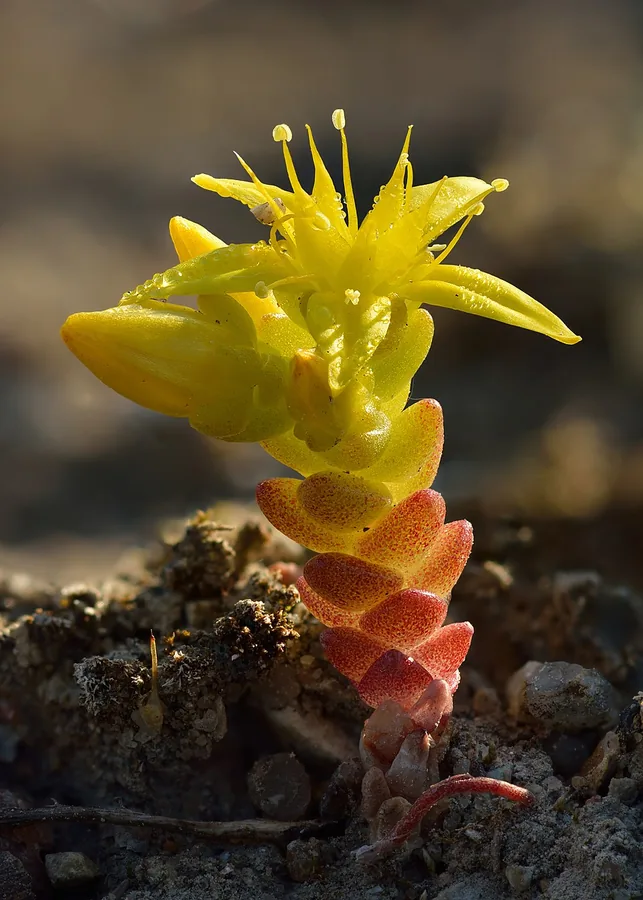
Sedum, the stonecrop genus, sits within the Crassulaceae family of leaf-succulents, and that membership explains most of its behavior. Water held in the swollen leaves and stems buffers the plant through drought, which is why it outlasts thinner-leaved neighbors when the soil runs dry. Cold hardiness spans zones 3 to 9, so the genus performs from an alpine trough to a green roof.
Growth habit varies by species and dictates where each belongs. Upright clumping forms build fleshy crowns and raise terminal flower heads in late summer, while prostrate species creep and root at the nodes as they run, colonizing rock gardens and paving joints. Mature height therefore ranges widely, from 4 to 24 inches (10 to 60 cm).
The genus tolerates almost everything except sustained moisture at the roots. In gritty, fast-draining media under strong light, sedum is nearly self-sufficient. In heavy, water-retentive ground the succulent tissue and standing water together invite stem and root rot, which remains the leading cause of failure. Drainage, more than any other factor, decides whether a planting persists.
Care
The short version: site sedum in full sun and a gritty, sharp-draining medium, and irrigate only after the profile has dried out completely, since the plant tolerates drought but not saturation. Fertilize sparingly in the growing season, pinch etiolated stems, and exclude standing water.
Light
Provide full sun, ideally several hours daily, because high irradiance keeps internodes short and pigmentation intense. The plant will persist in partial sun or bright indirect light indoors, but insufficient light triggers etiolation, leaving stems elongated and lax.
Water
Irrigate thoroughly, then withhold water until the medium has dried out completely. Because the fleshy leaves hold a stored reserve, the plant withstands a deferred watering far better than a saturated root zone. Standing moisture is the direct precursor to stem and root rot.
Soil
Use a gritty, well-drained mix so water passes through rather than lingering at the roots. A pH of 6.0 to 7.0 is suitable, though drainage governs success far more than the precise reading. Dense, moisture-retentive substrates are the principal thing to avoid.
Temperature
Sedum performs across 50°F to 77°F (10°C to 25°C). Hardy species endure outdoor winters throughout zones 3 through 9 by dying back to persistent crowns, whereas indoor specimens hold at standard room temperatures.
Humidity
Low ambient humidity poses no difficulty, which suits the plant to dry indoor air. No humidity target applies here; conversely, damp, stagnant air favors rot organisms and does measurable harm.
Feeding
Feed from spring through summer during active growth, at roughly monthly intervals, with a balanced water-soluble fertilizer at half strength. Overfeeding forces soft, succulent growth that rots readily and attracts pests, so the restraint is deliberate.
Pruning
After flowering, remove the spent inflorescences to redirect the plant's resources. Pinch elongated or leggy stems to restore a compact habit, and excise soft, rotted tissue immediately, since decay spreads through the fleshy stems if left.
Repotting
Repot every 2 to 3 years, or earlier once roots fill the container. Two reliable indicators of crowding are a substrate that dries unusually fast, because roots have displaced much of it, and a slowing of new growth.
Size & spacing
Mature height runs 4 to 24 inches (10 to 60 cm) by species, over a spread of about 12 to 24 inches (30 to 60 cm). Allow creeping types the lateral room to knit into a mat, and space clumping types so air moves freely and foliage dries.
When to plant
As a cold-hardy perennial, sedum regrows from established crowns each season, so no indoor sowing schedule applies. Establish or divide it in spring during the flush of new growth, and inflorescences develop from summer into fall, with the precise window set by species.
Northern hemisphere
Southern hemisphere
Typical months for a temperate climate: start earlier in warm zones, later where spring frosts linger.
- Harvest: Summer to fall depending on species
Hardiness
USDA hardiness zones: 3–9
Temperature: down to -40°C
Troubleshooting
Sedum disorders nearly all originate in either the water regime or the light level, and the stems register them earliest. Reading those first signals lets you correct the cause while the plant is still recoverable. Identify the symptom below, then treat the underlying condition.
Soft, discolored stems and a collapsing crown
Softening, discolored stems that give way at the base indicate rot, the predictable result of excess irrigation or a medium that fails to drain. Excise every affected stem back to firm, turgid tissue, allow the cuttings to callus so the wound seals, then re-establish them in dry, gritty mix while irrigation is suspended. A draining container and a substrate that dries between waterings prevent recurrence.
Fix:
- Cut away all soft, rotted tissue back to firm healthy growth
- Allow healthy cuttings to callus and re-root in dry, gritty mix
- Withhold water until new roots form
White waxy colonies lodged in the leaf axils
White, cottony colonies in the leaf axils, accompanied by sticky honeydew, are mealybugs, sap-feeders that drain the plant's vigor. Contact each insect directly with a cotton bud carrying 70 percent isopropyl alcohol, then reinspect at intervals of a few days until none remain. Segregate the specimen from neighboring succulents to halt spread.
Fix:
- Dab insects with a cotton swab dipped in 70 percent isopropyl alcohol
- Repeat treatment every few days until clear
- Isolate the plant from other succulents
Elongated, pale stems oriented toward the light
Stretched, widely spaced growth of faded color is etiolation, the plant's response to inadequate light. Deprived of sun, internodes elongate and pigment thins as the stems lean toward the source. Relocate the plant to a position that receives direct sun for several hours, then pinch the drawn stems to reinstate compact growth. The removed tips root readily and need not be discarded.
Fix:
- Move the plant to a brighter location with several hours of direct sun
- Pinch or cut back stretched stems to encourage compact regrowth
- Use the trimmed tips as cuttings
Toxicity
Toxicologically, sedum is reassuring. Stonecrops contain no compounds known to poison cats, dogs, horses, or other animals, and the ASPCA classifies the widely grown burro's tail as non-toxic. Ingestion may provoke mild, self-limiting gastrointestinal upset, as with most non-food plants, but no systemic risk is documented.
Safe for
People · Cats · Dogs · Horses · Rabbits · Livestock · Birds
Cats None
Non-toxic to cats. At most, ingestion prompts transient salivation or mild gastric upset, the ordinary reaction to any inedible plant.
Dogs None
Non-toxic to dogs. Consumption yields, at worst, a brief episode of gastrointestinal upset, and even that is infrequent.
Horses None
Non-toxic to horses. Stonecrop contains no constituent capable of harming an equine grazer.
Rabbits None
Non-toxic to rabbits. The succulent foliage carries no harmful compounds, though sedum functions as an ornamental rather than a dietary staple.
Livestock None
Non-toxic to ruminants. Cattle, sheep, and goats may occupy plantings safely, as stonecrops are absent from the poisonous-pasture listings.
Birds None
Non-toxic to birds. The plant presents no toxic constituents to caged or wild birds.
People None
Non-toxic to people. Handling is harmless, and certain stonecrops have been consumed in small quantities, yet the plant is best kept ornamental rather than culinary.
Varieties
The genus comprises hundreds of species spanning erect clumps to appressed ground mats. The three profiled here are among the most cultivated and bracket that morphological range.
Sedum spectabile / 'Autumn Joy'
An erect border species whose fleshy stems carry broad, flat cymes that open pink and age to rust through autumn.
Sedum acre
Goldmoss stonecrop, a prostrate mat-former bearing minute yellow-green leaves above a dense flush of yellow flowers.
Sedum spurium
A creeping, mat-forming species with rounded, crenate leaves, valued for rock gardens and extensive green roofs.
How to propagate
Few genera propagate as readily as sedum. Detached leaves regenerate adventitious roots and shoots on their own, so a single specimen yields many clones with minimal intervention.
Stem cuttingsEasy
Spring through summer during active growth · 2 to 3 weeks to root
Take stem cuttings within the spring-to-summer growth phase. Allow the severed ends to callus for a day or so, sealing the wound against rot, then insert them into gritty mix held barely moist. Rooting follows in roughly 2 to 3 weeks.
Leaf cuttingsEasy
Spring through summer · 3 to 6 weeks to form plantlets
Whole plants regenerate from individual leaves throughout spring and summer. Rest each detached leaf on dry, gritty mix; adventitious rosettes with their own roots differentiate at the base within about 3 to 6 weeks.
DivisionEasy
Early spring · 2 to 4 weeks to settle
Clump-forming border species divide cleanly in early spring. Lift the crown, separate the rooted segments, and reset each at its former planting depth; re-establishment takes about 2 to 4 weeks.
Myths
Sedum and other succulents subsist on neglect and require no watering.
Sedum is drought-adapted, not water-independent; during active growth it still benefits from periodic, thorough irrigation. The functional risk is inverted from the myth. Saturation, not occasional watering, is what kills stonecrops.