Ornamental · Crassulaceae
Stonecrop
Sedum
Site it in full sun over sharp drainage and stonecrop needs little else to establish and thrive.
Full sun
Every 10–21 days
60–90 days
USDA 3–9
Overview
Stonecrop occupies the niche where most plants fail: thin, hot, drought-prone ground. As succulents, these low sedums store water in their fleshy leaves, which buffers them through heat, drought, and lean rocky soils. Most species are creeping mat formers, knitting into a living carpet well suited to rock gardens, gravel, green roofs, and the dry gaps between paving stones.
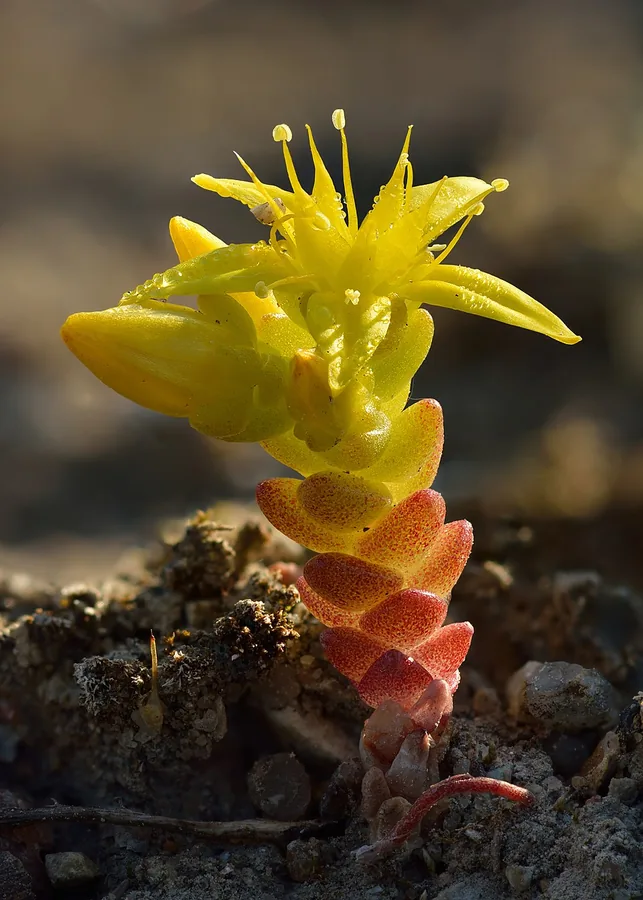
The genus spans a wide range of form and color. Foliage may read gold or chartreuse, deep bronzy-red, or intensify its pigment as temperatures drop, a common cold-weather response. Star-shaped summer flowers in yellow, white, pink, or red draw pollinators, after which the foliage sustains the display through the year. Cold hardiness is exceptional, with the toughest types enduring winter lows near -40°F (-40°C).
The plant's chief vulnerability is over-provision. Rich soil and steady moisture drive soft, floppy, leggy growth, and saturated soil rots the roots and crown. Grow it lean and dry in the strongest light available, and the main discipline required is restraint.
Care
The short version: full sun, a lean and gritty fast-draining medium, and water applied only after the soil has dried completely. Withhold feed and interfere little.
Light
Stonecrop performs best in full sun, where light drives the compact habit and pigment. It tolerates partial sun or light shade, but reduced light etiolates the stems into stretched, flopping growth and drains the gold and red forms back to green.
Water
As a succulent, stonecrop should be watered only after the soil dries completely, then irrigated deeply. Established plants typically subsist on rainfall, requiring supplemental water only every 10 to 21 days during extended drought. Excess water is the principal cause of decline, exceeding every other factor.
Soil
Grow in lean, gritty, sharply drained soil, ideally sandy to gravelly. A pH of 6.0 to 7.5 is suitable, and the plant tolerates infertile ground that would limit less-adapted species. Heavy soil that retains water around the roots is the one medium it cannot survive.
Temperature
The tolerance range is broad, from -40°F to 100°F (-40°C to 38°C), which underlies the winter hardiness of the toughest types. Drainage governs winter survival more than temperature does, since saturated cold soil, not cold air, drives the loss.
Humidity
Ambient humidity is immaterial; dry air poses no problem and there is no target range. The relevant risk is stagnant, damp air, which favors rot and provides harborage for slugs.
Feeding
Feeding should be minimal or omitted. Because stonecrop is adapted to lean ground, excess nutrition produces floppy, leggy growth, so a single light application of balanced fertilizer in spring is the upper limit.
Pruning
Shear leggy or flopped stems to restore the mat's density and stimulate branching, and pinch back runners that overreach their allotted space. Remove spent flower stems once bloom concludes.
Repotting
Container plants warrant repotting every 2 to 3 years, or sooner when the mat crowds the pot, thins at the center, or sheds water almost immediately, all signs of a spent, root-filled medium. Replace with fresh gritty, fast-draining mix.
Size & spacing
Creeping stonecrops remain low, generally 2 to 6 inches (5 to 15 cm) tall, while each plant extends 12 to 24 inches (30 to 60 cm) to form a broad mat. Space according to that spread so the plants coalesce into continuous cover.
When to plant
Stonecrop is reliably hardy across zones 3 to 9. Plant out in spring once frost has passed and continue through early fall, working within the warm season when roots establish fastest. Bloom follows in summer, from June into August.
Northern hemisphere
Southern hemisphere
Typical months for a temperate climate: start earlier in warm zones, later where spring frosts linger.
- Sow: Late winter to early spring (8-10 weeks before last frost); most types are grown from cuttings or division rather than seed
- Plant: Spring after last frost through early fall
- Harvest: Summer (June to August); star-shaped yellow, white, pink, or red flowers attract pollinators
Hardiness
USDA hardiness zones: 3–9
Temperature: down to -40°C
Troubleshooting
Stonecrop presents few disorders, and the great majority trace to excess moisture or insufficient light. Because the stems and roots register these stresses early, diagnosis is straightforward. Match the symptom below and intervene before rot advances.
Blackened, mushy stems and roots failing from the center
This is root and stem rot, the leading cause of death in cultivated sedums. The mechanism is direct: water held in heavy or poorly drained soil suffocates and decays the tissue, and no fungicide addresses the underlying cause. Cease irrigation, excise all softened rotted stems, and re-root firm cuttings in fresh gritty medium on a raised, sharply drained site.
Fix:
- Stop watering and let the soil dry out completely
- Cut away all soft, rotted stems and roots and discard them
- Re-root healthy firm cuttings in fresh gritty, fast-draining mix
- Replant in a raised, lean, sharply drained site or amend heavy soil with coarse sand and grit
Etiolated, flopping stems reverting to plain green
The cause is nearly always insufficient light, sometimes compounded by soil that is too rich or too wet driving soft growth. Relocate the plant to full sun, shear the drawn stems hard to force a denser habit, and reduce both water and feed. Gold and red forms express their color only under the strongest available light, since pigment production depends on it.
Fix:
- Move or transplant to a full-sun location
- Shear back leggy stems to force denser, more compact regrowth
- Stop fertilizing and grow in leaner, grittier soil
- Reduce watering
Ragged, perforated leaves, at times with slime trails
Slime trails and damage appearing overnight indicate slugs and snails feeding on the succulent tissue. Small bumps, white cottony masses, or clustered soft-bodied insects on the stems instead point to scale, mealybugs, or aphids. Remove the slugs by hand after dark, dislodge the others with insecticidal soap or a forceful water jet, and eliminate the damp, shaded debris that harbors them.
Fix:
- Hand-pick slugs and snails or use slug bait/traps
- Wipe off or spray scale, mealybugs, and aphids with insecticidal soap or a strong water jet
- Improve airflow and avoid overly damp, shaded conditions that favor slugs
Toxicity
Stonecrop is non-toxic, which is welcome for households with pets and children. The ASPCA lists it as safe for cats and dogs, and it presents no meaningful hazard to other animals or to people. The single qualification is that a few species carry sap capable of a mild irritation on sensitive skin.
Safe for
People · Cats · Dogs · Horses · Rabbits · Livestock · Birds
Cats None
Cats are unaffected; stonecrop does not appear on the ASPCA toxic list. A cat that chews foliage may show mild gastrointestinal upset, as with any plant outside its normal diet, and nothing more severe.
Dogs None
Dogs face no toxic risk. Ingestion at most produces slight drooling or a transient loose stool that resolves without treatment.
Horses Safe
No records document stonecrop poisoning in horses, and it is not classified as a pasture hazard. A horse that grazes a small amount of foliage should be unaffected.
Rabbits Safe
Rabbits may browse the fleshy leaves without harm. As with any new forage, introduce it gradually so that a large sudden intake does not disturb the gut.
Livestock Safe
Cattle, goats, and sheep are not poisoned by stonecrop, which most stock decline in favor of more palatable forage.
Birds Safe
The plant carries no toxic risk to backyard or pet birds, and chickens may occasionally peck the low mats without adverse effect.
People Safe
Stonecrop is safe to cultivate and handle around children. Sap from a few species can produce a mild dermatitis in sensitive individuals, so wash the hands after prolonged trimming or planting.
Generally safe to handle, but the sap of a few sedum species may cause mild skin irritation in sensitive people; wash hands after extensive handling.
Varieties
The genus ranges widely in foliage color and habit, from upright gold needles to flat red mats. The following are the forms encountered most often.
Sedum rupestre 'Angelina'
A vigorous creeping groundcover whose spiky gold-to-chartreuse needles turn reddish-orange under fall and winter cold, carrying yellow flowers in summer.
Sedum spurium 'Dragon's Blood'
A low two-row stonecrop forming bronzy-red foliage and bearing deep red star-shaped flowers in summer.
Sedum album
An evergreen mat former of small, fleshy green leaves and white summer flowers, and the species the ASPCA specifically lists as non-toxic Stonecrop.
Sedum acre
Gold moss stonecrop, small-leaved and bright yellow in flower, a prolific self-seeder that can spread rapidly enough to become weedy.
Upright border sedums (now Hylotelephium, e.g. 'Autumn Joy')
A distinct group of taller, clump-forming border perennials reclassified into Hylotelephium, upright in habit rather than low and creeping.
Companions
Stonecrop pairs best with other sun-loving, drought-tough plants that want the same lean, dry, gritty soil, and worst with anything that needs rich, wet ground and shade.
Plant near
Sempervivum (hens and chicks): Another sun-loving, drought-tolerant succulent with the same lean, well-drained soil needs for rock gardens and green roofs.
Creeping thyme: Low, sun-loving, drought-tolerant mat former that shares the same gritty, well-drained, dry conditions between pavers and on slopes.
Keep apart
Moisture-loving shade plants: Plants needing rich, consistently moist soil and shade require conditions (wet soil) that rot sedum and shade that makes it leggy.
How to propagate
Stonecrop propagates with unusual ease, a direct consequence of its succulent, node-rooting habit. A detached stem or a shed leaf will frequently root unaided, so a single plant readily yields many.
Stem cuttingsEasy
Spring to summer · 2 to 4 weeks to root
Stem cuttings are the simplest and most widely used method. Cut a stem in spring or summer, allow the wound to dry and callus for a day as a guard against rot, then insert it in gritty medium or lay it on the surface, where it roots at the nodes within 2 to 4 weeks.
DivisionEasy
Spring or early fall · A few weeks to a season
Division suits established mats. Lift the clump in spring or early fall, separate it into sections by pulling or cutting, and replant the divisions, each of which reestablishes over a few weeks to a full season.
Leaf cuttingsEasy
Spring to summer · 3 to 6 weeks
Leaf cuttings work when a healthy leaf is detached with a short section of stem, which supplies the tissue that regenerates roots. Set it on gritty medium during spring or summer growth, and roots develop over 3 to 6 weeks.
SeedModerate
Late winter to spring · Several weeks to germinate
Species sedums can be raised from seed sown in late winter or spring, germinating over several weeks. Named cultivars do not reproduce true from seed, so cuttings or division are required to preserve their color and form.
Myths
Sedums require rich soil and frequent watering to thrive.
The reverse holds. As succulents adapted to hard, dry substrates, stonecrops require lean, gritty soil, sharp drainage, and minimal water. Supplying rich earth and regular irrigation instead yields floppy, leggy growth and fatal root and stem rot.