Ornamental · Lamiaceae
Russian Sage
Perovskia atriplicifolia
Grown in full sun and dry, sharp-draining soil, Russian sage carries a haze of blue from midsummer to fall.
Full sun
Every 10–21 days
USDA 4–9
2–4 ft · 0.6–1.2 m
Overview
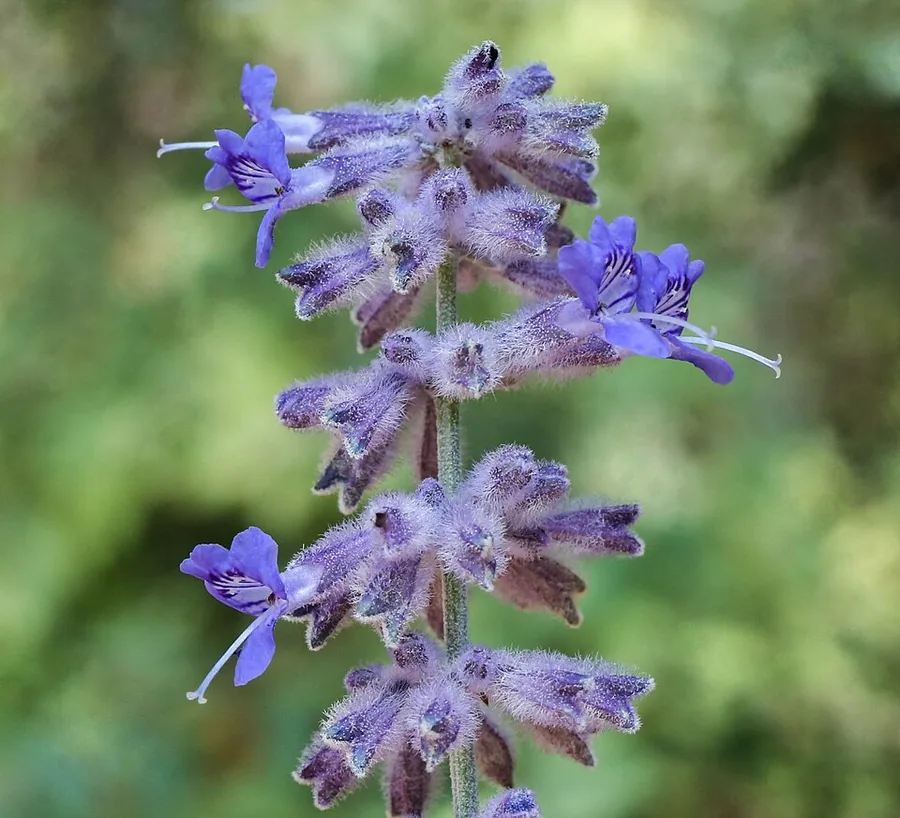
Russian sage is a woody-based perennial valued for silvery stems and open panicles of small blue flowers. Neither the common name nor its two parts hold up botanically, since the plant originates in central Asia and is unrelated to culinary sage. Its real distinction is horticultural: a long flowering season paired with strong tolerance of drought, heat, and poor soil.
The plant performs in sites that defeat less adaptable perennials. On hot, dry, lean ground it grows well precisely because those conditions match its native range, and its aromatic foliage deters browsing by deer and rabbits. That combination explains its standing as a mainstay of xeric and low-maintenance plantings.
Its one demand is restraint. Rich soil, shade, and excess water all drive soft, elongated growth that loses rigidity and splits open by midsummer. Held on lean ground in full sun and cut back hard each spring, the crown produces the stiff, erect stems that carry months of blue bloom without collapsing.
Care
The short version: full sun and sharp drainage are the two non-negotiables. Keep the soil lean and dry once the plant is established, withhold fertilizer, and cut every stem back almost to the ground in late winter, since that hard cut is what forces vigorous upright growth.
Light
Full sun governs the plant's form. In part shade the stems elongate and weaken, lose rigidity, and flower less, because the tissue that develops in low light lacks the strength to stand. Maximum sun is what maintains the stiff, upright habit.
Water
First-season irrigation exists to build the deep root system that later carries the plant through drought, after which it ranks among the most drought-tolerant perennials in cultivation. Once that framework is established, withhold water, because saturated soil damages the roots far more readily than dry soil does.
Soil
Sharp drainage is the single limiting factor for survival. The plant accepts poor, dry, clay, and alkaline ground across a broad pH of 6.0 to 8.0, but wet, heavy soil holds moisture around the crown and rots the roots, which is the usual cause of death.
Temperature
Cold and heat tolerance are wide. The plant withstands winter lows near -29°F (-34°C) and summer highs near 100°F (38°C), and that span is precisely what qualifies it for cultivation across zones 4 to 9.
Humidity
Low ambient humidity suits it, consistent with its origin in hot, dry country. Stagnant, humid air raises disease pressure more than dry air ever does, so spacing and free air movement protect the foliage.
Feeding
This species performs on lean ground, so fertilizer is largely counterproductive. Feeding promotes soft, elongated stems that flop, which is why little or none is advised, with at most a light application in spring.
Pruning
Cut every stem back almost to the ground in late winter or early spring as growth resumes. The hard cut removes the previous season's weak wood and forces vigorous basal shoots, which are the stems that flower strongly and remain upright through the season.
Repotting
As a long-lived perennial best left undisturbed, it seldom needs repotting. In containers, roots circling the pot or water passing straight through without uptake indicate the plant has exhausted its root run and needs more space.
Size & spacing
Mature plants reach 2 to 4 feet (60 to 120 cm) in height with a comparable spread of 2 to 4 feet (60 to 120 cm). Spacing at that width sustains the air circulation the foliage needs and gives the stems room to stand without leaning on neighbors.
When to plant
Rated for zones 4 to 9, Russian sage breaks dormancy late in spring. Plant young stock after the last frost, cut the previous year's stems back hard as the new shoots emerge, and flowering follows from July through October.
Northern hemisphere
Southern hemisphere
Typical months for a temperate climate: start earlier in warm zones, later where spring frosts linger.
- Sow: late winter to early spring; seed germinates in 1-4 months at 60-65 degrees F
- Plant: spring after last frost
- Harvest: July to October
Hardiness
USDA hardiness zones: 4–9
Temperature: down to -34°C
Troubleshooting
Russian sage is largely trouble-free, and the two disorders that appear share one root cause: excess moisture or overly rich soil. Because both work through the same mechanism, reading the early signs and correcting drainage and exposure resolves nearly every case.
Wilting driven by root rot in saturated soil
Wilting in soil that remains wet points to root rot, since waterlogged, poorly drained ground deprives the roots of oxygen and invites pythium and phytophthora that leave them brown and soft. The response is drainage first: relocate to a raised, sharply drained site, cut irrigation sharply, and discard any crown too far decayed to recover.
Fix:
- Improve drainage or move to a raised, sharply drained site
- Reduce irrigation and let soil dry between waterings
- Remove and discard severely rotted plants
Weak stems lose rigidity and open at the crown
The familiar flop develops when shade or rich, moist soil produces soft, elongated stems that cannot support their own weight. Uncut plants carrying old wood open the same way after flowering. Correcting the cause means full sun on lean, dry ground, reduced water and feed, and a hard cut each spring to force sturdy new growth.
Fix:
- Cut stems back almost to the ground in late winter to early spring
- Move or site in full sun with lean, well-drained soil
- Reduce watering and fertilizer
Toxicity
For households with pets and children, the record is clear. The ASPCA classifies Russian sage as non-toxic, so contact or an exploratory bite by cats, dogs, or other animals produces nothing beyond a strong taste. The only practical caution is that the aromatic foliage is not culinary and should not be eaten.
Safe for
People · Cats · Dogs · Horses · Rabbits · Livestock · Birds
Cats None
Safe for cats on the ASPCA classification of non-toxic. An exploratory bite of the aromatic foliage carries no reported effect.
Dogs None
No toxicity to dogs is on record. The strong scent tends to discourage a second chew, but ingestion causes no harm.
Horses Safe
Horses may graze in its vicinity without risk. The plant contains no recognized toxins, and its bitter, aromatic foliage generally makes it unpalatable to grazers.
Rabbits Safe
Rabbits largely avoid it, an effect of the pungent foliage rather than any hazard. Where they do sample it, the leaves are entirely safe.
Livestock Safe
Cattle, goats, and sheep are unaffected, since the plant holds no known toxic compounds. Its aromatic oils typically render it unappealing to livestock.
Birds Safe
Birds are at no risk. The flowers support pollinators through summer, and no part of the plant is harmful to visiting wildlife.
People Safe
Handling and cultivation around children present no hazard. The foliage is aromatic but not culinary, so it should not be treated as an edible herb.
Aromatic foliage; despite the common name it is not a true culinary sage and should not be eaten.
Varieties
The named selections were largely chosen to hold a stiffer, more upright habit than the species, correcting its tendency to flop. The following are the most widely grown.
Little Spire
Little Spire is a compact selection holding roughly 18 to 24 inches (2 feet) with a more upright carriage, which markedly reduces the flopping seen in the species.
Blue Spire
Blue Spire is an upright form to about 3 feet, distinguished by deeply cut foliage and large panicles of violet-blue flowers.
Longin
Longin is a tall, narrow selection reaching close to 4 feet in both height and width, notable for a stiff, strongly upright habit.
Filigran
Filigran grows 2 to 3 feet tall and is marked by finely dissected, lacy foliage carried on an upright frame.
How to propagate
Russian sage propagates from cuttings or seed, and the choice hinges on genetics, since only vegetative cuttings reproduce a named cultivar faithfully.
Stem cuttingsModerate
Summer · Several weeks to a few months
Cuttings are the reliable method for reproducing a named cultivar, because seedlings segregate and will not come true. Softwood cuttings of 3 to 4 inches taken in summer root over several weeks to a few months and yield plants genetically identical to the parent.
SeedModerate
Any time of year, just covering the seed · Germinates in 1-4 months at 60-65 degrees F
Seed can be sown at any time under a bare covering, but germination is slow, running 1 to 4 months at 60°F to 65°F (16°C to 18°C). A cold period improves germination rates, and because the species is variable, seed-raised plants differ from one another.
DivisionDemanding
Spring · Slow
Division is the least practical option. As a woody-based subshrub it responds poorly to being split, re-establishes slowly in spring, and rarely requires the treatment, so cuttings or seed are the sounder choices.
Myths
Russian sage is a culinary sage that can be cooked with like garden sage.
Taxonomically it is Perovskia, since reclassified as Salvia yangii, and it is grown strictly as an ornamental. The crushed foliage carries a sage-like aroma but no culinary value. It is neither Russian nor a true sage, but a species native to central Asia.