Ornamental · Lamiaceae
Lamb's Ear
Stachys byzantina
A groundcover of soft, silvery leaves that carpets lean, dry ground and asks little in return.
Full sun
USDA 4–8
6–18 in · 15–46 cm
Overview
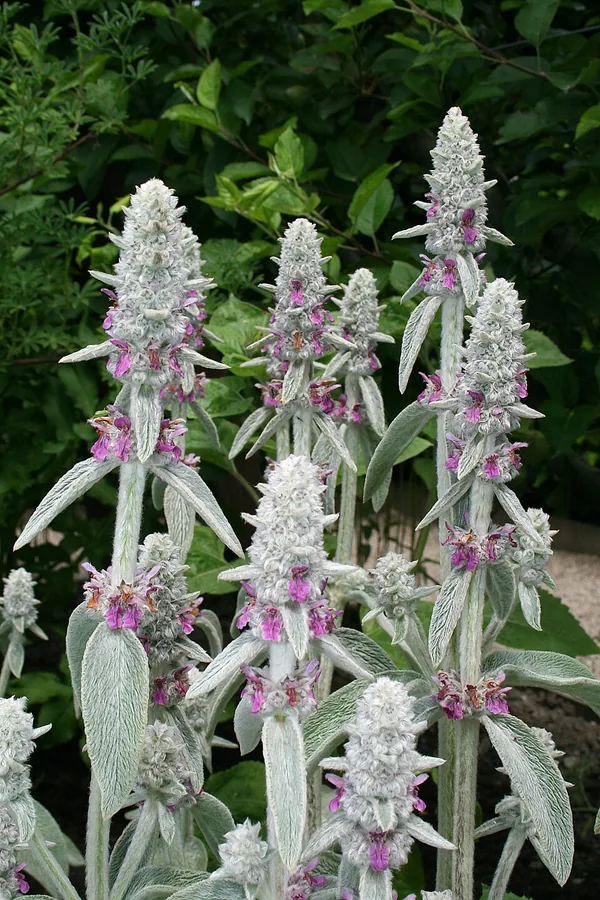
Lamb's ear announces itself by feel. The leaves are thick and clad in dense silver hairs, a trichome layer that gives them the exact softness of a lamb's ear, and the plant runs those leaves into a low silvery mat across the front of a border. It sits in the mint family and originates in the dry hills of the Middle East, and that provenance predicts its preference for lean, sun-baked, freely draining conditions.
This is a groundcover for a gardener who wants coverage with minimal input. It performs in full sun and dry, lean soil and advances outward on stems that root at the nodes as they travel. Grown chiefly for foliage, it is often stripped of its purplish-pink flower spikes before they open, though the spikes serve as a nectar source for bees where they are retained.
Its single real weakness is standing moisture. The woolly leaves retain water at the surface, and in a humid summer that retained film is the pathway to rot. Provide sharp drainage and open air movement, and the plant holds condition with almost no intervention.
Care
The short version: full sun, dry and very well-drained soil, and restrained watering. Feed it rarely, irrigate at the base rather than overhead, and divide the clump every few years to keep it vigorous.
Light
Site lamb's ear in full sun for the densest, most strongly silvered foliage, since high light drives the felted leaf character. It accepts partial shade, which is useful in hot-summer regions where afternoon cover moderates heat load, but insufficient light produces a thin, lax clump.
Water
Once rooted in it is reliably drought tolerant and prefers the soil to dry between waterings. Direct water to the base and keep it off the foliage, because persistent moisture on the woolly leaves is the direct precursor to leaf rot and disease through a humid summer.
Soil
Establish it in average, dry to medium soil with fast drainage, where it also handles sandy or rocky substrates. It is indifferent across a pH range of 6.0 to 8.0, so reaction is not limiting, but sharp drainage is the non-negotiable requirement.
Humidity
No target humidity applies, yet humid summers are the principal stress on this plant. Stagnant, moist air lodges in the felted leaf surface and precipitates rot, so opening the clump to promote air exchange is the effective countermeasure.
Feeding
Fertilize rarely, if at all. Fertile ground drives soft, lax growth that splays open and rots, so withhold heavy feeding and supply nothing beyond a thin spring topdressing of compost.
Pruning
Where foliage is the objective, remove the flower stems as they emerge. In spring, shear off the matted, dead, or rotting leaves to open the clump and let clean new growth develop unobstructed.
Size & spacing
The plant stays low at 6 to 18 inches (15 to 46 cm) tall, and each clump spreads 12 to 18 inches (30 to 46 cm) across. Space plants at roughly that interval and they close into a continuous groundcover.
When to plant
Lamb's ear is a hardy perennial that persists from year to year, so timing centers on establishment rather than a harvest window. Sow seed indoors in late winter or set divisions out in spring once the frost risk has passed. The purplish-pink spikes appear from May to July, though many growers remove them to concentrate the display in the foliage.
Northern hemisphere
Southern hemisphere
Typical months for a temperate climate: start earlier in warm zones, later where spring frosts linger.
- Sow: Late winter, about 8 to 10 weeks before the last frost, if growing from seed.
- Plant: Spring after the last frost; space plants 12 to 18 inches apart for groundcover.
- Harvest: Purplish-pink flower spikes from May to July, though many gardeners remove them.
Hardiness
USDA hardiness zones: 4–8
Temperature: down to -34°C
Troubleshooting
Nearly every disorder in lamb's ear resolves to a single factor: moisture held where it should not persist. Recognize the early expression of rot on the leaves and crown, and you can intervene before a humid interval compromises the whole clump. Match the presentation below, then respond without delay.
Collapse and dieback driven by a rotted crown
Crown and root rot is the more serious disorder, and it develops where soil stays saturated around the base of the plant. The diagnostic sign is a plant that wilts even in visibly moist ground, because rotted roots have lost the capacity to move water into the foliage. Excavate and discard the softened crowns, reset healthy divisions into fast-draining soil, and reduce irrigation to keep the root zone from staying wet.
Fix:
- Dig and discard severely affected crowns
- Replant healthy divisions in well-drained soil
- Reduce watering
Foliage rotting and melting out through the center of the clump
The culprit is leaf rot, a fungal breakdown that follows moisture held on the woolly foliage during humid weather or heavy rain. The same dense trichomes that give the leaf its felted feel keep a film of water pressed against the tissue, which is precisely the condition fungi need to establish. Strip out the collapsing leaves, thin the clump so air can circulate and the surface can dry, and confine watering to the base.
Fix:
- Remove and discard affected leaves
- Improve air circulation by thinning and dividing
- Water only at the base of the plant
Woody, hollow center ringed by fresh outer growth
This is an aging clump rather than a pathogen. Because the plant advances outward on rooting stems, the original center is progressively starved of vigor as the colony expands, so it turns woody and bare while the perimeter continues to gain ground. Lift the mat, reset the vigorous outer sections, and discard the exhausted core to reset the planting.
Fix:
- Lift and divide the clump
- Replant vigorous outer sections
- Discard the old center
Toxicity
For households with pets and children, the assessment is straightforward: lamb's ear is non-toxic across every category. No part of the plant presents a hazard to cats, dogs, horses, rabbits, livestock, birds, or people, and the soft felted leaves are a feature rather than a risk. The worst plausible outcome is a transient, mild digestive upset if an animal ingests a large quantity of any foliage.
Safe for
People · Cats · Dogs · Horses · Rabbits · Livestock · Birds
Cats None
Non-toxic to cats. A cat that samples the felted leaves faces no risk, though the woolly surface rarely invites a repeat.
Dogs None
Not poisonous to dogs. Beyond the transient, mild digestive upset that any large quantity of plant matter can cause, it poses no hazard.
Horses Safe
Not toxic to horses. Grazing appeal is low because the hairy foliage is unpalatable, so pastured animals tend to bypass it.
Rabbits Safe
Safe for rabbits. A sampled leaf carries no toxin, and the woolly texture discourages most from returning to it.
Livestock Safe
Cattle, goats, and sheep can graze alongside it without harm. It contains no recognized toxin, and the felted foliage ranks poorly as forage.
Birds Safe
No hazard to birds. Certain species even harvest the leaf fibers as nesting material.
People Safe
Harmless to people, children included. The soft leaves have a long ethnobotanical history as a dressing for minor abrasions, a folk use rather than an evidenced treatment.
Varieties
Several named selections extend lamb's ear in defined directions, from oversized leaves to strictly foliar, non-flowering mats. The following are the ones worth recognizing.
Big Ears (Helene von Stein)
Its leaves reach up to a foot long, it withstands heat and humidity better than the species, and it flowers only rarely, which together make it the standard selection for warm, humid gardens.
Silver Carpet
A low, non-flowering selection maintained solely for its dense silver mat of foliage.
Primrose Heron
Its woolly leaves emerge chartreuse-yellow in spring and transition to silvery green as temperatures rise.
Cotton Boll (Sheila Macqueen)
Its flower stems bear atypical cottony, ball-like clusters in place of the usual spikes.
How to propagate
Lamb's ear is among the most straightforward perennials to increase, whether by dividing an established clump or raising a new batch from seed.
DivisionEasy
Spring or fall · A few weeks for rooted divisions to take hold
Division is the most reliable method, best carried out in spring or fall. Since the stems root where they contact the soil as they creep, the shallow outer sections detach with a functional root system already formed. Reset those vigorous pieces and they establish within a few weeks.
SeedEasy
Start indoors in late winter or sow outdoors in spring · One season to form a usable groundcover mat
Seed is a workable alternative, sown indoors in late winter or directly outdoors in spring, and a single season is enough to develop a usable groundcover mat. The true species reproduces reliably from seed, but many named cultivars do not come true, so propagate those by division to preserve the type.
Myths
Lamb's ear is poisonous to cats and dogs.
The species is absent from the ASPCA toxic plant lists and is classified as non-toxic to both cats and dogs. A curious animal can investigate or sample it without danger, since only a large ingestion of any plant material tends to provoke a transient digestive upset.
Lamb's ear needs frequent watering to keep its soft leaves looking good.
Once established the plant is drought tolerant and is set back rather than helped by heavy irrigation. Persistent moisture on the woolly foliage is the trigger for rot and leaf disease, so a dry interval favors leaf health rather than degrading it.