Ornamental · Lamiaceae
Hummingbird Mint
Agastache foeniculum
Site it in full sun with sharp drainage, and anise hyssop sustains bees and hummingbirds across the whole season.
Full sun
Every 7–14 days
USDA 4–8
2–5 ft · 0.6–1.5 m
Overview
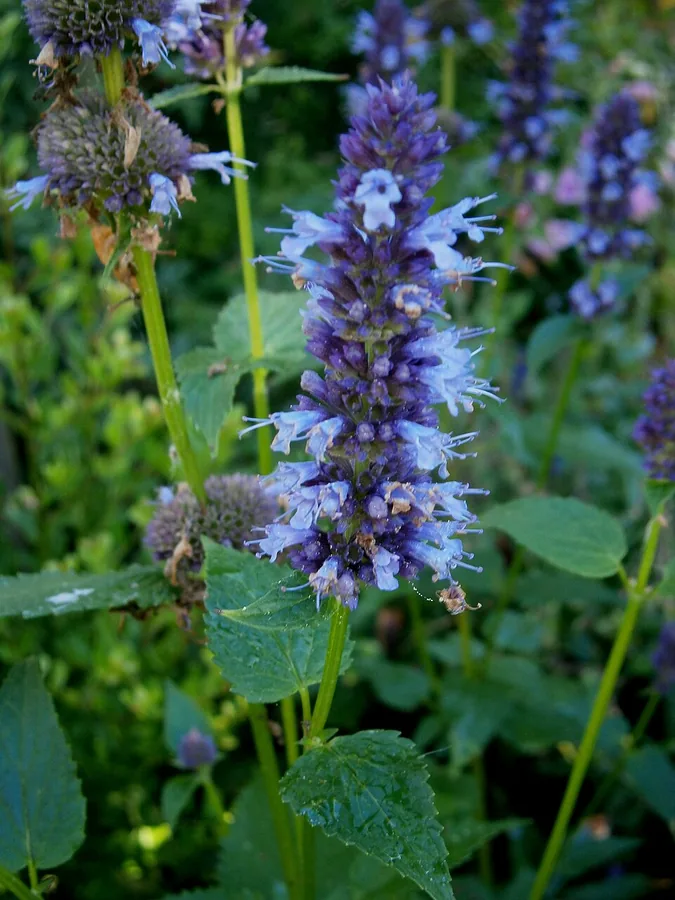
Anise hyssop owes its hummingbird mint name to the steady traffic of bees, butterflies, and hummingbirds it draws from June into September. Though a member of the mint family, it forgoes the invasive habit of its relatives, producing upright spikes of pale blue-lavender flowers above foliage that emits anise and licorice volatiles when bruised.
It is an undemanding perennial for an open, sunny aspect, rated hardy from zone 4 to zone 8 and tolerant of cold to -29°F (-34°C). Once established its requirements are minimal: it withstands drought competently and resists browsing by deer and rabbits that favor softer neighbors.
Given adequate spacing and free-draining soil, a single clump develops into a 2 to 5 foot (60 to 150 cm) column of bloom. The flowers provision pollinators through summer and the persistent seed heads sustain finches into winter, extending the plant's ecological return well past peak flowering.
Care
The short version: full sun and free-draining soil govern success, because the plant's tolerance for drought far exceeds its tolerance for saturation. Irrigate deeply but allow the upper half of the profile to dry between applications, fertilize sparingly if at all, and deadhead through summer to extend flowering.
Light
Position anise hyssop in full sun to maximize stem strength and floral output. It accepts light afternoon shade, but insufficient light yields lax, sparsely flowered growth, and reduced light also predisposes the foliage to the mildew it otherwise resists.
Water
Irrigate deeply, then pause. Permit the upper half of the soil to dry before the next application, an interval that approximates every 7 to 14 days. The established plant tolerates drought well, whereas continuously saturated soil is the principal cause of decline.
Soil
Fertility is not limiting, and the plant performs in loam, sand, or rocky substrate provided it drains freely. Target a pH in the 6.0 to 7.5 range, and reject any site where water collects after rainfall.
Temperature
Hardy across zone 4 to zone 8, anise hyssop endures cold to -29°F (-34°C) and heat to roughly 95°F (35°C). This broad thermal amplitude explains its persistence where less adaptable perennials fail.
Humidity
Ambient outdoor humidity is adequate, so no target value applies. The decisive factor is air movement, since crowded, still, humid plantings provide precisely the microclimate in which powdery mildew establishes.
Feeding
The species favors low fertility. Fertilize only occasionally, applying no more than a light dressing of balanced fertilizer or compost during the growing season. Excess feeding produces soft, lodging-prone stems at the expense of bloom.
Pruning
Deadhead spent spikes through August to maintain flowering. Leave the stalks standing over winter as bird forage, then cut to new growth in spring; reducing the clump to about 12 inches at that time stimulates denser, more branched regrowth.
Size & spacing
Anticipate a clump 2 to 5 feet (60 to 150 cm) tall by 1.5 to 3 feet (45 to 90 cm) wide. Honor the full spread so air circulates through the planting and mildew pressure stays low.
When to plant
Anise hyssop follows a perennial cycle once planted out. Sow seed indoors in late winter, transplant after the last frost when the soil has warmed, and expect bloom from June through September. Retain the spent stalks through winter and cut back to emerging growth in spring.
Northern hemisphere
Southern hemisphere
Typical months for a temperate climate: start earlier in warm zones, later where spring frosts linger.
- Sow: 8 to 10 weeks before the last spring frost
- Plant: after the last spring frost once soil has warmed
- Harvest: Blooms June to September
Hardiness
USDA hardiness zones: 4–8
Temperature: down to -34°C
Troubleshooting
Nearly every problem with anise hyssop reduces to a single factor: excessive soil moisture. Manage drainage and airflow correctly and the plant becomes essentially self-sufficient. Identify the symptom below, then intervene while the response still alters the outcome.
Collapsing plant over a darkened, softened crown
The cause is crown or root rot, a disorder rooted in saturated soil rather than a pathogen you can knock out with a foliar spray. Standing moisture starves the crown tissue of oxygen, so it softens, discolors, and eventually fails, taking the whole plant with it. Correct the drainage and scale back irrigation, discard any specimen too compromised to recover, and reestablish sound divisions in a freely draining bed.
Fix:
- Improve drainage and reduce watering
- Remove and discard severely affected plants
- Replant healthy divisions in well-drained soil
Powdery white deposit coating leaves and stems
That floury surface is powdery mildew, a fungus that establishes where stagnant air, crowding, and humidity let its spores germinate on the leaf. The infection is largely an aesthetic concern and seldom undermines vigor. Restore airflow by thinning and widening spacing, excise the most colonized leaves, and keep irrigation off the canopy to deny the spores the moisture they exploit.
Fix:
- Improve air circulation by spacing and thinning
- Remove affected foliage
- Avoid overhead watering
Pustular orange and brown lesions on foliage
Elevated rust-colored pustules or darker lesions indicate rust and fungal leaf spots, fungi that disperse and infect through a film of surface water on the leaf. In most seasons the consequence is cosmetic and the plant carries on. Remove and destroy the affected foliage to cut the spore load, increase airflow through the canopy, and irrigate at soil level so the leaves dry quickly.
Fix:
- Remove and destroy infected leaves
- Improve air circulation
- Avoid wetting foliage
Toxicity
The verdict is favorable. Anise hyssop contains no toxic principles, making it safe in the presence of cats, dogs, horses, livestock, and children. Its leaves further qualify as a culinary herb, valued in teas and baked goods for their anise flavor, while the strong aromatic profile deters most browsing animals unaided.
Safe for
People · Cats · Dogs · Horses · Rabbits · Livestock · Birds
Cats None
The species contains no toxic constituents, so a cat that samples a leaf faces no physiological hazard. Ingesting a large volume of any plant matter can provoke transient salivation or mild gastrointestinal upset, but anise hyssop presents no genuine risk to felines.
Dogs None
Dogs are unaffected by this plant. A dog that consumes a quantity of foliage might show a brief digestive disturbance, as with any non-toxic species, though the pronounced anise volatiles typically deter further sampling after the first bite.
Horses Safe
Horses may graze in proximity without concern, as no tissue of the plant is poisonous to equines. Its aromatic foliage proves unpalatable to them, so it is usually left untouched in the pasture.
Rabbits Safe
Rabbits incur no toxicity from the plant. It is documented as rabbit-resistant, and its scented foliage is generally bypassed in favor of more palatable forage.
Livestock Safe
Cattle, goats, and sheep can be pastured alongside it with no toxin of concern. The minty, licorice aroma renders it unappealing, so most stock graze elsewhere and the stand remains intact.
Birds Safe
Birds suffer no harm from anise hyssop, and the planting offers them clear forage value. Finches take the seed heads retained into winter, while hummingbirds and other pollinators exploit the summer inflorescences.
People Safe
Beyond being safe, the leaves serve as a culinary herb, contributing an anise or licorice note to teas, salads, and baked goods. No part of the plant poses a hazard to children.
Varieties
Breeding has produced several notable cultivars of anise hyssop worth identifying by name. The following are the selections most frequently encountered in the trade.
Blue Fortune
A widely planted hybrid valued for its compact, extended display of blue-lavender flower spikes.
Golden Jubilee
Selected chiefly for its luminous golden-yellow foliage, which it pairs with lavender spikes held above the canopy.
Blue Blazes
A tall selection distinguished by conspicuous spikes of violet-blue bloom.
How to propagate
Anise hyssop propagates with minimal intervention, either by dividing a mature clump or by allowing it to recruit its own seedlings throughout the bed.
DivisionEasy
Spring or fall · One growing season
Division is the most reliable vegetative method. Lift an established clump in spring or fall, separate it into viable sections each bearing roots and crown, and reset the divisions into freely draining soil. Allow each one a full growing season to reestablish its root system and resume full vigor.
SeedEasy
Spring; self-seeds readily in the garden · First season from transplanted seedlings
Because anise hyssop self-seeds freely, the path of least resistance is transplanting volunteer seedlings to their intended positions in spring. To generate that volunteer crop, suspend deadheading in late summer so the spikes mature seed; the resulting transplants attain appreciable size within their first season.
Myths
Anise hyssop is a true mint that will take over the garden.
Its placement in the mint family is correct, yet it lacks the aggressive stoloniferous habit of the true mints. Spread proceeds modestly by rhizome and self-seeding, and the plant frequently behaves as a short-lived perennial rather than a persistent colonizer.
Anise hyssop is related to true hyssop and tastes like it.
The common name overstates the relationship, since it is classified in Agastache rather than the true genus Hyssopus. Crushing the foliage releases a distinct anise or licorice scent, the volatile that accounts for its use in teas, salads, and baked goods.