Ornamental · Lamiaceae
Woodland Sage
Salvia nemorosa
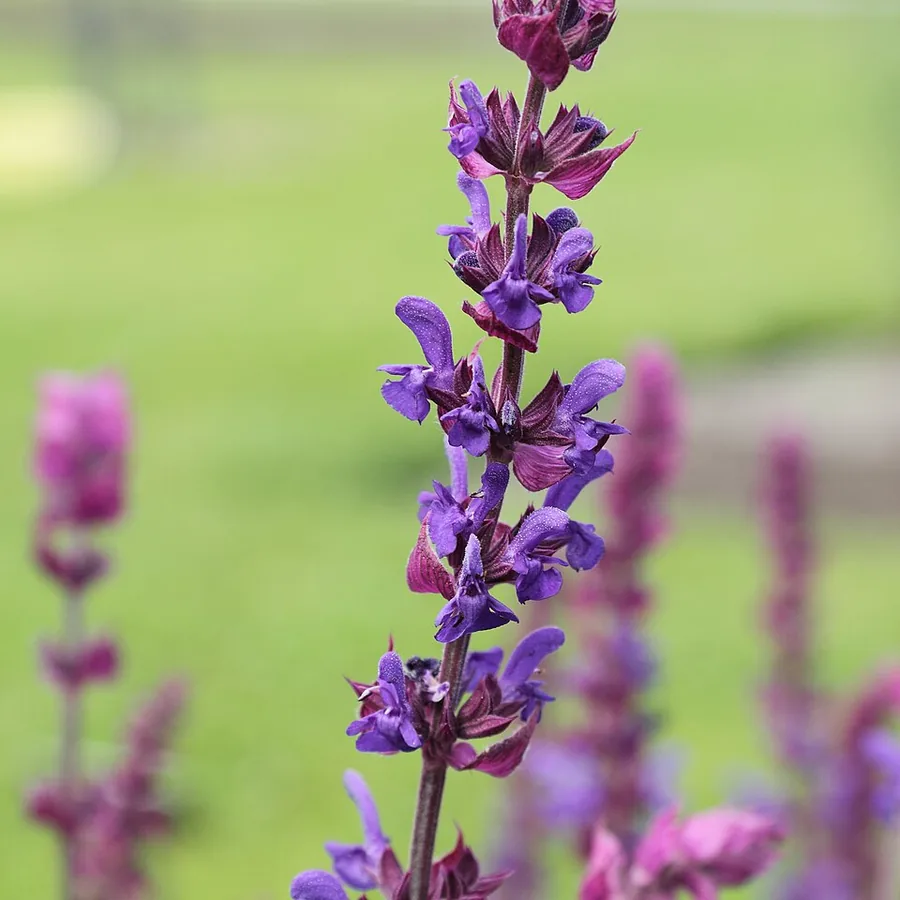
In full sun and lean, dry soil, woodland sage builds sturdy violet spikes that carry from early summer into autumn.
Full sun
Every 7–14 days
USDA 4–8
2–3 ft · 0.5–0.9 m
Overview
Woodland sage is a clump-forming herbaceous perennial in the Lamiaceae, the mint family, valued in the border for its low upkeep. From early summer it produces dense terminal spikes of violet-blue flowers, a rich nectar source that keeps bees and hummingbirds returning for weeks. Removing the spent spikes before they set seed is what prompts the plant to rebloom rather than run to seed.
This species asks for very little because its adaptations suit tough sites. Once the root system establishes it rides out drought, tolerates summer heat, and survives to zone 4 by dying back to a hardy crown each winter. The aromatic, pungent foliage is the reason deer and rabbits pass it by, so browsing pressure stays low.
One point of taxonomy clears up a common mix-up: ornamental Salvia nemorosa is unrelated in effect to the psychoactive Salvia divinorum that periodically makes the news. They fall in the same genus and share the common name sage, but nemorosa is a benign garden ornamental, safe to site where pets and children spend time.
Care
The short version: site it in full sun, in lean and sharply drained soil, water sparingly once established, and shear it after the first flush, since removing the spent spikes is what drives a second round of flowers.
Light
Provide full sun, meaning at least six hours of direct light daily, because flower production depends on it. Light afternoon shade is tolerated, but under heavier shade the stems stretch and weaken, bloom declines, and the clump splays open at the center.
Water
Water a new planting until it roots, then reduce sharply. Established plants are drought-tolerant and perform best when the soil dries between waterings, on the order of every 7 to 14 days, because sustained moisture around the roots favors root rot and the fungal diseases this species is prone to.
Soil
Grow it in average, well-drained soil, ideally lean and gritty. A slightly acidic to neutral pH of 6.0 to 7.0 is optimal, and sandy or gravelly substrates outperform rich, heavy soils that hold water at the crown and raise the risk of rot.
Temperature
Cold hardiness reaches roughly -29°F (-34°C), and the plant remains functional through heat to about 90°F (32°C). That breadth of tolerance is precisely what allows reliable overwintering across zones 4 through 8.
Humidity
Ambient outdoor humidity is not a limiting factor, so no target reading applies. Air circulation is the operative variable, because still, humid air pooling within a dense clump creates the leaf-surface conditions that powdery mildew needs to establish.
Feeding
This is a species adapted to low fertility, and it performs better lean. Planted into reasonable soil amended with compost, it needs little to no supplemental fertilizer; excess feeding forces soft, weak growth that flops and is more disease-prone.
Pruning
Deadhead spent spikes back to the basal foliage through the season to sustain rebloom, since removing flowers before they set seed keeps the plant flowering. Leave the stems standing over winter to protect the crown, and defer cutting back until new basal growth appears in early spring.
Repotting
Division is seldom required, but declining flower output, a clump that dies out in the center, and crowded stems signal that the crown has aged and needs renewal. Lift and divide in early spring, replanting vigorous outer pieces to restore performance.
Size & spacing
Mature height runs 1.5 to 3 feet (46 to 91 cm) with a spread of 6 to 24 inches (15 to 61 cm). Space plants so air moves freely between clumps, a placement that directly lowers the humidity that drives mildew.
When to plant
As a cold-hardy herbaceous perennial, woodland sage resprouts from its crown each spring rather than being replanted. Sow seed indoors in late winter, transplant after the last frost in spring, and the plants flower from June to September, extending into fall wherever spent spikes are removed to prevent seed set.
Northern hemisphere
Southern hemisphere
Typical months for a temperate climate: start earlier in warm zones, later where spring frosts linger.
- Sow: About 12 weeks before planting time
- Plant: Spring after last frost
- Harvest: June to September, repeating into fall with deadheading
Hardiness
USDA hardiness zones: 4–8
Temperature: down to -34°C
Troubleshooting
Salvia rates among the more trouble-free perennials, and its common disorders share a root cause: excess moisture, insufficient light, or crowding that traps humid air. Identify the symptom below, then correct the underlying condition, because cultural fixes outperform sprays here.
Rapid wilting and total collapse despite adequate soil moisture
Sudden collapse in hot, humid weather points to Southern bacterial wilt or Southern blight, with soil-borne stem and root rots a secondary cause under wet conditions. These pathogens are not curable, so the plant should be removed and destroyed rather than composted, which would spread inoculum. Sharp drainage, full sun, and restrained watering are the effective preventive controls.
Fix:
- Remove and destroy affected plants
- Improve soil drainage
- Avoid overwatering and overhead irrigation
A white powdery layer developing across leaf surfaces
The coating is powdery mildew, a fungal disease that establishes where still, humid air collects around crowded, damp foliage. Thinning and dividing restores air movement, watering at the base keeps the leaf surface dry, and removing coated leaves lowers the spore load. Full sun and sharp drainage remove the conditions it depends on.
Fix:
- Improve air circulation by thinning and dividing clumps
- Avoid overhead watering
- Remove and discard affected foliage
The clump opening at the center and splaying by midsummer
Flopping reflects overly favorable conditions, namely rich soil, shade, or surplus fertility that push soft, elongated stems unable to support themselves. Cutting the stems back to the basal leaves induces a shorter, sturdier rebloom. Grown lean, in full sun and well-drained soil, the plant holds an upright habit on its own.
Fix:
- Cut back spent stems to basal leaves to promote compact rebloom
- Grow in full sun and lean, well-drained soil
- Avoid over-fertilizing
Toxicity
For households with pets or children, the verdict is straightforward: ornamental garden salvia is non-toxic across every listed species. The ASPCA records sage as safe for cats, dogs, and horses, and the bitter aromatic foliage further discourages sampling. This is the horticultural species, distinct from the unrelated psychoactive one.
Safe for
People · Cats · Dogs · Horses · Rabbits · Livestock · Birds
Cats None
Non-toxic to cats. In practice the strong, minty aroma of the foliage discourages most cats from investigating it at all.
Dogs None
Non-toxic to dogs. Ingesting a quantity of leaf may cause transient gastrointestinal upset from bulk alone, but the plant contains no poisonous compound.
Horses None
Recorded as non-toxic to horses, so a salvia planting adjacent to a paddock or pasture presents no hazard.
Rabbits Safe
Harmless to rabbits, which generally avoid it regardless. The aromatic foliage is the basis for salvia's reputation and marketing as rabbit-resistant.
Livestock Safe
Presents no danger to cattle, goats, or sheep. The pungent leaves are unpalatable, so grazing animals seldom consume it even within reach.
Birds Safe
No risk to birds. The tubular flowers function as a nectar source that attracts hummingbirds and other pollinators.
People Safe
Safe to handle and to cultivate around children. This is the ornamental garden species, not the psychoactive Salvia divinorum, which is taxonomically distinct.
Aromatic foliage is generally unpalatable; not a known toxicity hazard. Distinct from the psychoactive Salvia divinorum.
Varieties
The garden salvias sold today are largely selections and hybrids of Salvia nemorosa, chosen for deeper flower color and a more compact, upright habit. A small group recurs in the trade, and those are the cultivars worth recognizing.
Caradonna
Distinguished by dark purple-black stems beneath bright violet-blue flower spikes, reaching roughly 30 inches in height.
May Night (Mainacht)
Awarded Perennial Plant of the Year in 1997, a compact selection bearing deep violet-blue flowers.
Ostfriesland (East Friesland)
A compact, well-behaved cultivar with deep purple flowers, reaching about 18 inches.
Companions
Woodland sage pairs best with other sun-loving, drought-tolerant perennials that want the same lean, well-drained soil, filling out a pollinator or cottage border alongside them.
Plant near
Coreopsis: Shares full-sun, well-drained, drought-tolerant conditions in perennial and pollinator borders
Echinacea (coneflower): Similar sun and soil needs; complements salvia in butterfly and cottage gardens
How to propagate
Salvia propagates readily, but the appropriate technique depends on whether the plant is the true species or a named cultivar, since cultivars will not reproduce faithfully from seed.
DivisionEasy
Early spring when new growth begins · One growing season
Division is the most reliable method of increase. Lift the crown in early spring as new growth emerges and separate it into rooted pieces, each of which reestablishes and reaches full size within a single growing season.
Stem cuttingsModerate
Late spring to summer · Several weeks to root
Softwood cuttings taken from non-flowering shoots in late spring or summer also root well. Prepare a healthy shoot, insert it into moist medium, and roots form over the following several weeks.
SeedModerate
Sow indoors about 12 weeks before planting time · One growing season to flowering
The species can be raised from seed sown indoors about 12 weeks before planting time, flowering within its first growing season. Named cultivars such as Caradonna do not come true from seed, so they are perpetuated by division or cuttings to preserve their traits.
Myths
Garden salvia is the same plant as the hallucinogenic salvia classified as a controlled substance.
Salvia nemorosa is a non-psychoactive ornamental perennial with no intoxicating properties. The controlled plant is a separate species, Salvia divinorum, native to Oaxaca, Mexico, whose compound salvinorin A acts as an agonist at the brain's kappa-opioid receptors. The relationship extends no further than a shared genus.