Ornamental · Lamiaceae
Salvia (Annual)
Salvia splendens
In full sun and consistently moist soil, scarlet sage produces flower spikes from summer through the first frost.
Full sun
Every 3–7 days
50–90°F · 10–32°C
USDA 10–11
Overview
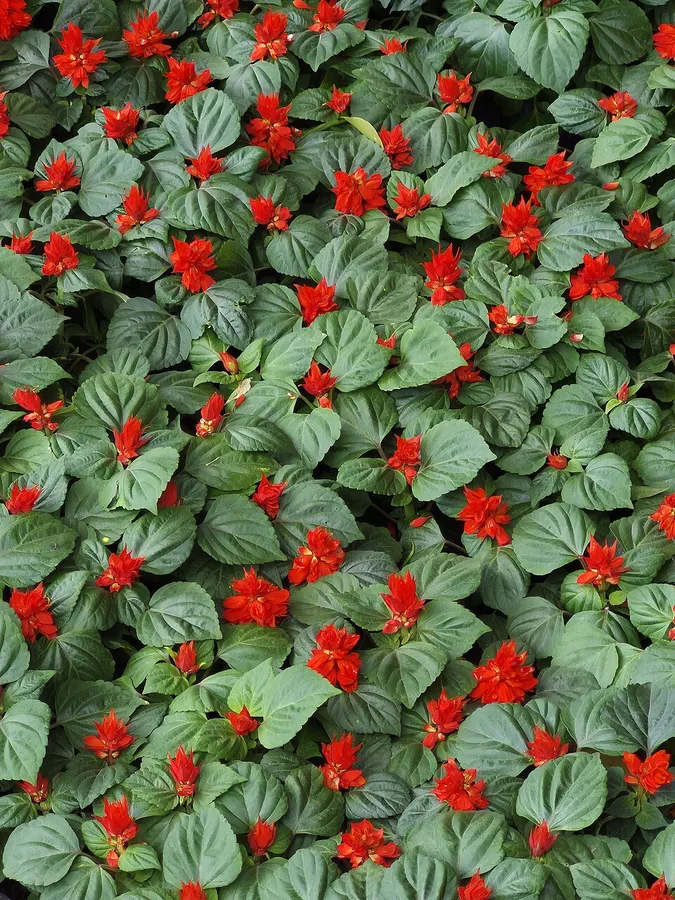
Annual salvia, or scarlet sage, is a tender perennial in the mint family grown across most gardens as a warm-season bedding annual. Its winter hardiness reaches only zones 10 and 11, so in colder regions the plant is treated as a single-season annual and replaced each spring. The upright, fire-red flower spikes are the reason it edges so many summer borders.
The display runs long because the plant produces spikes continuously from early summer until frost ends the season. The tubular florets are shaped for hummingbirds and bees, which work the blooms for nectar. Mature height varies by cultivar across 8 to 36 inches (20 to 91 cm), a range that suits bedding, edging, and container culture.
For its ornamental value the plant asks little: sun, warmth, and soil held evenly moist. Left on the plant, spent spikes slow the show, so regular deadheading keeps new spikes forming through summer. That pairing of steady moisture and spent-flower removal is what drives the long bloom.
Care
The short version: full sun with at most light afternoon shade, soil kept evenly moist rather than dry, a slow-release annual fertilizer worked in at planting, and steady deadheading to sustain the flush of spikes.
Light
Flowering is strongest in full sun; light intensity drives the number of spikes the plant sets. A little afternoon shade is tolerable where summer heat is extreme, but in deeper shade the stems elongate and flop and bloom count falls sharply.
Water
The plant is not drought tolerant, so the soil should stay evenly moist. Water once the top inch begins to dry, and more frequently in containers and heat, where the root zone loses moisture faster. Drought stress shows first in reduced flowering.
Soil
A well-drained loam rich in organic matter is ideal, though average soils are tolerated. The plant is adaptable across a soil pH of 6.0 to 8.0, so nutrient availability is rarely limiting within that band.
Temperature
Growth favors warmth in the range of 50°F to 90°F (10°C to 32°C), and frost is lethal to the tissue. Transplant only after both soil and air have warmed, since cold checks root activity and slows establishment.
Humidity
Ambient outdoor humidity is adequate, and no target level applies. The greater concern is air movement: still, crowded canopies hold a humid film on the leaf surface that favors powdery mildew, so spacing for airflow matters more than any humidity figure.
Feeding
Incorporate a slow-release fertilizer formulated for annuals at planting, then supplement lightly through the season. A measured supply sustains spike production, whereas excess feeding pushes soft, weak growth prone to flopping.
Pruning
Deadhead faded spikes through summer to keep new ones forming; spent flowers left in place slow the display. Shearing leggy plants back after a flush restores a compact, branching habit.
Size & spacing
Cultivars mature at 8 to 36 inches (20 to 91 cm) tall with a spread of 8 to 18 inch (20 to 46 cm). Spacing to the mature width preserves airflow through the canopy and limits the leaf-surface humidity that powdery mildew exploits.
When to plant
Salvia is frost-sensitive, so its schedule tracks soil and air temperature rather than the calendar alone. Seed is started indoors in late winter to early spring, transplanted out only once frost has passed and the soil has warmed, after which the plant flowers from early summer until cold ends growth. Cold soil at transplanting stalls establishment, so waiting for warmth pays off.
Northern hemisphere
Southern hemisphere
Typical months for a temperate climate: start earlier in warm zones, later where spring frosts linger.
- Sow: 6 to 8 weeks before the last spring frost; do not cover seed as light aids germination
- Plant: After the last frost when soil and air have warmed
- Harvest: Summer to frost (roughly June until first fall frost)
Hardiness
USDA hardiness zones: 10–11
Temperature: down to -1°C
Troubleshooting
Most disorders in salvia trace to two conditions the grower controls: cold, wet media at the seedling stage and stagnant, crowded air later on. Identify the symptom early, since intervention works best before a pathogen or pest population builds. Match the signs below to the cause and act accordingly.
Seedlings pinched off and rotting at the soil line
The cause is damping-off, a complex of soilborne fungi that becomes active in cold, saturated starting mix and girdles seedling stems at the surface. Remove and discard the collapsed seedlings, allow the medium to dry between waterings, and increase air circulation to lower surface moisture. Resow into sterile medium and clean containers, holding the seedlings warm to move them past the vulnerable stage.
Fix:
- Discard affected seedlings
- Improve air circulation and let the surface dry between waterings
- Use sterile mix and clean containers for resowing
Rapid wilt with basal rot in hot, saturated soil
Wilting that persists while the soil stays wet indicates southern blight or southern bacterial wilt, pathogens that thrive in hot, waterlogged ground and destroy the stem base and roots so the plant can no longer take up water. Because there is no cure, lift and destroy any affected plant. Correct the drainage and avoid replanting susceptible annuals in that location.
Fix:
- Remove and destroy affected plants
- Improve drainage
- Avoid replanting susceptible annuals in the same spot
White powdery film across leaf surfaces
A dusty white coating is powdery mildew, a fungal disorder that establishes where crowding and poor air movement keep humidity high at the leaf surface. Widen the spacing, remove the most heavily coated foliage, and stop wetting the leaves late in the day when they dry slowly. Full sun and open airflow keep the pathogen from re-establishing.
Fix:
- Increase spacing and airflow
- Remove badly affected foliage
- Avoid overhead watering late in the day
Deformed shoots with honeydew and small insects
Distorted new growth and a sticky film point to aphids, whiteflies, or spider mites drawing sap from the tender tissue and excreting honeydew. Dislodge the colonies with a firm water spray, then apply insecticidal soap to the survivors. Consistent moisture reduces the plant stress these pests exploit, and beneficial insects help hold later populations down.
Fix:
- Rinse plants with a strong spray of water
- Apply insecticidal soap to affected areas
- Encourage beneficial insects
Toxicity
For toxicity, the record is clear: scarlet sage is non-toxic. The ASPCA classifies it as safe for cats and dogs, and no toxic principle is present that would affect other livestock, wildlife, or people. It can be sited without concern in gardens shared with animals and children.
Safe for
People · Cats · Dogs · Horses · Rabbits · Livestock · Birds
Cats None
The ASPCA places scarlet sage on its non-toxic list for cats, so no poisoning results from ingestion. A cat consuming a large quantity may vomit, a mechanical response common to any plant material, not a toxic effect.
Dogs None
For dogs the plant is likewise listed as non-toxic by the ASPCA. Heavy ingestion of the foliage may cause transient gastrointestinal upset, as with most plants, but no toxin is involved.
Horses Safe
No toxic principle in this salvia affects horses, so it presents no grazing hazard in pasture or border.
Rabbits Safe
Rabbits may browse the foliage and flowers without toxic risk. Introduce it gradually, as with any new forage, to allow the gut to adjust.
Livestock Safe
Cattle, goats, and sheep are unaffected, since the plant contains nothing toxic to grazing livestock.
Birds Safe
The plant holds no compound harmful to birds, and pollinators work the flowers freely. Backyard poultry may forage on it without adverse effect.
People Safe
Annual scarlet sage is not toxic to people; it is grown as an ornamental rather than for consumption. Incidental handling or tasting by a child poses no poisoning risk.
Varieties
Named selections are numerous, but a few account for most of what reaches retail benches. The cultivars below are worth recognizing.
Bonfire
Bonfire produces uniform scarlet spikes on an upright habit, reaching roughly 26 inches in height.
Salsa Series
The Salsa Series remains compact at 12 to 14 inches across scarlet and mixed colors, with good heat performance in the Southeast.
Vista Group
The Vista Group is an early-flowering, dwarf bedding type offered in a broad color range.
Salvia farinacea (mealycup sage)
Salvia farinacea, the mealycup sage, bears blue to violet or white spikes on clumps of 1 to 2 foot and is frequently grown as an annual.
How to propagate
Annual salvia propagates readily by two methods, each suited to a different aim: seed for raising fresh plants, and cuttings for carrying a selected plant through winter.
SeedModerate
Start indoors 6 to 8 weeks before the last frost; surface sow because light aids germination · Several weeks to germinate and grow on before transplanting after frost
Seed is the usual method: sow indoors 6 to 8 weeks before the last frost and leave the seed uncovered on the surface, since it is light-requiring for germination. Held warm under bright light, the seedlings need several weeks to germinate and develop before transplanting once frost has passed.
Stem cuttingsModerate
Take softwood cuttings in late summer to overwinter plants indoors · A few weeks to root
Cuttings serve to overwinter a chosen plant. Softwood cuttings taken in late summer root within a few weeks, yielding young plants that are held in a bright, cool location until spring.
Myths
Ornamental bedding salvias such as scarlet sage are the same species as the psychoactive Salvia divinorum.
The two share only the genus Salvia and are distinct species. The ornamental annuals, Salvia splendens and Salvia farinacea, are cultivated solely for their flowers, and possess none of the properties attributed to Salvia divinorum.
Salvia is drought tolerant and may be allowed to dry out once established.
That does not hold for the annual scarlet sage, which is not drought tolerant. Its best flowering depends on warm, well-drained soil held evenly moist; once the root zone dries, spike production declines rapidly.