Ornamental · Asteraceae
Coreopsis
Coreopsis grandiflora
Give it full sun and lean, dry soil, and tickseed throws gold daisies from late spring to frost.
Full sun
Every 7–14 days
USDA 4–9
1–3 ft · 0.3–0.9 m
Overview
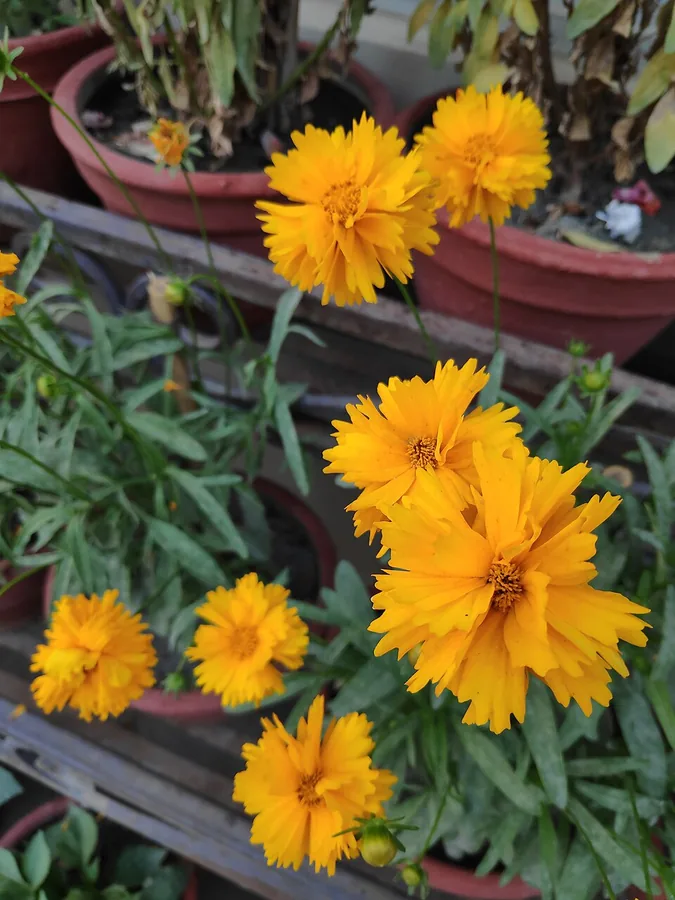
Coreopsis, commonly known as tickseed, ranks among the most undemanding perennials for a sunny border. A member of the daisy family, Asteraceae, it responds to poor, dry, rocky ground with a sustained display of golden-yellow flowers that pollinators and butterflies visit throughout the season. The common name derives from the small, dry achenes, which resemble ticks at close range, and has no connection to the arthropod itself.
The defining trait of coreopsis is its low resource demand. It tolerates drought once established, performs in lean, infertile substrates, and flowers from late spring well into summer, frequently until the first frost. Rich soil and abundant irrigation are counterproductive, promoting weak vegetative growth, so the conventional impulse to enrich and water generously is precisely wrong for this species.
The genus separates into two horticulturally distinct groups. The large-flowered tickseeds bear sizeable daisy flowers and reach bloom quickly from seed, whereas the threadleaf types such as Moonbeam and Zagreb exchange flower size for finely divided foliage and smaller flowers held over a longer interval. Both require the same conditions: full sun, sharp drainage, and minimal intervention.
Care
The short version: site it in full sun and lean, well-drained soil, irrigating only after the top half of the profile has dried. Withhold heavy feeding, deadhead through the season, and shear the clump in midsummer to induce a second flush.
Light
Coreopsis requires full sun to flower at its best. It will accept limited afternoon shade, but greater shading reduces photosynthetic input, producing weak, elongated stems and markedly fewer blooms.
Water
Once established, coreopsis is drought-tolerant and depends on a drying cycle. Allow the top half of the soil to dry between irrigations, on the order of every 7 to 14 days, and prioritize sharp drainage over any fixed interval, since sustained saturation is the principal cause of decline.
Soil
Lean substrate is optimal. The plant performs in well-drained sandy, rocky, or clay soils, tolerates poor, infertile sites, and accepts a slightly acidic to neutral pH of 5.5 to 7.0. Fertile soil produces lax, floppy growth.
Humidity
Ambient outdoor humidity is adequate, so no target value applies. The governing factors are drainage and air movement, because stagnant, crowded, humid conditions predispose the plant to rot.
Feeding
Fertilize rarely or not at all. A light application during the growing season suffices, as elevated fertility drives soft, weak vegetative growth at the expense of flowering.
Pruning
Deadhead spent flowers through the season to prolong bloom. Then shear the entire clump in mid to late summer to stimulate a fall flush and remove sprawling foliage.
Size & spacing
Mature plants stand 1 to 3 feet (30 to 91 cm) tall with a comparable spread. Allow 1 to 3 feet (30 to 91 cm) between plants to maintain air movement through the clump.
When to plant
Coreopsis is a cold-hardy perennial suited to zones 4 through 9. Sow seed indoors a few weeks ahead of the last frost or direct-sow it, transplant after spring has stabilized, and flowering follows from late spring into summer.
Northern hemisphere
Southern hemisphere
Typical months for a temperate climate: start earlier in warm zones, later where spring frosts linger.
- Sow: 6 to 8 weeks before last spring frost
- Plant: After last spring frost in spring
- Harvest: Late spring to late summer, sometimes to first frost
Hardiness
USDA hardiness zones: 4–9
Temperature: down to -34°C
Troubleshooting
Nearly every coreopsis disorder originates in a single factor: excess soil moisture. Correct the drainage and the majority of the problems below do not develop. Identify the symptom against the entries below, then intervene before it progresses.
Mushy stems at the soil line and a plant that flops over
Soft, collapsing tissue at the stem base signals crown rot, a moisture disorder rather than a pest. Saturated, poorly drained soil deprives the crown of oxygen and lets rot organisms take hold, and once the basal tissue darkens and softens recovery is unlikely, so discard the plant. Correct the underlying cause by reducing irrigation and improving drainage, then establish healthy divisions in fast-draining ground.
Fix:
- Remove and destroy affected plants
- Improve drainage and reduce watering
- Replant healthy divisions in well-drained soil
White fungal threads at the base with sudden collapse
Southern blight, caused by Sclerotium rolfsii, advances quickly in warm, humid conditions and can be fatal within days. Diagnose it by the white mycelial mat at the soil line bearing tan, mustard-seed-sized sclerotia, the resting bodies that let the fungus persist. Remove the plant with its surrounding soil to lift those sclerotia, keep mulch off the stems where the fungus colonizes, and improve air circulation to lower the humidity it depends on.
Fix:
- Remove and destroy infected plants and surrounding soil
- Avoid mulching directly against stems
- Improve air circulation and drainage
Ragged holes chewed in the leaves with slime trails
Irregular holes in the foliage point to slugs and snails, mollusks that feed nocturnally and favor damp ground. The silvery trails near the damage are dried mucus, the surest confirmation. Hand-pick after dark when they are active, then reduce the surface moisture and mulch that sustain them, and protect susceptible plants with traps or barriers.
Fix:
- Hand-pick at night
- Reduce excess moisture and mulch
- Use traps or barriers
Few flowers on floppy, sprawling stems
Vegetative, leggy growth with poor flowering reflects soil that is too rich or too moist, since excess fertility and water drive foliage at the expense of bloom and weaken the stems. Leaving spent flowers in place compounds the problem by signaling the plant to set seed rather than continue flowering. Reposition it in full sun and lean, well-drained soil, withhold fertilizer, deadhead through the season, and shear the clump back in mid to late summer to renew bloom.
Fix:
- Deadhead regularly
- Shear back in mid to late summer
- Reduce fertilizer and grow in full sun and leaner soil
Toxicity
The safety profile is favorable for households with animals. Coreopsis is non-toxic to cats, dogs, and horses per the ASPCA, and no known hazard extends to other animals or to people. Ingestion of a leaf or flower presents no toxicological concern.
Safe for
People · Cats · Dogs · Horses · Rabbits · Livestock · Birds
Cats None
Non-toxic to cats. The ASPCA classifies coreopsis as safe, so an investigative nibble carries no toxic effect.
Dogs None
No toxic risk to dogs. The plant contains no recognized toxins, though ingesting a large volume of any plant matter can produce transient, non-toxic gastrointestinal upset.
Horses None
Classified non-toxic to horses, presenting no poisoning hazard in grazing situations.
Rabbits Safe
Safe for rabbits. Neither the foliage nor the flowers carry compounds known to harm them if browsed.
Livestock Safe
Cattle, goats, and sheep face no toxicity concern grazing in its vicinity.
Birds Safe
Harmless to birds, which commonly forage the dried seed heads as a food source.
People Safe
No human toxicity. It is cultivated as an ornamental rather than a food crop, so the plant offers no edible portion.
Varieties
Coreopsis exists in dozens of named selections, but a small number recur in cultivation for sound horticultural reasons. The following cultivars merit recognition by name.
Coreopsis verticillata 'Moonbeam'
A threadleaf selection distinguished by finely divided foliage and soft, pale yellow flowers carried over an extended season.
Coreopsis verticillata 'Zagreb'
A compact threadleaf cultivar that maintains a dense, mounding habit beneath golden-yellow flowers.
Coreopsis verticillata 'Grandiflora'
A more compact threadleaf form attaining roughly 2.5 feet and bearing bright golden-yellow daisy flowers.
Coreopsis grandiflora 'Early Sunrise'
A large-flowered tickseed producing semi-double golden blooms and flowering rapidly from seed within its first year.
How to propagate
Coreopsis propagates readily by division of an established clump or from seed, and it commonly self-sows before deliberate propagation is undertaken.
DivisionEasy
Early spring; divide clumps every 2 to 3 years to maintain vigor · One growing season
Division is the most dependable method for sustaining vigor in coreopsis. Lift an established clump in early spring before active growth, separate it into well-rooted sections, and replant to rejuvenate aging crowns and restrain lateral spread. A single growing season is sufficient for the divisions to establish.
SeedEasy
Start indoors 6 to 8 weeks before last frost or direct sow; self-seeds readily · Blooms first year for many large-flowered types
Coreopsis germinates and grows readily from seed, sown indoors 6 to 8 weeks before the last frost or direct-sown into the bed. Many large-flowered types reach flowering in their first season. Large-flowered tickseed is often short-lived, but its prolific self-seeding sustains the planting without intervention.
Myths
Tickseed is named for attracting or harboring ticks.
The epithet refers to the achenes, not the arthropod. Each small, dry seed bears a resemblance to a tick, which is the sole origin of the common name. In the garden the plant attracts pollinators and butterflies, never ticks.
Coreopsis is poisonous and must be kept away from cats and dogs.
The ASPCA classifies coreopsis as non-toxic to dogs, cats, and horses. A pet that ingests a leaf or flower is exposed to no toxic compound.