Ornamental · Asteraceae
Purple Coneflower
Echinacea purpurea
Sited in full sun and lean, well-drained soil, purple coneflower flowers reliably from early summer into fall.
Full sun
Every 7–14 days
USDA 3–8
2–4 ft · 0.6–1.2 m
Overview
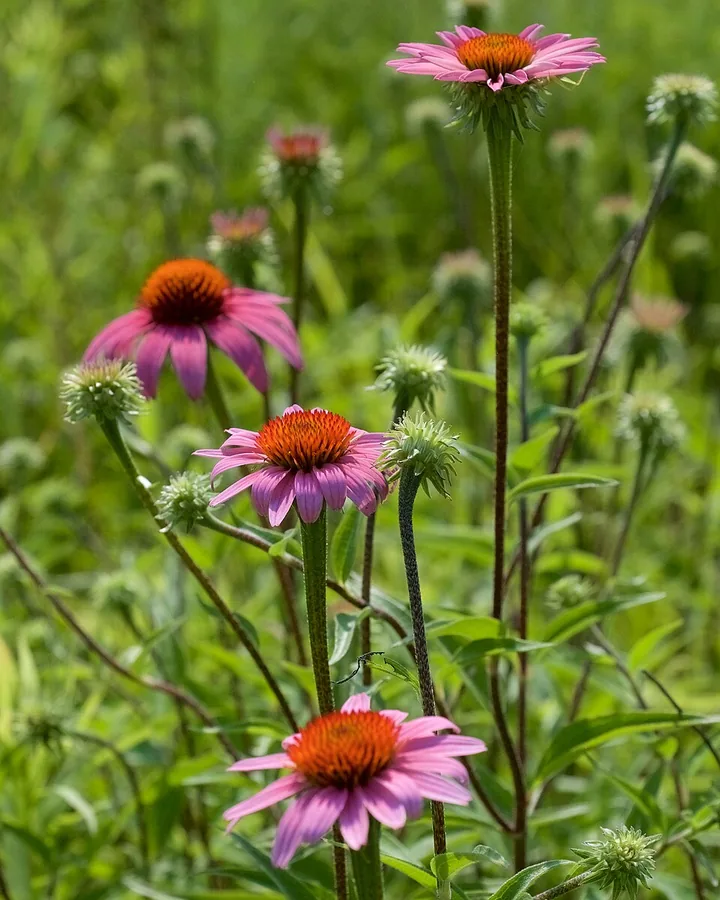
Purple coneflower is a hardy, sun-demanding perennial in the Asteraceae, indigenous to the prairies and open woodlands of eastern North America. It produces rigid stems bearing rosy-purple ray florets around a raised, bristly central cone, and the crown enlarges and flowers more freely with each year. Cold-hardy through USDA zones 3 to 8, it tolerates both severe winters and hot, dry summers because its taproot reaches moisture beyond the surface layer.
Few perennials match its garden contribution. Flowering extends from early summer well into fall, supporting bees and butterflies across the season, and the persistent seed heads provide forage for finches through winter when left standing. The species also has a long pharmacological history as the herb echinacea, used as a dietary supplement.
Its reputation for ease rests on real adaptation. Coneflower requires only full sun and free-draining soil, after which it is largely self-sufficient, withstanding drought and infertile ground that would weaken less resilient perennials. Adequate spacing for air movement is the main cultural input, and in return it persists for years.
Care
The short version: full sun and lean, well-drained soil suit it, and once established it draws on deep roots for moisture and needs irrigation only every week or two. Adapted to clay, sand, and drought, it asks little feeding and gains vigor as the crown enlarges each season.
Light
Coneflower performs best in full sun, defined as a minimum of six hours of direct light daily, which drives flowering and keeps stems erect. It accepts partial shade, but reduced light induces etiolation, so shaded plants stretch, lodge, and bloom less.
Water
Once established, the plant is drought tolerant and requires irrigation only every 7 to 14 days, favoring dry to medium soil moisture. Apply water at the base rather than overhead, since persistent leaf wetness promotes the foliar pathogens it is otherwise resistant to.
Soil
It grows in average, well-drained loam and adapts to clay, sand, and rocky substrates without difficulty. A broad pH of 6.0 to 8.0 is acceptable, and the single limiting factor is waterlogging, which the taproot cannot tolerate.
Humidity
Ambient outdoor humidity meets its requirements entirely, so no target value applies. Air circulation is the operative variable, because stagnant, humid air around crowded foliage is the precondition for powdery mildew development.
Feeding
This species has low nutrient demand and thrives in lean soil. A single light slow-release application such as 12-6-6 in early spring suffices, and excess nitrogen produces weak, lodging-prone stems at the expense of flower production.
Pruning
Deadheading improves appearance and prolongs bloom, though reflowering occurs without it. Retaining some seed heads into winter both provides finch forage and permits self-seeding, while stems may be cut in late fall or left standing to overwinter native bees.
Size & spacing
At flowering the plant reaches 2 to 4 feet (60 to 120 cm) in height. Allow 12 to 24 inches (30 to 60 cm) between plants to maintain the air movement that suppresses mildew.
When to plant
This species follows a temperate northern cycle. Sowing indoors in late winter gives transplants a head start, planting out after the last spring frost avoids cold injury, and flowering then proceeds from early summer into fall.
Northern hemisphere
Southern hemisphere
Typical months for a temperate climate: start earlier in warm zones, later where spring frosts linger.
- Sow: Sow indoors at 65 to 70°F about 8 to 10 weeks before last frost; germinates in 10 to 20 days.
- Plant: Transplant outdoors after the last spring frost.
- Harvest: Blooms early summer through mid-fall, peaking June through August.
Hardiness
USDA hardiness zones: 3–8
Temperature: down to -40°C
Troubleshooting
Coneflower disorders concentrate on the reproductive heads and the foliage, and a vigorous, well-spaced stand seldom develops many. Recognizing the diagnostic signs below allows intervention before a pathogen or pest population establishes across the bed.
Petals turning green with leafy tufts on the cone
Greened ray florets accompanied by witches-broom tufts indicate aster yellows, a phytoplasma vectored between plants by leafhoppers. Because the infection is systemic, it does not resolve, and an affected plant cannot be restored once these symptoms appear. The appropriate response is to excavate the plant, bag it for disposal rather than composting, and suppress leafhoppers and weedy host species nearby.
Fix:
- Promptly dig up and remove infected plants
- Bag and discard them in the trash, not compost
- Control leafhoppers and weedy hosts nearby
Foliage chewed to lace in midsummer
Skeletonized leaves and damaged blooms in summer are diagnostic of Japanese beetles, which aggregate on tissue and consume it to the veins. Hand-removal into soapy water early in the morning exploits their reduced activity when temperatures are low, and insecticidal soap addresses light infestations. Scouting in early summer permits suppression before the population accumulates.
Fix:
- Hand-pick beetles into soapy water in early morning
- Treat with insecticidal soap for light infestations
Distorted, tufted blooms with a rosetted cone
Twisted, rosetted flower heads result from eriophyid mites feeding concealed within the developing buds. The mites are microscopic and not visible, so the deformed inflorescences serve as the only practical diagnostic. Excising and discarding the affected heads in fall removes the mites before they overwinter in the tissue.
Fix:
- Cut back and remove affected flower heads in fall
White powdery film coating the leaves
A white-to-gray powdery coating on upper leaf surfaces during humid conditions identifies powdery mildew, which establishes most readily in the still air of crowded plantings. Increasing plant spacing restores air movement, and basal irrigation keeps foliage dry and less hospitable to the fungus. The disorder is largely cosmetic and seldom causes lasting injury.
Fix:
- Improve spacing and air circulation
- Avoid overhead watering
Toxicity
From a toxicological standpoint, purple coneflower presents no hazard: it is non-toxic across the board. The species is absent from the ASPCA toxic plant list, poses no risk to cats, dogs, horses, or livestock, and has a long record of human use as the herb echinacea. It may be planted without restriction where animals graze.
Safe for
People · Cats · Dogs · Horses · Rabbits · Livestock · Birds
Cats None
Because purple coneflower is absent from the ASPCA toxic list, a cat that samples a leaf is exposed to no toxic principle.
Dogs None
Dogs may investigate the plant by sniffing, chewing, or digging with no risk of poisoning.
Horses Safe
Horses grazing in proximity to a coneflower stand encounter no toxic constituent in either the foliage or the flowers.
Rabbits Safe
The foliage and stems present no toxicity to rabbits, although a rabbit may graze the plant to ground level.
Livestock Safe
Cattle, goats, and sheep may browse coneflower without adverse effect, as the species contains no recognized toxin.
Birds Safe
Birds are entirely safe around the plant, and finches in particular feed on the dried seed heads through fall and winter.
People Safe
Echinacea has a long history of human consumption as an herbal supplement, and the species is regarded as non-toxic.
Varieties
The genus offers numerous named selections, from the established purple forms to recent multicolor seed strains. Those described below are the cultivars most often encountered.
Magnus
Magnus is distinguished by large flowers whose flat, horizontal rosy-purple ray florets remain held outward rather than reflexing downward as in many coneflowers.
White Swan
White Swan replaces the typical purple coloration with clean white ray florets surrounding a warm coppery-orange cone.
Cheyenne Spirit
Cheyenne Spirit is a seed-propagated strain that yields flowers in red, orange, yellow, purple, and cream from a single packet.
How to propagate
Coneflower propagates readily by two routes, vegetative division of the crown and seed, the latter aided by the plant's own self-sowing.
DivisionModerate
Divide clumps in spring or fall, roughly every 3 to 4 years when they become overcrowded. · One growing season to re-establish.
Lift an overcrowded clump in spring or fall, at intervals of roughly 3 to 4 years, and divide it into sections that each retain both roots and shoots. Immediate replanting allows the divisions to re-establish over a single growing season.
SeedEasy
Sow indoors 8 to 10 weeks before last frost or allow self-seeding in the garden. · Germinates in 10 to 20 days; typically blooms the second year from seed.
Sow seed indoors 8 to 10 weeks before the last frost, or permit the plant to self-sow within the bed. Germination occurs in 10 to 20 days, though seedlings characteristically delay flowering until their second year. Leaving the seed heads in place results in dependable self-seeding without intervention.
Myths
Coneflowers will not rebloom unless you deadhead them.
Reflowering proceeds independently of deadheading, so plants return to bloom whether or not the spent flowers are removed. The practice chiefly improves appearance, whereas retaining some seed heads supplies bird forage and allows the plant to self-sow for the following season.
Echinacea is toxic and dangerous to pets.
Purple coneflower is absent from the ASPCA toxic plant list and is classified as non-toxic without qualification. It additionally carries an extensive record of human use as an herbal supplement.