Shrub · Iteaceae
Virginia Sweetspire
Itea virginica
A wetland-adapted native shrub that carries fragrant spring spires and long-holding fall color on arching stems.
Full sun
Every 3–7 days
USDA 5–9
3–8 ft · 0.9–2.4 m
Overview
Virginia sweetspire ranks among the most adaptable native shrubs for the home landscape, a trait rooted in its origins along the wet woods and stream banks of the eastern United States. That wetland ancestry explains its tolerance for conditions that defeat many shrubs. Provided with room and reliable moisture, it largely maintains itself.
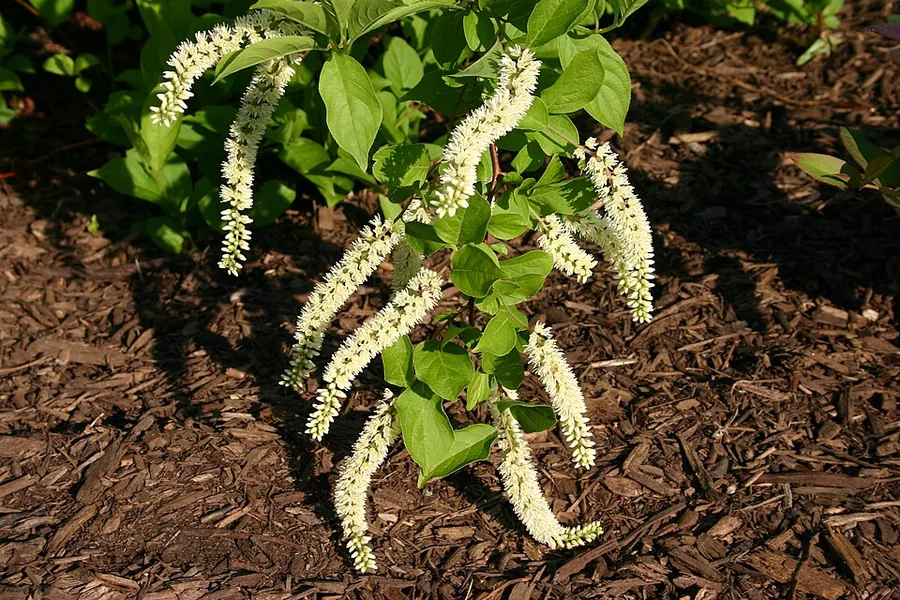
Its ornamental value spans two seasons. Arching stems produce fragrant white flower spires in late spring, and the foliage develops deep red and burgundy tones in autumn that persist well after neighboring plants defoliate. It performs adequately in a mixed border, but its impact is greatest when massed along a moist margin or within a rain garden, settings that echo its native habitat.
One trait governs where it belongs: the plant spreads by root suckers to form colonies. In a wet or difficult site that colonizing habit becomes an asset, knitting the ground with dependable growth. In a formal bed it obliges an annual removal of errant shoots, so the planting position should account for that lateral root activity from the outset.
Care
The short version: site it in moist to wet, slightly acidic soil under full sun to part shade, maintain even moisture through establishment, and confine pruning to the period immediately after flowering.
Light
Sweetspire tolerates the full range from full sun to full shade, an unusual latitude for a flowering shrub. Give it at least some direct sun regardless, because flowering and fall pigmentation both depend on adequate light; plants held in deep shade bloom sparsely and color poorly.
Water
This species is wetland-adapted and performs best in consistently moist to saturated soil. It withstands periodic flooding, heavy clay, and impeded drainage, which is precisely why it suits rain gardens and streamside plantings where other shrubs decline. Established specimens endure short dry intervals, but sustained growth and appearance depend on steady moisture.
Soil
Provide moist, fertile soil rich in organic matter, held on the acidic side between a pH of 5.0 and 7.0. The plant adapts to clay and wet ground, but in alkaline soil iron becomes chemically unavailable to the roots and the foliage yellows with chlorosis, the mechanism behind the disorder covered below.
Temperature
Cold hardiness is a defining strength: the shrub tolerates winter lows near -20°F (-29°C) and summer highs to 100°F (38°C). This broad thermal range underlies its reliable performance across hardiness zones 5 to 9.
Humidity
Ambient humidity is not a management concern for this outdoor shrub, and no target range applies. Having evolved in damp woodland, it accommodates whatever atmospheric moisture the site provides.
Feeding
Nutrient demand is low. A single spring application of balanced general-purpose fertilizer, or a topdressing of compost, satisfies its requirements, and heavier feeding offers no benefit.
Pruning
Pruning timing is dictated by flowering physiology: sweetspire blooms on old wood, so next season's buds are borne on the current framework. Cut immediately after flowering and before buds set in late summer, and use the same operation to remove suckers and aging stems for rejuvenation and containment.
Repotting
As a landscape subject, sweetspire rarely requires repotting. In container culture, pot up only when roots circle the rootball, water passes through with little absorption, or growth stalls despite adequate irrigation, all indications the roots have outgrown the vessel.
Size & spacing
Mature dimensions run 3 to 8 feet (91 to 244 cm) in height and 3 to 6 feet (91 to 183 cm) in spread, with continued lateral extension by suckering beyond the stated width. Allow room for expansion, or space compact cultivars more closely to form a uniform low mass.
When to plant
Rated for zones 5 to 9, sweetspire withstands winter minimums near -20°F (-29°C), which places it among the hardier flowering shrubs. Establish new plants in spring or fall, anticipate flower spires from late spring into early summer, and expect autumn coloration to develop as night temperatures decline.
Northern hemisphere
Southern hemisphere
Typical months for a temperate climate: start earlier in warm zones, later where spring frosts linger.
- Plant: Spring or fall
- Harvest: Late spring to early summer (May to June)
Hardiness
USDA hardiness zones: 5–9
Temperature: down to -29°C
Troubleshooting
Sweetspire is largely trouble-free and hosts no serious pests or diseases. The disorders that do arise are cultural rather than pathological, tracing to siting or pruning timing. Identify the symptom below to reach the corrective measure.
Suckers extending the plant into a spreading colony
The behavior is intrinsic: sweetspire produces root suckers that progressively coalesce into a dense colony. Sever or excavate emerging shoots at ground level while they are young, or install a subsurface root barrier and maintain a defined edge to arrest lateral spread. Where a colonizing habit is undesirable, the surest strategy is to site the plant where thicket formation is acceptable or to select a compact cultivar at the outset.
Fix:
- Dig out or cut unwanted suckers at ground level as they appear
- Install a root barrier or site the plant where colony spread is acceptable
- Mow or edge the perimeter regularly to limit lateral expansion
Interveinal yellowing while the veins hold green
This pattern is chlorosis driven by iron deficiency, and the cause is chemical rather than a shortage in the soil: at elevated pH, iron is not available for root uptake. Confirm with a soil test showing a reaction above neutral, then correct the underlying pH using elemental sulfur or acidifying organic matter. Chelated iron and an acidic pine-bark mulch serve as interim measures while the pH is brought down.
Fix:
- Test soil pH and amend with elemental sulfur or acidifying organic matter to lower pH
- Apply chelated iron as a temporary corrective measure
- Mulch with acidic organic matter such as pine bark
Reduced flowering and diminished autumn color
Two cultural factors suppress the display: excessive shade and pruning at the wrong stage. Insufficient light limits both flowering and pigment development, so relocate a shaded specimen to a position with some direct sun daily. Because the flower buds are set on old wood, restrict pruning to the interval directly after bloom, since cutting in late winter or spring removes the buds before they open.
Fix:
- Site or transplant to a location receiving at least some direct sun each day
- Prune only immediately after flowering, not in late winter or early spring
Toxicity
For households with pets or children, the toxicity profile is reassuring: Itea virginica is non-toxic across the board. It does not appear on the ASPCA toxic-plant database and presents no meaningful hazard to cats, dogs, horses, livestock, birds, or people. The only plausible effect, from ingesting a large quantity of foliage, is transient gastrointestinal upset.
Safe for
People · Cats · Dogs · Horses · Rabbits · Livestock · Birds
Cats None
Itea virginica is not among the plants the ASPCA lists as toxic, so a cat that samples the foliage is not at risk. A large ingestion might, at most, cause brief gastrointestinal upset.
Dogs None
The species is non-toxic to dogs. Chewing the leaves poses no systemic hazard, though consuming a large volume could produce transient loose stool, as with many plants.
Horses Safe
No toxicity to horses is documented, and a grazing horse may browse the shrub without harm.
Rabbits Safe
Rabbits may feed on the foliage without concern, as the plant contains no compound toxic to them.
Livestock Safe
Cattle, goats, and sheep are not endangered by this native shrub, which holds no constituents harmful to grazing stock.
Birds Safe
Birds are unaffected. Songbirds frequent the plant, and its seeds along with the insects it attracts contribute to its value in wildlife plantings.
People Safe
The shrub is non-toxic to people. It is not cultivated as an edible, but a child who tastes a leaf is in no danger.
No special handling precautions are required for toxicity; as with any plant, ingestion of large amounts of foliage could cause mild, transient gastrointestinal upset.
Varieties
Named selections are generally preferred over the straight species because they offer a more compact habit and superior coloration. The three below are the ones most often encountered in the trade.
Henry's Garnet
Recognized as a Missouri Botanical Garden Plant of Merit, this selection matures at 3 to 5 feet tall and 4 to 6 feet wide and produces longer flower spires and more intense red-burgundy autumn color than the species.
Little Henry (Sprich)
A dwarf selection maturing to roughly 2 to 3 feet in all dimensions, bearing creamy-white spires and coloring yellow, orange, and red in autumn.
Scentlandia (SMNIVDFC)
A compact cultivar selected for stronger flower fragrance and greater bud hardiness, which improves cold performance relative to most selections.
Companions
Sweetspire pairs naturally with other natives that share its taste for moist, acidic ground, which makes it a mainstay of rain gardens and wet borders.
Plant near
Inkberry holly (Ilex glabra): Another native shrub tolerant of moist, acidic soils, pairing well in rain gardens and naturalized wet borders.
Summersweet (Clethra alnifolia): Shares preference for moist to wet acidic soils and part shade, complementing sweetspire in pollinator and rain-garden plantings.
How to propagate
Propagation is straightforward, and the plant's suckering, low-branching architecture supports several vegetative approaches alongside seed.
Stem cuttingsEasy
Spring to early summer using softwood cuttings · Several weeks to root; transplantable the following season
Softwood cuttings taken from spring through early summer root readily. Rooting takes several weeks, after which the young plants are best held and transplanted to their permanent position the following season.
DivisionEasy
Dormant season or early spring · One season
The plant's prolific suckering lends itself to division: lift an established clump in the dormant season or early spring and separate rooted shoots from the parent. Each division establishes within a single season.
LayeringEasy
Spring to summer · One growing season to root
The low, arching branches self-layer wherever they contact moist soil. Peg a stem down in spring or summer and it will form roots over one growing season, at which point it can be severed from the parent.
SeedModerate
Sow collected seed; slower than vegetative methods · Multiple seasons to reach landscape size
Seed propagation is possible but slower and less predictable than vegetative methods. Seedlings show greater variability than cuttings or divisions and require several seasons to attain landscape size.
Myths
Virginia sweetspire poses a toxic hazard to pets.
It does not. Itea virginica is absent from the ASPCA toxic-plant database and is regarded as non-toxic to cats and dogs. Ingestion of foliage carries no systemic risk; at most, a large quantity may produce the mild, self-limiting gastrointestinal upset common to many plants.
Virginia sweetspire may be pruned at any time without consequence.
Pruning in late winter or spring removes the developing flower buds before they open. Because the species flowers on previous season's wood, the only appropriate window is immediately after bloom. Pruning at that point preserves both form and the following year's flowering.