Shrub · Aquifoliaceae
Inkberry Holly
Ilex glabra
A native shrub adapted to wet ground, hard winters, and shade that holds its evergreen foliage year round.
Full sun
Every 3–7 days
USDA 4–9
5–10 ft · 1.5–3 m
Overview
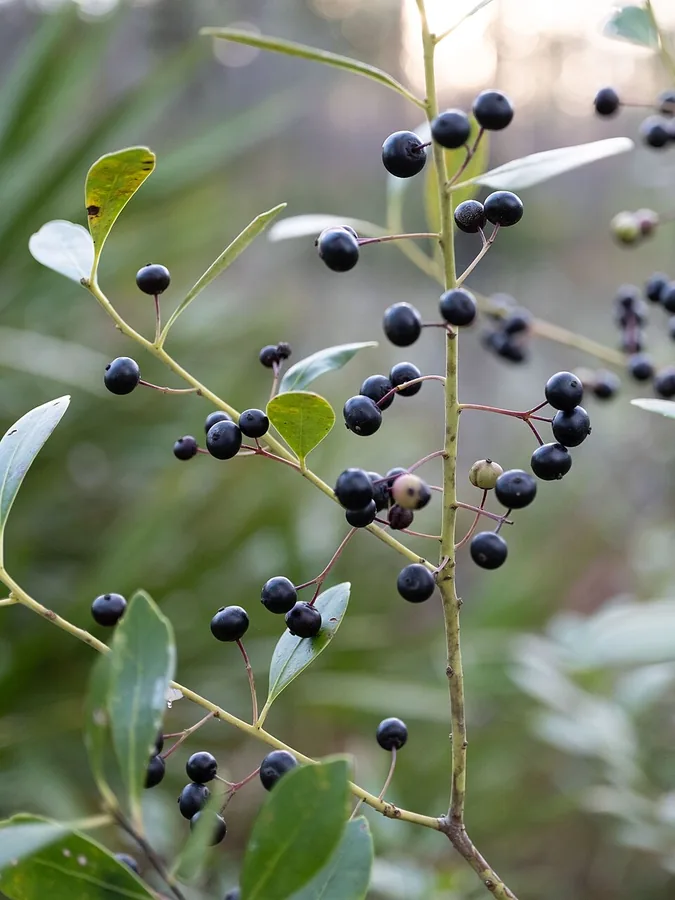
Inkberry holly is a slow-growing evergreen shrub of eastern North America whose black berries once yielded a household dye, which is where the name comes from. Its foliage departs from the spiny English hollies familiar to most gardeners; the leaves are smooth-margined and small, a trait that makes the plant comfortable to site along a path. In cultivation it functions as a low, evergreen structural backbone for beds and hedges.
Its defining quality is a wide tolerance grounded in its native ground. It performs in acidic, wet soils that defeat less adaptable shrubs, withstands winter lows near -29°F (-34°C), and accepts anything from full sun to part shade. The offsetting trait is habit: the wild species is stoloniferous, so it spreads by suckers and thins at the base with age, which explains the preference among growers for the tidier named cultivars.
The species is dioecious, so a single plant will not fruit; a nearby male is required for a female to set berries. Those drupes provision birds well into winter and the spring flowers are worked by honeybees, both reasons the plant recurs on native-plant lists. Once established it demands very little management.
Care
The short version: grow it in acidic, evenly moist soil under full sun to part shade, feed sparingly, and apply an occasional spring prune to keep an aging plant from thinning at the base.
Light
Inkberry accepts full sun to part shade, and higher light yields a denser, better-clothed shrub. Under deep shade the plant grows thin and leggy and loses form as lower stems drop their leaves, so site it in the brightest position the situation allows.
Water
The shrub is adapted to consistently moist soil and even tolerates wet to boggy ground that would asphyxiate the roots of most plants. It becomes moderately drought tolerant once established, but a young plant has yet to build that root system and needs steady water, roughly every 3 to 7 days, while it does.
Soil
Grow it in acidic, organically rich soil, ideally a pH of 5.0 to 6.0. It adapts to clay or sand and endures wet sites, but at neutral to alkaline pH iron turns unavailable and the leaves yellow, so avoid limed soil.
Temperature
Inkberry is genuinely cold-hardy, enduring lows near -29°F (-34°C) and summer heat to about 100°F (38°C). That span accommodates most temperate gardens without winter protection.
Humidity
Ambient outdoor humidity satisfies it, so there is no target to maintain. As a plant of damp woods and bogs, its requirement is root-zone moisture far more than atmospheric moisture.
Feeding
Its nutrient demand is low. One application of balanced or acidifying holly or azalea fertilizer in early spring suffices, and an acidifying formulation has the added effect of holding the soil at the low pH the plant requires.
Pruning
In most years the plant needs little intervention. Prune to shape in early spring just before growth resumes, and where an older specimen has gone bare and woody at the base, cut hard into old wood to force dense regrowth from low buds.
Repotting
Container-grown inkberry rarely needs repotting. Move it up only when roots circle the pot, emerge from the drainage holes, or water passes straight through, each of which signals the plant has outgrown its container.
Size & spacing
A mature shrub reaches 5 to 10 feet (1.5 to 3 m) in height and spreads 5 to 8 feet (152 to 244 cm) wide. Space plantings at that mature width so a hedge closes over while each shrub retains airflow.
When to plant
As a hardy shrub, inkberry imposes no narrow planting window. Establish new plants in spring or fall while the soil is workable and moist, expect greenish-white flowers in late spring, and note that the black drupes ripen in fall and persist through winter.
Northern hemisphere
Southern hemisphere
Typical months for a temperate climate: start earlier in warm zones, later where spring frosts linger.
- Plant: spring or fall
- Harvest: May to June (greenish-white flowers); black drupes mature September and persist into winter
Hardiness
USDA hardiness zones: 4–9
Temperature: down to -34°C
Troubleshooting
Inkberry is largely trouble-free from year to year. The few disorders it does present register either in the foliage or in the plant's overall form, and each has an identifiable cause. Match the sign below, then address the underlying cause rather than the visible symptom.
Interveinal yellowing with green-veined leaves
This pattern is iron chlorosis, and on inkberry it traces back to soil that has moved out of the acidic range the plant is adapted to. Iron becomes chemically unavailable as pH rises toward neutral, so the leaves starve for it even where the element is present in the ground. Confirm with a pH test, then acidify with organic matter to return the soil toward 5.0 to 6.0, supply chelated iron per label, and withhold lime.
Fix:
- Acidify soil and lower pH toward 5.0-6.0
- Apply iron/chelated micronutrients per label
- Improve organic matter and avoid liming
Open, leggy habit with a bare lower framework
Basal thinning is the natural aging habit of the species, and low light accelerates it because shaded stems abandon their lower leaves. Treat it as habit rather than pathology. Renewal-pruning in early spring, cutting back into old wood, drives dormant basal buds and rebuilds density; relocating to fuller sun helps, and where a reliably tight form is wanted, the compact cultivars Shamrock, Compacta, and Gem Box hold their shape.
Fix:
- Renewal-prune in early spring to encourage dense basal growth
- Site in fuller sun
- Choose compact cultivars such as 'Shamrock', 'Compacta', or Gem Box
Mines, blotches, or stippling on the foliage
Serpentine or blotch tracks in the leaf tissue are the feeding galleries of a leaf miner working between the leaf surfaces, fine chlorotic stippling indicates spider mites draining cell contents, and waxy encrustations on stems and leaves are scale. None threatens an established inkberry. Remove and destroy the worst leaves to cut the population, treat mites or scale with an appropriate horticultural control, and sustain vigor through correct moisture and soil so the plant outgrows the injury.
Fix:
- Remove and destroy heavily infested leaves
- Monitor and treat mites/scale with appropriate horticultural controls per label
- Maintain plant vigor with proper water and soil
Toxicity
Inkberry rates as mildly toxic rather than harmless. In common with other hollies, its leaves and berries contain saponins and related compounds that irritate the digestive tract on ingestion, and the berries carry the greater risk. A small ingestion produces gastrointestinal upset rather than an emergency, but the berries and prunings still warrant keeping out of reach of pets and small children.
Toxic to
Cats · Dogs · Horses · Rabbits · Livestock · People
Safe for
Birds
Cats Mild
A cat that ingests leaves or berries typically responds with hypersalivation, then vomiting and some diarrhea, and appears dull and inappetent for about a day. The berries carry the greatest share of the irritant load and are the part most often responsible.
Dogs Mild
In dogs the gastrointestinal response mirrors the feline one: vomiting and loose stools after a mouthful of berries or foliage. The saponins, along with the ingested leaves, account for the irritation. The signs remain mild and generally self-limiting.
Horses Mild
Horses seldom browse inkberry, but an animal that does graze the foliage may develop colic and dullness. Excluding clippings from the paddock is a sensible precaution.
Rabbits Mild
Leaves and berries can irritate a rabbit's digestive tract, producing lethargy and reduced feeding, so neither belongs in the hutch or run.
Livestock Mild
Ruminants such as goats, sheep, and cattle may suffer gastric upset from the foliar saponins, though clinically significant poisoning is uncommon. Fencing the shrubs or removing prunings is preferable to allowing stock to browse.
People Caution
For people the berries and leaves are mildly toxic and are not to be eaten, with the berries posing the larger risk, particularly to small children drawn to them. Ingesting a few berries generally provokes vomiting and diarrhea rather than serious harm. Store them out of reach and wash after pruning.
Birds Safe
Birds consume inkberry drupes through winter without ill effect, and the shrub is planted in part as an avian food source. The same fruit that upsets a mammalian gut serves as forage for songbirds.
Keep berries and trimmings away from pets and children; wash hands after handling.
Helpline numbers

United States
ASPCA Animal Poison Control: (888) 426-4435 (fee applies)
Poison Control: (800) 222-1222



Canada
Poison Centres: 1-844-764-7669
Varieties
Because the wild species tends toward legginess, growers generally choose a named cultivar bred for a compact habit. The selections below are the ones worth knowing.
Shamrock
A compact, mounded selection that retains a tight habit and resists the legginess of the wild species.
Compacta
A female cultivar denser and lower in habit than the species, so it maintains cover to the ground.
Gem Box
A small, rounded form with fine dark foliage marketed as a durable substitute for boxwood.
Nigra
Selected for deep green foliage that retains its color reliably across the seasons.
How to propagate
Inkberry can be increased by cuttings, by division of its suckers, or from seed, and the method to choose depends on your patience and on whether the identity of the resulting plant matters to you.
Stem cuttingsModerate
Early to mid summer (June-July) · Several weeks to months to root, then a season or more to establish
Cutting propagation is the conventional method for inkberry and the only one that preserves a named cultivar true to type, since it clones the parent. Collect semi-hardwood or softwood terminal shoots in early to mid summer, around June or July. Rooting proceeds over several weeks to a few months, after which the plant requires a season or more to establish.
DivisionEasy
Early spring · One growing season
Because inkberry is stoloniferous and throws rooted suckers around the crown, those shoots can be severed and transplanted. Lifting them in early spring gives them roughly one growing season to establish. It is the simplest approach when the aim is only to increase an existing shrub.
SeedDemanding
After cleaning ripe fruit · Slow; seed has dormancy and can be slow to germinate
Seed propagation is the most demanding route. Clean the seed from ripe fruit before sowing, and expect delay, because a built-in dormancy makes germination slow and uneven. Seedlings segregate into males and females, so a batch needs at least one male for the females to fruit.
Myths
A solitary inkberry will produce a crop of black berries.
Inkberry is dioecious, so any given plant is either male or female. Fruit forms only on female plants, and only after pollen reaches them from a male growing within range. Without a male sited nearby, a lone shrub will not set berries.