Shrub · Aquifoliaceae
Winterberry Holly
Ilex verticillata
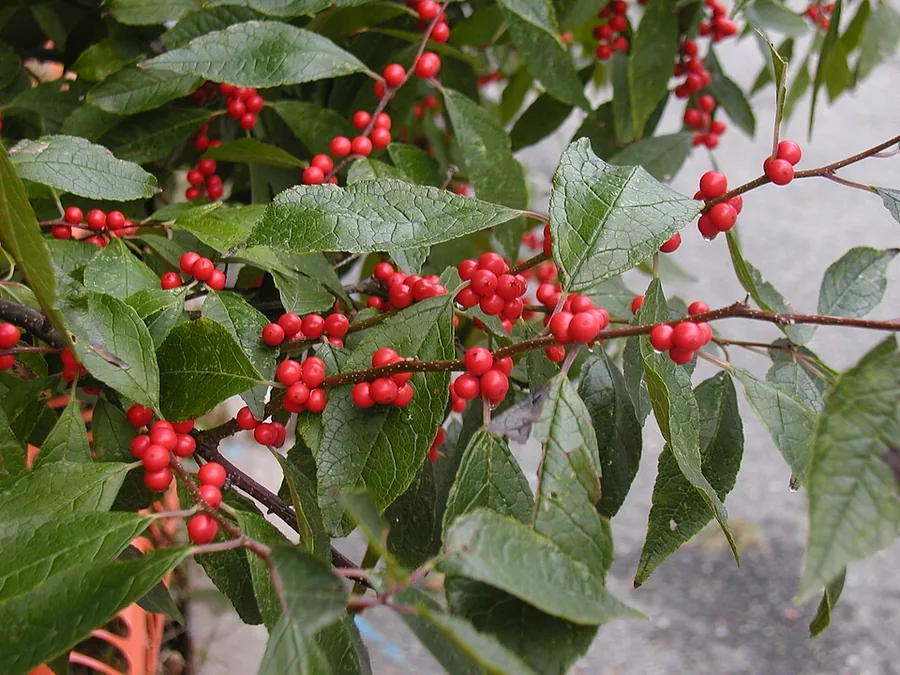
Grown as a dioecious pair, winterberry sets bare stems dense with red berries that persist through winter.
Full sun
Every 3–7 days
USDA 3–9
3–15 ft · 0.9–4.6 m
Overview
Winterberry holly is a deciduous member of the genus Ilex, and that deciduous habit is the whole point. Unlike its evergreen relatives it sheds every leaf in autumn, leaving bare stems set with scarlet fruit that persists into winter. The berries hold as a food source for songbirds and cut cleanly for seasonal arrangements.
Native to the wetlands of eastern North America, along swamp edges, pond margins, and low woods, the species is adapted to moist, acidic ground where drainage is poor and most shrubs decline. That adaptation makes it well suited to a rain garden or a saturated site, and its cold hardiness extends to zone 3, among the coldest limits any broadleaf shrub will tolerate.
The defining trait for a grower is that the species is dioecious: individual plants are male or female, and only a pollinated female bears fruit. A female sets berries solely when a compatible male flowers within range at the same time. Arrange that pairing and cropping is dependable; omit it and the plant grows well but never fruits.
Care
The short version: site winterberry in full sun to part shade in steadily moist, acidic soil that never dries, and plant at least one male within pollinating range of your females so they crop.
Light
Winterberry tolerates a range from full sun to full shade, but fruit set responds directly to light. At least a half day of direct sun drives the densest, best-colored crop, because flowering and fruiting draw on the energy the canopy captures; in deep shade the plant stays healthy but fruits sparsely.
Water
This is a wetland species, so the soil should stay evenly moist and never dry out. It tolerates boggy, poorly drained sites that would asphyxiate the roots of most shrubs, a reflection of its swamp-edge origin. Irrigate through establishment and during dry spells until the root system is settled.
Soil
Grow it in moist to wet, acidic soil within a pH of 4.5 to 6.0 and high in organic matter. It adapts to clay or sand provided the ground stays damp, and the acidity is functional rather than cosmetic: it keeps iron and manganese available so the foliage stays green.
Temperature
Cold hardiness is exceptional, spanning -40°F to 100°F (-40°C to 38°C). That range corresponds to zones 3 through 9, so midwinter low temperatures rarely limit the species the way they constrain the evergreen hollies.
Humidity
Ambient humidity outdoors is set by climate, and winterberry is indifferent to it. Air movement matters more, since the minor leaf fungi that affect the species establish most readily in still, crowded plantings.
Feeding
A single spring application of an acidic, slow-release fertilizer formulated for acid-loving plants meets its needs. More is unnecessary for so undemanding a shrub, and the acidifying formulation also helps hold the soil within the plant's preferred pH range.
Pruning
Prune in early spring before growth resumes, because flowers form on new wood and later cuts would remove developing bloom. Take out dead or crossing stems at the same time; the species needs little else.
Repotting
As a landscape shrub it is seldom containerized, so repotting rarely applies. Where one is grown in a pot, move it up only when roots circle the container, water runs straight through, or growth stalls despite adequate care, all signs the roots have outgrown the volume.
Size & spacing
Mature size varies by cultivar across 3 to 15 feet (91 cm to 4.5 m) tall with a comparable spread. Space each plant for its final width, and keep a male within about 50 feet of the females so pollen reaches them.
When to plant
As a hardy woody perennial rather than an annual crop, winterberry follows a straightforward seasonal sequence. Establish new plants in spring or fall under mild conditions, expect the small greenish-white flowers from spring into early summer, and look for the red fruit that colors in late summer and persists through the cold months.
Northern hemisphere
Southern hemisphere
Typical months for a temperate climate: start earlier in warm zones, later where spring frosts linger.
- Plant: Spring or fall
- Harvest: Inconspicuous greenish-white flowers April to July; bright red berries August to December persisting through winter
Hardiness
USDA hardiness zones: 3–9
Temperature: down to -40°C
Troubleshooting
Winterberry presents few problems, and each traces to a definable cause rather than to poor vigor. The common ones are a soil pH that has risen above the species' acidic range and the absence of a compatible male pollinator. Identify the mechanism below, then correct the cause.
Interveinal yellowing on new foliage
This pattern is chlorosis, and in an acid-loving shrub it points almost invariably to a soil pH above the species' preferred range. At neutral to alkaline pH the roots cannot take up iron and manganese, so the youngest leaves pale between the veins while the veins themselves stay green. Acidify the soil with elemental sulfur or an acidifying fertilizer, mulch with pine bark, and apply chelated iron as an immediate correction while the pH adjusts.
Fix:
- Lower soil pH using elemental sulfur or an acidifying fertilizer
- Apply chelated iron as a temporary correction
- Mulch with acidic organic matter such as pine bark
A female setting little or no fruit
Because the species is dioecious, a female fruits only when a compatible male flowers nearby at the same time, so sparse fruit usually signals a pollination gap. Plant one male such as 'Jim Dandy' or 'Southern Gentleman' per 6 to 20 females within about 50 feet, align its bloom period with your female cultivars, and ensure pollinators can work the flowers.
Fix:
- Plant one male cultivar such as 'Jim Dandy' or 'Southern Gentleman' per 6 to 20 females within 50 feet
- Match the male's bloom time to the female cultivars
- Ensure pollinators have access during bloom
Leaf spotting or a white surface film
These are fungal leaf spot and powdery mildew, both favored by humid, crowded conditions and neither damaging to an otherwise healthy shrub. Thin the branches to improve air movement, remove the affected leaves to reduce inoculum, and avoid wetting the foliage.
Fix:
- Improve air circulation by thinning and proper spacing
- Remove and dispose of affected foliage
- Avoid overhead watering
Toxicity
Winterberry holly rates as low in toxicity, though not as harmless. The foliage and especially the fruit contain saponins along with caffeine-like compounds, and these irritants provoke vomiting, diarrhea, and salivation when ingested. Because the ripe berries are the most conspicuous and most often eaten part, keep cut branches and fallen fruit away from pets and small children.
Toxic to
Cats · Dogs · Horses · Rabbits · Livestock · Birds · People
Cats Mild
A cat that samples the leaves or, more often, the conspicuous berries typically salivates and vomits, followed by loose stools and lethargy. The saponins and caffeine-like compounds are the irritant principles, and clinical signs generally remain mild.
Dogs Mild
Dogs are the species most likely to ingest a quantity of fallen berries, which produces vomiting, diarrhea, and marked salivation. The spiny leaf margins can also abrade the oral tissues. Signs are usually self-limiting, though a large ingestion warrants veterinary assessment.
Horses Mild
Lacking the ability to vomit, a horse instead develops diarrhea, dullness, and colic-like discomfort from the same fruit and foliage. Grazing animals seldom select the plant, and small quantities rarely produce more than transient upset.
Rabbits Mild
The saponins in leaf and fruit irritate the sensitive rabbit digestive tract, so both should be kept out of reach. Even a small intake can cause inappetence and soft droppings.
Livestock Mild
Cattle, goats, and sheep can sustain digestive irritation from foliage and fruit, commonly shown as salivation and loose manure. The plant's low palatability keeps serious poisoning uncommon.
Birds Caution
Wild songbirds consume the ripe fruit through winter without harm, and it functions as an important cold-season food source. Companion birds differ physiologically, so holly should not be offered to a parrot or finch.
People Caution
The berries are not edible, and a child who consumes a handful may develop vomiting, diarrhea, and abdominal cramping. One or two rarely cause significant effect, but cut branches and fallen fruit should be kept from small children regardless.
Keep cut berried branches and fallen berries away from pets and small children; berries are the most likely part to be ingested.
Helpline numbers

United States
ASPCA Animal Poison Control: (888) 426-4435 (fee applies)
Poison Control: (800) 222-1222



Canada
Poison Centres: 1-844-764-7669
Varieties
The named winterberries divide cleanly into fruiting females and the males that pollinate them, so selecting a matched pair is the practical basis of any planting. The cultivars below are the ones most often offered.
Winter Red
A heavy-cropping female valued for dense glossy red fruit that retains its color well into winter.
Red Sprite
A compact female dwarf of roughly 3 to 5 feet that nonetheless bears large red fruit, suiting confined plantings.
Jim Dandy
An early-flowering male that pollinates the early female cultivars while setting no fruit itself.
Southern Gentleman
A late-flowering male whose bloom period coincides with the mid- to late-season females.
Winter Gold
A female whose fruit ripens to pinkish-gold and orange rather than the typical red.
Companions
Winterberry pairs best with the male shrub that fruits it and with other plants that love the same wet, acidic ground.
Plant near
Jim Dandy winterberry (male): Provides early-season pollen needed for female winterberry shrubs to set fruit.
Red osier dogwood: Shares moist, acidic site preferences and pairs well in rain gardens and native plantings.
Cinnamon fern: Thrives in the same wet, acidic shade conditions for a layered native moist-soil planting.
How to propagate
Winterberry propagates from stem cuttings or from seed, and the two differ in reliability and in what they yield. Cuttings reproduce a known plant of known sex, whereas seed segregates for sex and germinates slowly.
Stem cuttingsModerate
Late spring to summer · 6 to 12 weeks to root, then transplant the following season
Stem cuttings are the reliable method and preserve the sex of the parent. Take softwood to semi-hardwood pieces of the current season's growth from late spring into summer, treat them with rooting hormone, and most will root within 6 to 12 weeks, after which they are transplanted the following season. A cutting from a female remains female and will fruit once a male is established nearby to pollinate it.
SeedDemanding
Fall sowing of cleaned seed · Slow; seeds require warm then cold stratification and may take more than a year to germinate
Seed is slow and genetically uncertain. Sow cleaned seed in fall, since germination requires warm stratification followed by cold and the seed may lie more than a year before emerging. The sex of a seedling cannot be determined until it flowers, which is why cuttings are preferred whenever guaranteed fruiting females or a specific cultivar is the goal.
Myths
Every winterberry shrub grows its own red berries.
The species is dioecious, so the sexes are borne on separate plants and only females fruit. A female colors up solely when a compatible male with an overlapping bloom period grows within pollinating range, which means an isolated shrub, or any male, remains fruitless.
Winterberry holly stays green through winter like other hollies.
Unlike the evergreen hollies, this species is deciduous and defoliates completely each autumn. What remains is bare wood lined with red fruit that persists through the cold season, and that persistent display is the horticultural reason for growing it.