Shrub · Aquifoliaceae
Japanese Holly
Ilex crenata
Root it in acid, freely draining ground and Ilex crenata holds a sheared outline for decades with little intervention.
Full sun
Every 5–10 days
USDA 5–8
3–10 ft · 0.9–3 m
Overview
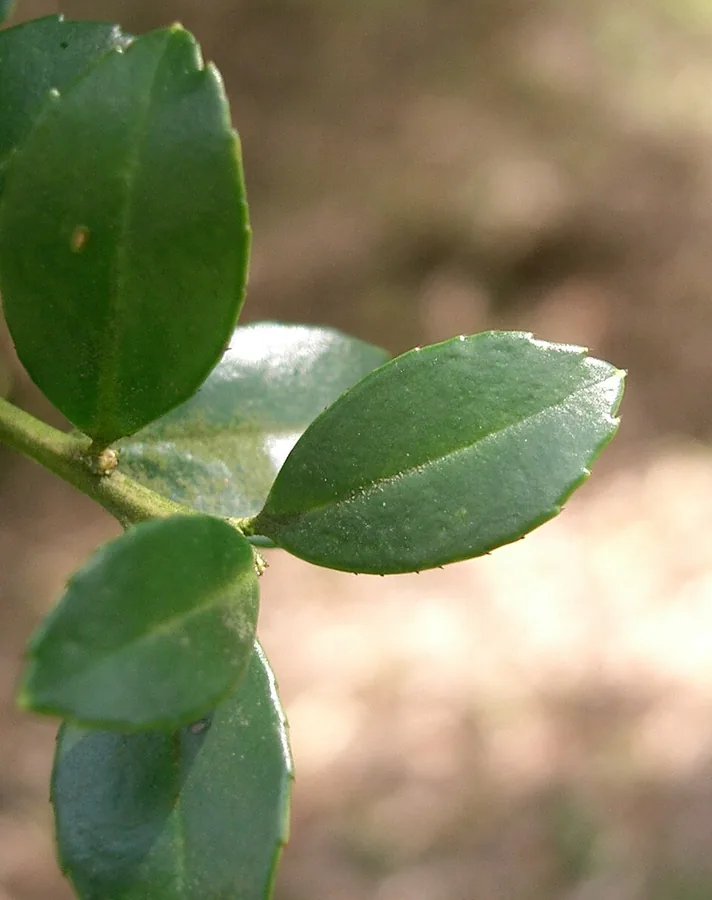
Japanese holly serves as the standard evergreen substitute for boxwood where a hardier constitution is wanted. Its small, glossy, dark leaves are borne densely along the stems, and because the plant breaks readily from old wood it accepts hard shearing, which is why growers train it into low hedges, clipped globes, and formal foundation lines. Grown to its natural habit it develops slowly into a rounded shrub of 3 to 10 feet (91 cm to 3 m) in height.
This is a slow-growing, long-lived species, hardy across USDA zones 5 to 8 and tolerant of temperatures from -20°F to 95°F (-29°C to 35°C). It is dioecious, meaning individual plants are either male or female, and only a pollinated female carries the small black drupes that ripen in autumn. Those fruits are inconspicuous against the dark foliage, though birds locate and feed on them through winter.
Its central requirement is acidic, well-drained soil, and the two most common failures follow directly from missing it. Let the pH rise and iron uptake falls, producing interveinal yellowing; let the roots stand in cold, saturated ground and root rot takes hold. Satisfy the soil and allow adequate spacing, and the plant demands little further attention.
Care
The short version: full sun to part shade in acidic, well-drained soil, watered to remain evenly moist during establishment, sheared in late winter, and fertilized once each spring with a product formulated for acid-loving evergreens.
Light
Japanese holly performs best in full sun, yet it accepts partial shade and partial sun. Higher light drives denser, more compact growth that holds a sheared outline, whereas heavy shade thins the canopy because the plant cannot photosynthesize enough to fill it.
Water
Maintain evenly moist soil, watering on roughly a 5 to 10 day interval as temperature and rainfall dictate. Young plants depend on that consistency while the root system extends, after which established shrubs draw on their depth to endure a dry interval.
Soil
The species wants light, acidic, well-drained loam and adapts from sand to clay provided drainage is free, since standing water invites root disease. Hold the pH between 5.0 and 6.5, because above that band iron precipitates out of reach and the foliage yellows.
Temperature
It is both cold-hardy and heat-tolerant, functioning from -20°F to 95°F (-29°C to 35°C) across USDA zones 5 to 8. That amplitude covers the majority of temperate gardens without protective measures.
Humidity
Ambient outdoor humidity is adequate, so no target applies. Air movement around the canopy matters more, because still, crowded air favors the mites and fungal problems that trouble this shrub.
Feeding
Apply a single feeding in early spring using a balanced or acidifying fertilizer intended for acid-loving evergreens. One seasonal dose meets the plant's slow demand, and the acidifying grade doubles as a way to hold soil pH within the preferred range.
Pruning
The shrub tolerates shearing exceptionally, breaking new growth from cut wood. Prune in late winter to early spring to shape hedges and sustain density, and because it answers repeated cutting much as boxwood does, it suits the tight, formal outlines those uses require.
Repotting
Cultivated chiefly in the ground, it seldom needs a container at all. Where one is grown in a pot, repot every 2 to 3 years in spring, taking roots that circle the rootball or emerge from the drainage holes as the signal that space has run out.
Size & spacing
Mature plants stand 3 to 10 feet (91 cm to 3 m) tall and reach 5 to 8 feet (152 to 244 cm) across in time. Allow each shrub its full mature spread so air circulates through the canopy and foliar disease finds no foothold.
When to plant
This slow, woody evergreen rewards unhurried timing. Establish new plants in spring or fall while soils are cool and workable and root growth is favored, expect the small white flowers in late spring, and look for the black drupes to color on female plants by autumn.
Northern hemisphere
Southern hemisphere
Typical months for a temperate climate: start earlier in warm zones, later where spring frosts linger.
- Plant: Spring or fall
- Harvest: May to June (small white flowers); black drupes ripen in fall on female plants
Hardiness
USDA hardiness zones: 5–8
Temperature: down to -29°C
Troubleshooting
Nearly every problem on Japanese holly resolves to the soil or to a single persistent pest, and the foliage registers the fault before the roots do. Learn to read a bronzed leaf, an interveinal-yellow leaf, and a stunted shoot tip. Match the pattern below and intervene while correction is still possible.
Shortened internodes, chlorotic shoots, and steady decline
Stalled terminal shoots, internodes drawn short, and a shrub in general decline signal black root rot, a fungus that colonizes roots in wet, cool soils and starves the canopy of water and nutrients. Excavate a root and inspect the tips, which turn dark brown to black as the infection advances. The disease cannot be cured once established, so remove and destroy the plant, correct the underlying wet soil with a raised bed, and replant with a resistant species such as Chinese holly. Japanese holly ranks among the most susceptible woody shrubs to this pathogen, which is why prevention matters more than any treatment.
Fix:
- Remove and discard infected plants (cannot be cured)
- Replace with resistant species such as Chinese holly
- Improve drainage with raised beds
Bronzed, stippled foliage overlaid with fine silk
Dull, bronzed foliage laced with fine webbing points to the southern red mite, a spider mite that punctures cells on the lower leaf surface and drains their contents, which drives the speckling and loss of color. Confirm the diagnosis by tapping a branch over white paper and watching for the moving specks the naked eye can otherwise miss. Because the mites shelter beneath the leaves, direct a hard water spray there first to dislodge them, follow with horticultural oil to smother what remains, and repeat a week to 10 days later to catch the next hatch. Inspect Convexa and other cupped-leaf cultivars earliest, since their concave leaves give the mites cover.
Fix:
- Spray undersides thoroughly with horticultural oil
- Use strong water sprays to dislodge mites
- Repeat treatment in 7-10 days
- Encourage natural predators
Interveinal yellowing while the vein network stays green
A yellow leaf blade held against green veins is classic chlorosis, and on this acid-loving shrub it traces back to soil that has drifted alkaline, where iron binds into forms the roots cannot absorb. Confirm the cause with a pH test, since the reading will sit above the acidic band the plant requires. Lower the pH over time with elemental sulfur applied to the soil test, buy an immediate green-up with a foliar or soil iron chelate, and top the bed with acidic organic mulch to slow the drift back upward.
Fix:
- Acidify soil with elemental sulfur per soil test
- Apply iron chelate as a temporary corrective
- Mulch with acidic organic matter
Toxicity
This is a mildly toxic shrub that calls for reasonable care rather than concern. The leaves and berries contain saponins that irritate the digestive tract, and the small black fruit presents the greatest risk. An isolated nibble seldom causes lasting harm, but keep pets and small children from consuming the berries and clear any that fall.
Toxic to
Cats · Dogs · Horses · Rabbits · Livestock · People
Safe for
Birds
Cats Mild
In a cat, ingested foliage or a swallowed berry irritates the gut, so drooling, vomiting, and loose stools appear, followed by a period of lethargy and reduced appetite.
Dogs Mild
Dogs contact the plant most often, chewing the spiny leaves or ingesting dropped berries, and the saponins provoke vomiting, diarrhea, and a dull, depressed state that resolves as the gut clears.
Horses Mild
A horse seldom grazes holly, yet a mouthful of foliage or fruit still irritates the digestive tract enough to leave the animal off-color and sluggish.
Rabbits Mild
The saponins in leaf and berry disrupt a rabbit's delicate hindgut, so exclude clippings and fallen fruit from its reach to prevent diarrhea and the lethargy that follows.
Livestock Mild
Grazing stock generally avoid the prickly evergreen, though an underfed animal that browses the foliage can develop the same gastrointestinal upset and dullness.
People Caution
No part of this shrub is edible. The fruit poses the real hazard, since a child who consumes a handful of berries can present with vomiting and diarrhea, so site the plant beyond a small child's reach.
Birds Safe
Birds consume the ripe black drupes through winter and void the seeds intact, a dispersal partnership that accounts for how the shrub naturalizes.
Keep fallen berries away from pets and children; wear gloves when pruning if skin is sensitive.
Helpline numbers

United States
ASPCA Animal Poison Control: (888) 426-4435 (fee applies)
Poison Control: (800) 222-1222



Canada
Poison Centres: 1-844-764-7669
Varieties
The plants offered commercially are almost all named cultivars selected for form and dimension rather than the wild species. The selections below are the ones worth understanding before purchase.
Compacta
A dense, rounded selection that responds well to shearing, which recommends it for low hedges and foundation plantings.
Helleri
A dwarf cushion form that mounds low over the ground, although it succumbs to black root rot more readily than most selections.
Convexa
Distinguished by its cupped, convex leaves, whose concavity shelters southern red mite more than other forms and warrants close monitoring.
Sky Pencil
A narrow, columnar selection with strongly upright growth that reads like a green exclamation point where a vertical accent is wanted.
Hetzii
A vigorous, spreading cultivar that covers ground quickly but carries the same susceptibility to black root rot seen in Helleri.
How to propagate
Japanese holly propagates dependably from cuttings, the technique nurseries rely on to keep each cultivar genetically true to its parent.
Stem cuttingsEasy
Summer to early fall · 6 to 10 weeks to root
Semi-hardwood stem cuttings taken from summer into early fall root readily, typically forming roots within 6 to 10 weeks. Since a cutting is a clone of the parent, it reproduces a named cultivar faithfully, preserving its habit and leaf shape where seed would segregate.
Myths
The tiny black drupes of Japanese holly appear so insignificant that the shrub is presumed to carry no toxic compounds at all.
The unassuming fruit and the foliage both contain saponins that irritate the gastrointestinal tract. A pet or child that ingests them can develop vomiting and diarrhea, and the berries carry the greater risk. Regard the plant as mildly toxic and remove fallen fruit promptly.