Shrub · Aquifoliaceae
Sky Pencil Holly
Ilex crenata
A fastigiate Japanese holly that reads as a green column, dependent chiefly on acidic soil and winter protection.
Full sun
Every 5–10 days
USDA 5–8
4–10 ft · 1.2–3 m
Overview
Sky Pencil is a selection of Ilex crenata bred for a strongly fastigiate, columnar habit. It reaches 4 to 10 feet (1.2 to 3 m) in height while its spread holds to 1 to 3 feet (30 to 90 cm), a ratio that suits it to constrained plantings. Growers deploy it to define an entry, edge a narrow bed, or set a symmetrical vertical pair.
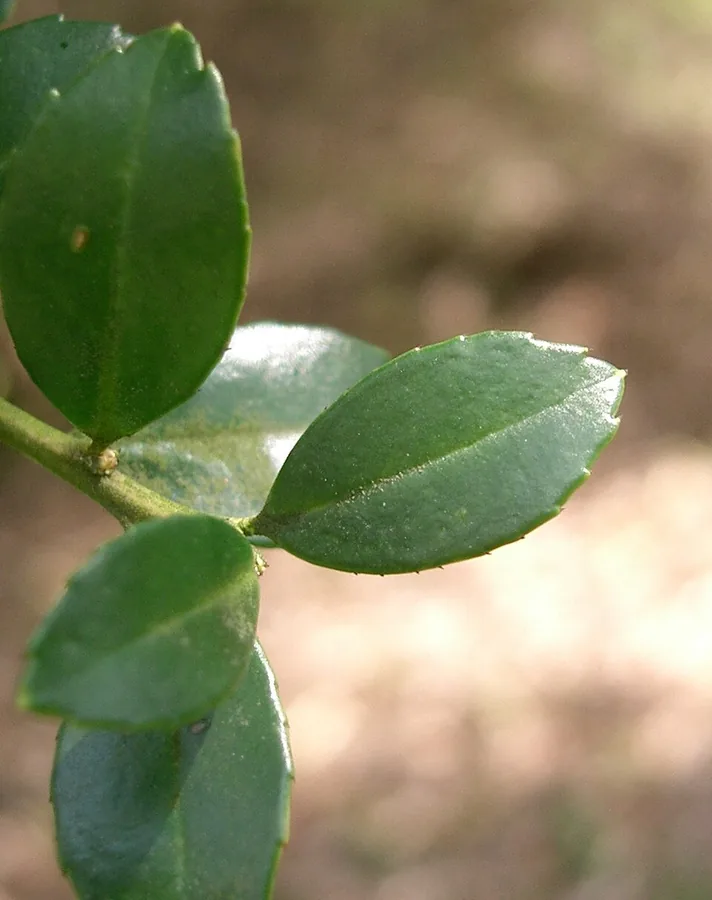
Its foliage is small, glossy, and evergreen, so the plant retains color year round, and because the growth rate is slow, the outline stays true with minimal intervention. Note that this is an all-female cultivar: without a male holly nearby to supply pollen, the flowers set no fruit, and the small black berries appear only where cross-pollination occurs.
Cold tolerance is a real asset: the cultivar withstands minima near -9°F (-23°C) and performs across zones 5 to 8. The trade-off lies in the narrow crown, which offers little resistance to snow load and desiccating wind. Sited in acidic, well-drained soil with wind protection, it proves undemanding.
Care
The short version: full sun to partial shade, an acidic and freely draining medium held at consistent moisture, a single early-spring feeding, and a loose binding of the stems ahead of winter to preserve the columnar crown.
Light
Sky Pencil performs best under full sun, where high light drives the dense, compact growth that keeps the column rigid. It tolerates partial shade, but reduced light produces elongated, sparser growth and a looser habit.
Water
Maintain evenly moist soil, which usually means irrigating every 5 to 10 days as temperature and rainfall dictate. The species tolerates brief dry intervals but declines under sustained drought, and it is intolerant of waterlogged conditions, which encourage root rot.
Soil
Establish it in light, acidic, well-drained soil within a pH range of 5.0 to 6.5. It accommodates textures from clay to sand, but alkaline substrates induce chlorosis and depress vigor as iron becomes less available.
Temperature
The cultivar is notably cold-hardy, tolerating roughly -9°F to 95°F (-23°C to 35°C). This range supports reliable performance through zone 5 to 8 winters, though a dry, freezing wind will still scorch exposed foliage, so a sheltered placement matters.
Humidity
Ambient outdoor humidity is adequate, which is why the record specifies no target range. Good airflow around the crown contributes more to plant health than any humidity figure, particularly through humid summer weather.
Feeding
Supply a balanced, acid-forming shrub fertilizer once in early spring, timed to the flush of new growth. Given the slow growth rate, this single seasonal application meets the plant's nutrient demand for the year.
Pruning
The plant sustains its columnar form unaided, so routine shearing is unnecessary. Trim lightly in spring only to refine the outline, and before winter tie the stems into a loose bundle, since the fastigiate crown resists snow and ice poorly and can splay under their load.
Repotting
In containers, plan to repot every 2 to 3 years, or when roots begin circling the rootball or protruding from the drainage holes. Step it up one container size into fresh acidic medium once growth slows or water passes through unusually fast, both signs the roots have filled the pot.
Size & spacing
At maturity the plant forms a slender column 4 to 10 feet (1.2 to 3 m) tall and only 1 to 3 feet (30 to 90 cm) wide. That minimal lateral spread allows close spacing, so a row can serve as a slim hedge or a solid screen.
When to plant
As an evergreen, Sky Pencil offers no harvest window, only an establishment window. Install it in spring or fall, when moderate temperatures let the root system knit in before summer heat or a hard freeze can stress it. Flowering is inconspicuous, occurring in May and June, and fruit follows solely where a male pollinizer grows within range.
Northern hemisphere
Southern hemisphere
Typical months for a temperate climate: start earlier in warm zones, later where spring frosts linger.
- Plant: spring or fall
- Harvest: May to June
Hardiness
USDA hardiness zones: 5–8
Temperature: down to -29°C
Troubleshooting
Given suitable conditions this holly is largely trouble-free, yet a poorly drained site or a severe winter will expose its physiological limits. Symptoms concentrate on the foliage and the erect stems, so inspecting those reveals problems while they remain correctable. Identify the disorder below and intervene early.
Foliar yellowing and dieback traced to the root zone
Yellowing, defoliation, and shoot dieback that originate in saturated soil point to Phytophthora or black root rot. Examination of the root zone reveals dark brown to black, decayed tissue, and the condition intensifies wherever drainage is poor. Correct the drainage, reduce irrigation, and on persistently wet sites establish the plant on a raised bed. Remove specimens that are extensively rotted to limit spread of the pathogen.
Fix:
- Improve drainage and stop overwatering
- Avoid planting too deeply or over-mulching
- Use raised beds in heavy or wet soils
- Remove severely affected plants
Stippled, bronzed foliage accompanied by fine webbing
Fine stippling, bronzing, and webbing indicate spider mites, most often the southern red mite, whose populations build rapidly under hot, dry conditions. Confirm the infestation by tapping a branch onto white paper and watching for movement. Dislodge the colonies with forceful water, then apply insecticidal soap or horticultural oil to the lower leaf surfaces, repeating the treatment about a week later while any remain active.
Fix:
- Apply strong water sprays to dislodge mites
- Treat with insecticidal soap or horticultural oil, covering lower leaf surfaces
- Repeat treatment in 7 to 10 days while mites are present
Foliar browning and a crown splayed by winter weather
Post-winter browning reflects winter burn, the desiccation of foliage by cold, dry wind, while accumulated snow and ice force the slender crown outward. Clear snow from the stems promptly after each storm so the weight does not deform them. For durable protection, gather the stems before winter and combine a windbreak with a maintained mulch layer over the root zone.
Fix:
- Gently brush snow off stems after storms
- Tie stems loosely together for winter support
- Provide a windbreak and winter mulch
Generalized chlorosis across the whole plant
Uniform yellowing across the canopy is chlorosis, driven by soil that is too alkaline for this acid-loving holly. Elevated pH reduces the availability of iron and other nutrients, so the foliage cannot maintain normal chlorophyll. Test the substrate, amend it downward toward the acidic range, and apply chelated iron to restore green while the correction takes effect.
Fix:
- Test soil pH
- Amend soil to lower pH toward acidic range
- Apply chelated iron if needed
Toxicity
Regard this as a mildly toxic species rather than a hazardous one. The foliage and fruit contain saponins, and because the conspicuous berries are the tissue most often ingested, they represent the primary concern. Ingestion typically produces gastrointestinal upset rather than systemic toxicity, so clearing dropped berries away from pets and children is a sensible precaution.
Toxic to
Cats · Dogs · Horses · Rabbits · Livestock · Birds · People
Cats Mild
A cat ingesting foliage or a berry generally develops mild gastrointestinal upset, with hypersalivation and an episode of vomiting or diarrhea. The reaction is self-limiting, though veterinary advice is warranted if several berries have been consumed.
Dogs Mild
Dogs, the animals most inclined to consume the conspicuous berries, react to the saponins with drooling and a day of reduced appetite. The typical outcome is vomiting or soft stools rather than serious illness.
Horses Mild
Horses seldom browse holly, but a quantity of foliage or berries can produce colic-like gastrointestinal upset accompanied by dullness and depression.
Rabbits Mild
The saponins disturb the sensitive digestive tract of rabbits, so cuttings and fallen fruit should be excluded from the hutch and exercise area.
Livestock Mild
Grazing stock generally reject the bitter foliage, but goats or sheep that browse a branch may experience mild digestive disturbance.
Birds Caution
Wild birds consume holly fruit through winter without ill effect, yet the same berries can prove unsuitable for aviary birds, so cage species are best kept away from the plant.
People Caution
No portion of the plant is intended for consumption. A single berry may cause only mild stomach upset, whereas ingesting several can induce vomiting and diarrhea, so the fruit should be kept out of reach of young children.
Keep fallen berries away from pets and children; the spiny evergreen foliage is otherwise low risk.
Helpline numbers

United States
ASPCA Animal Poison Control: (888) 426-4435 (fee applies)
Poison Control: (800) 222-1222



Canada
Poison Centres: 1-844-764-7669
Varieties
Sky Pencil is one of several narrow, fastigiate Japanese hollies in cultivation. The following selections are the ones most often encountered.
Sky Pencil
An unusually narrow female cultivar attaining 4 to 10 feet in height at only 1 to 3 feet across, valued as a precise vertical form.
Sky Pointer
A further upright Ilex crenata selection of closely comparable slim, columnar proportions.
Glow Stick
An Ilex crenata cultivar prized for its bright, golden-yellow foliage.
How to propagate
Because seedlings do not reproduce the fastigiate form, Sky Pencil is propagated vegetatively rather than by seed. The process demands patience more than technical skill.
Stem cuttingsModerate
Summer, using semi-hardwood cuttings · 6 to 10 weeks to root
Propagate from semi-hardwood cuttings taken in summer, the dependable method for maintaining the fastigiate habit, which seedlings fail to reproduce. Inserted into a moist, free-draining medium, cuttings root over 6 to 10 weeks. This reliance on vegetative propagation is why the cultivar is produced by cloning in the nursery trade.
Myths
Holly is safe around pets simply because it is a routine landscape plant.
Its ubiquity in gardens carries no bearing on its edibility. Holly contains saponins, and ingestion of the berries provokes drooling, vomiting, and loose stools in cats and dogs. The toxicity is genuinely low, yet real, so the fruit should not be treated as harmless.
Sky Pencil Holly can be counted on to bear berries.
As an all-female clone, it is incapable of self-fertilization. The small black berries develop only when a male holly grows near enough for its pollen to reach the flowers.