Shrub · Aquifoliaceae
Yaupon Holly
Ilex vomitoria
Evergreen and durable, the one North American holly you can brew, yaupon tolerates drought, salinity, and deep shade alike.
Full sun
Every 7–14 days
USDA 7–9
10–25 ft · 3–7.6 m
Overview
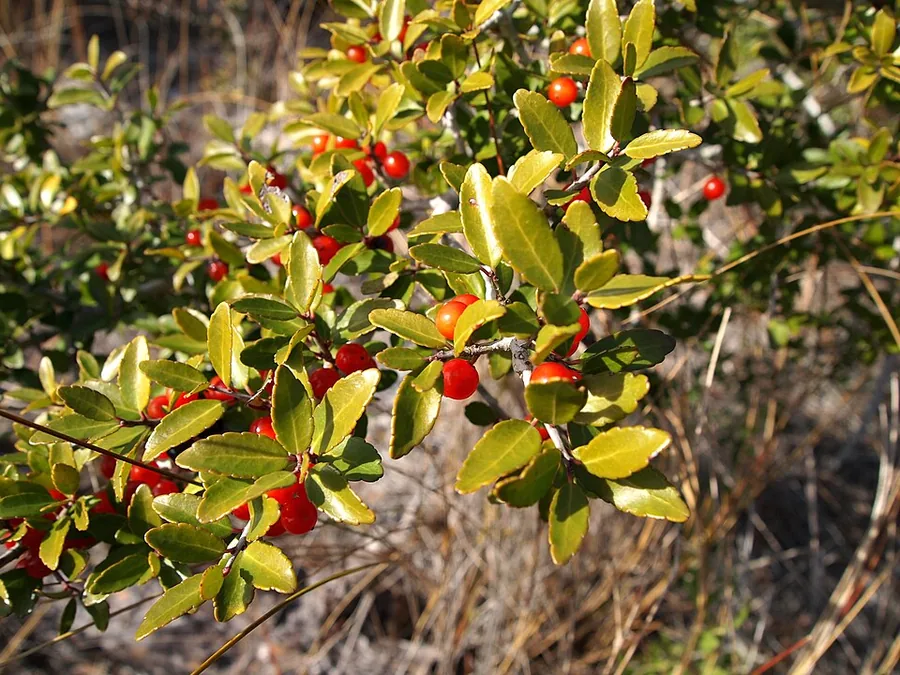
Yaupon holly is a tough, evergreen shrub native to the southeastern United States, adaptable in form to a sheared hedge, a small multi-stemmed tree, or an informal screen. Its foliage is small, smooth, and crenate, without the spines characteristic of the genus, so the plant handles safely without gloves. Rated for zones 7 to 9, it performs from full sun to full shade and withstands drought, salt spray, and periodic inundation.
It is distinguished among the hollies by its chemistry. The leaves accumulate caffeine, the highest concentration of any plant native to North America, and have been prepared as a stimulating infusion for centuries. The species is dioecious, bearing staminate and pistillate flowers on separate individuals, so only pollinated females produce the translucent red drupes that persist along the branches through winter.
Given adequate space, the shrub is exceptionally low in maintenance. The principal cultural task is suppressing root suckers, since an untended plant recruits basal shoots and develops into a thicket. Manage that single tendency and the result is a low-input, evergreen structural element for the landscape.
Care
The short version: establish it in nearly any well-drained soil across a full sun to full shade range, irrigate through the first season and then withhold water except in drought, and cut root suckers two or three times a year to check its spread.
Light
Yaupon performs across the full gradient from full sun to full shade, an unusual latitude for a fruiting shrub. Canopy density and fruit set are greatest under 6 or more hours of sun, though a shaded plant retains its foliage and habit.
Water
Irrigate consistently through the first growing season to drive root development, then allow the upper half of the profile to dry between applications. Once established the plant is markedly drought tolerant and requires supplemental water only during extended dry periods. It also tolerates the occasional flooding, so brief soil saturation is not limiting.
Soil
Few shrubs are as edaphically tolerant. Clay, loam, and sand all serve provided drainage is adequate, and the plant accepts conditions from periodically wet to dry. Its acceptable pH is broad, spanning 5.0 to 8.0.
Temperature
Yaupon is hardy from approximately 5°F to 100°F (-15°C to 38°C), a span that encompasses hot southern summers and zone 7 winter minima. This wide thermal tolerance underlies its function as a year-round evergreen throughout much of the Southeast.
Humidity
Ambient outdoor humidity is entirely adequate, with no target value to meet. Air circulation is the more consequential factor, since crowded, static conditions predispose the foliage to occasional leaf spot.
Feeding
A balanced slow-release shrub or tree fertilizer applied in spring, on a seasonal basis, is sufficient. An established plant in reasonable soil requires little to no supplemental nutrition, so restraint is warranted.
Pruning
The shrub responds well to the shears. It sustains heavy pruning and renders cleanly into hedges, screens, or topiary. The critical operation is severing the root suckers at ground level two or three times a year, absent which the plant colonizes into a thicket.
Repotting
A containerized yaupon should be advanced to a larger pot every 2 to 3 years. Repot when roots encircle the container or emerge from the drainage holes, when water passes straight through, or when growth slows and wilting develops rapidly between waterings.
Size & spacing
118–299 in (300–760 cm) tall
When to plant
Yaupon is best planted in spring or fall, when soil temperatures support rooting yet the seasonal heat has moderated. The greenish-white flowers open briefly in spring, roughly March to May, and the ensuing red drupes on pistillate plants ripen in fall and remain well into winter.
Northern hemisphere
Southern hemisphere
Typical months for a temperate climate: start earlier in warm zones, later where spring frosts linger.
- Plant: Spring or fall
- Harvest: Inconspicuous greenish-white flowers in spring (March-May); translucent red berries on female plants mature in fall and persist into winter
Hardiness
USDA hardiness zones: 7–9
Temperature: down to -18°C
Troubleshooting
Yaupon holly ranks among the least demanding shrubs, and the disorders it presents are generally cosmetic rather than structural. Inquiries typically concern absent fruit or a degree of foliar marking. Match the observed symptom below, and the corrective measure is usually straightforward.
A mature specimen that fails to set fruit
Fruiting failure traces back to sexual biology, not culture. Yaupon is dioecious, so staminate and pistillate flowers occur on separate individuals, and only a pollinated female bears fruit. A male specimen, an isolated female beyond the reach of pollen, or a cultivar selected for form rather than fruit will each leave the canopy bare. To secure a crop, site a proven pistillate cultivar such as 'Jewel' or 'Pride of Houston' alongside a staminate plant whose bloom overlaps hers.
Fix:
- Plant at least one male yaupon near female plants to ensure pollination
- Select a known fruiting female cultivar such as 'Jewel' or 'Pride of Houston'
Stippling and bronzing with webbing or honeydew
The combination of stippling, bronzing, webbing, and a sticky glaze indicates sap-feeding pests, chiefly spider mites, scale, and leaf miners, whose excreted honeydew becomes the substrate for the sooty mold that darkens the foliage. Examine the abaxial leaf surfaces and stems under a hand lens, and dislodge mites by tapping foliage over white paper. A forceful water spray physically removes much of the population, after which horticultural oil or insecticidal soap applied to the undersides smothers the survivors, and heavily colonized stems are best excised. Populations seldom reach damaging levels on yaupon.
Fix:
- Hose off foliage with a strong stream of water
- Treat with horticultural oil or insecticidal soap, covering leaf undersides
- Prune out heavily infested stems
Foliar lesions with limited defoliation
Discrete spots, raised tar-like lesions, or a white mycelial bloom identify fungal leaf spot or powdery mildew, pathogens favored by prolonged leaf wetness and stagnant air. Removing and destroying fallen infected leaves interrupts the inoculum cycle, while thinning and spacing the plants restores the air movement that dries the canopy, and directing irrigation to the root zone denies the fungi the free water they require. Sound drainage and vigorous growth hold these problems at a minor, essentially cosmetic level.
Fix:
- Remove and dispose of fallen infected leaves
- Improve air circulation by thinning and spacing plants
- Avoid overhead watering and water at the base
Toxicity
Yaupon occupies two positions at once. Its caffeinated foliage yields a safe, mild tea long consumed by people, whereas the red berries contain saponins and are mildly toxic on ingestion. Keeping fallen fruit away from pets and small children suffices, as the effect is confined to the berries and resolves without intervention.
Toxic to
Cats · Dogs · Horses · Rabbits · Livestock · Birds · People
Cats Mild
A cat that ingests a few of the red drupes typically presents with hypersalivation, vomiting, and loose stool alongside reduced activity. Because the saponins reside in the fruit rather than the foliage, the berries are the tissue of concern despite the leaves drawing more interest.
Dogs Mild
Ingestion of the berries in dogs commonly produces vomiting and diarrhea, sometimes accompanied by drooling and transient lethargy. The syndrome is self-limiting, though a substantial quantity warrants veterinary consultation.
Horses Mild
The fruit saponins can provoke diarrhea and a dull, listless demeanor in horses that consume them. The modest quantity a horse is likely to take confines the reaction to the mild end of the spectrum.
Rabbits Mild
Berry saponins readily disturb the sensitive hindgut of a rabbit, yielding soft stool and inappetence. Excluding the fallen fruit and offering none of it is the prudent measure.
Livestock Mild
Cattle, goats, and sheep rarely select the bitter fruit, yet the saponins can induce mild gastrointestinal upset in the event of grazing. Browsing on the foliage carries no comparable concern.
Birds Caution
Numerous wild birds consume yaupon fruit through winter without ill effect and disperse the seed, so the drupes constitute a natural dietary component. Caged pet birds warrant greater caution, since their lower body mass renders any saponin dose proportionally more significant.
People Berries mildly toxic
The foliage is that of the sole caffeine-bearing North American holly and yields a safe, mild tea, so the plant itself is not restricted for human use. The red berries are the exception, containing saponins that elicit vomiting and diarrhea on ingestion, and they should be kept from young children.
Keep fallen berries away from pets and small children; toxicity is generally mild and limited to ingestion of the fruit.
Helpline numbers

United States
ASPCA Animal Poison Control: (888) 426-4435 (fee applies)
Poison Control: (800) 222-1222



Canada
Poison Centres: 1-844-764-7669
Varieties
Yaupon spans a wide range of habit, from low dwarfs to pendulous tree forms, so selection should follow the intended use, whether hedge, specimen, or a reliable fruit display. A limited set of cultivars recurs in the trade.
'Nana' (Dwarf Yaupon)
A compact, mounding dwarf maturing at approximately 3 to 5 feet in height and width, a staminate, non-fruiting selection well suited to a formal low hedge.
'Pendula' (Weeping Yaupon)
A pendulous cultivar whose cascading branches attain 15 to 20 feet and, on pistillate specimens, bear heavy fruit.
'Folsom's Weeping'
A further weeping selection exhibiting a draping habit closely comparable to 'Pendula'.
'Jewel'
A pistillate cultivar valued for its abundant red fruit.
'Pride of Houston'
A medium-sized pistillate shrub noted for heavy and dependable fruiting.
'Will Fleming'
A staminate cultivar of strictly columnar habit that ascends vertically like a green exclamation point.
How to propagate
Because yaupon is dioecious, the propagation method determines whether fruiting can be assured. Cuttings preserve a known sex, whereas seed leaves it undetermined until flowering.
Stem cuttingsModerate
Take semi-hardwood cuttings in summer · 6-12 weeks to root; one or more seasons to establish
Vegetative propagation is the reliable approach precisely because yaupon is dioecious, and sourcing cuttings from a verified staminate parent and a verified pistillate parent secures both sexes required for fruit set. Semi-hardwood cuttings taken in summer root in roughly 6 to 12 weeks and then require a season or more to establish. A male must remain within pollinator range of the females for berries to develop.
SeedDemanding
Collect ripe fruit in fall · Often 1-3 years; seed has a hard, dormant coat and germinates slowly and erratically
Seed propagation is slow and unpredictable. Ripe fruit collected in fall carries a hard, dormant seed coat that protracts germination over 1 to 3 years and yields erratic, staggered emergence. Because sex remains indeterminate until first flowering, growers seeking a known staminate or pistillate plant generally favor cuttings.
Myths
The epithet vomitoria means yaupon leaves induce vomiting, making the plant poisonous to brew.
The foliage is not emetic. It contains caffeine and was prepared for centuries as a stimulating infusion, the ceremonial black drink, and the emesis recorded in those rites resulted from ingesting very large volumes during ritual fasting rather than from any property of the leaf. The specific epithet is a misnomer, and yaupon tea is safe in moderation.
All hollies bear sharp, spiny leaves.
Yaupon departs from the pattern, carrying small, smooth, crenate leaves that lack spines. Unlike English or American holly, it may be handled without gloves.