Ornamental · Osmundaceae
Cinnamon Fern
Osmundastrum cinnamomeum
Supply wet, acidic shade and cinnamon fern produces tall green sterile fronds and rust-colored fertile spikes year after year.
Partial shade
Every 2–4 days
USDA 3–9
2–5 ft · 0.6–1.5 m
Overview
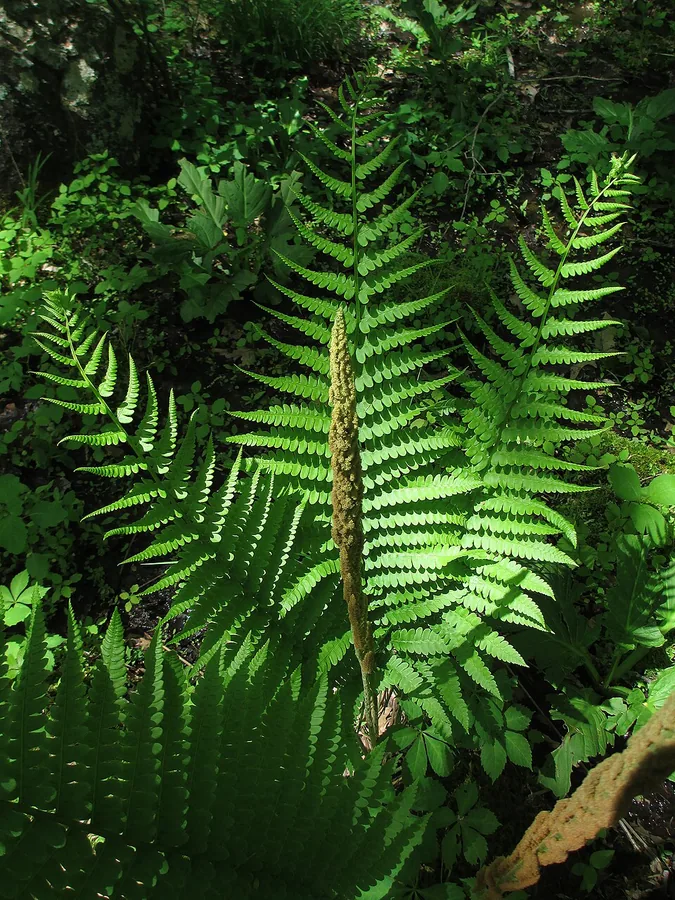
Cinnamon fern is a large, clump-forming species native to North American bogs and wet woodland, with the same growth habit recurring across much of eastern Asia. Each spring the crown produces a ring of upright sterile fronds reaching 2 to 5 feet (60 to 150 cm), arranged in the vase form typical of the genus. At the center of that ring stand separate fertile fronds packed with rust-colored spores, the cinnamon-brown spikes that account for the common name.
Its value lies in colonizing the damp, shaded ground that defeats most ornamentals. Pond margins, rain gardens, stream banks, and persistently wet low spots all suit its physiology, and its cold tolerance reaches USDA zone 3. Growth proceeds at a moderate pace, but an established clump expands to 2 to 4 feet (60 to 120 cm) across and gains size with each successive season.
Its requirements reduce to three: shade, acidic substrate, and a moisture supply that does not lapse. Because it cannot tolerate root drought, a dry summer triggers an early protective dormancy and the fronds are shed before fall. Maintain the moisture and the plant holds full foliage from the first spring fiddlehead until the first hard frost.
Care
The short version: part to full shade, a rich acidic substrate held consistently moist to wet, and an uninterrupted moisture supply through the season so the plant never dries and enters dormancy early.
Light
Cinnamon fern performs best in partial to full shade, the dappled regime of a woodland understory. It will grow in full sun, but only where soil moisture is sufficient to offset the higher transpiration and prevent marginal scorch on the fronds.
Water
Moisture is the non-negotiable factor for this species. Hold the soil consistently moist to wet, irrigating every 2 to 4 days in dry weather, and never let it dry out. It withstands standing water and saturated ground, but a summer drought drives it into early dormancy.
Soil
Site it in a rich, humusy, acidic substrate with good moisture retention and a pH of 4.5 to 6.0. Boggy, low-lying ground that stays wet is ideal, and a deep leaf-mold layer keeps the root zone cool and consistently damp.
Temperature
Its cold hardiness is exceptional, spanning -40°F to 86°F (-40°C to 30°C) and covering USDA zones 3 through 9. Severe winters present no risk because the crown overwinters dormant below the soil surface until spring.
Humidity
Adapted to wet woodland and bog margins, it favors atmospheric humidity in the range of 50% to 80%. A naturally moist, shaded position supplies this without intervention, so ambient humidity rarely needs active management.
Feeding
A rich substrate meets most of the plant's nutrient demand. A light spring top-dressing of compost or leaf mold suffices, and in genuinely fertile ground even that input is unnecessary.
Pruning
Retain all healthy green fronds through the growing season. The only justified cut is the removal of old, dead, or frost-damaged fronds in late winter, ahead of fiddlehead emergence.
Repotting
Established clumps seldom need disturbance. When the crowns become crowded and overlapping and frond size declines, the indicated response is to lift and divide the clump rather than simply relocate it.
Size & spacing
Anticipate a vase of fronds 2 to 5 feet (60 to 150 cm) tall with a spread of 2 to 4 feet (60 to 120 cm) at maturity. Allocate each crown that footprint so the mature clump can develop without crowding.
When to plant
There is no harvest to schedule with this fern, only one planting window of real consequence. Establish new plants in spring as the soil warms and the fiddleheads begin to expand, which allows the crown a full season to develop roots before the onset of winter.
Northern hemisphere
Southern hemisphere
Typical months for a temperate climate: start earlier in warm zones, later where spring frosts linger.
- Plant: spring
Hardiness
USDA hardiness zones: 3–9
Temperature: down to -40°C
Troubleshooting
Cinnamon fern hosts no serious pests or pathogens, so the differential for nearly any disorder collapses to a single cause: inadequate soil moisture. The fronds register water stress before the rest of the plant, so they serve as the earliest diagnostic. Intervene early with a deep watering and recovery is usually straightforward.
Brown, crisp frond margins indicating moisture stress
Marginal scorch on the fronds points to a water deficit at the roots. Cinnamon fern evolved in bogs and wet woodland, so its tissues are built for constant moisture and cannot regulate water loss once the soil dries, which is why the thin leaf margins desiccate first and the damage concentrates on the most sun-exposed side. Restore even moisture with a deep, thorough watering, apply leaf mold to slow evaporation from the root zone, and reduce light exposure if the plant stands in full sun.
Fix:
- Water deeply to keep soil consistently moist
- Mulch with leaf mold to retain moisture
- Provide more shade if sited in full sun
Premature summer dieback from drought-induced dormancy
Yellowing and early collapse in midsummer is a protective response rather than a disease. When soil moisture falls, the fern triggers summer dormancy, withdrawing resources from the fronds and shedding them to conserve the crown, which is why the foliage fades before its normal time. The crown itself stays viable, so the plant almost always re-emerges the following spring once you restore consistent deep watering and raise the soil's organic matter to hold moisture longer.
Fix:
- Resume consistent deep watering
- Improve soil organic matter and moisture retention
Toxicity
For households with pets and children the assessment is favorable. Cinnamon fern is a true fern with no documented toxin, so an exploratory nibble will not poison a cat, a dog, or a person. The single concern is mechanical: the wiry, cinnamon-colored hairs at the frond bases can abrade or irritate sensitive skin, so wash your hands after handling them.
Safe for
People · Cats · Dogs · Horses · Rabbits · Livestock · Birds
Cats None
As a true fern, cinnamon fern carries no recognized toxin, so a cat that samples a frond faces no chemical risk. The only foreseeable effect is the transient stomach upset any animal may show after eating a large amount of fibrous plant matter.
Dogs None
No toxic constituent has been documented in the fronds, so dogs are not chemically at risk near this plant. The practical caution is mechanical, since the rigid fibers at the frond bases are best kept from a persistent chewer.
Horses None
The foliage contains no compound known to harm horses, making it suitable for planting along paddocks and pasture margins.
Rabbits None
Rabbits may graze the plant without toxicological concern. Both the emerging fiddleheads and the mature fronds are free of any recognized toxin.
Livestock None
Cattle, goats, and sheep are not poisoned by it, so it presents no hazard in fields or on the wet ground where stock graze.
Birds None
Neither the fronds nor the spores pose any documented danger to birds, so backyard flocks can forage around the crowns without risk.
People None
The plant is non-poisonous, and the fiddleheads of related ferns are gathered and eaten in spring. The only concern is mechanical: the wiry hairs at the frond bases can abrade sensitive skin, so wash your hands after handling them.
The cinnamon-colored hairs and fibers at the frond bases may cause mild mechanical skin irritation in sensitive individuals.
Varieties
Cinnamon fern is cultivated chiefly as the wild type, though botanists recognize a small number of regional varieties worth distinguishing.
var. glandulosum
This variety bears glandular hairs along the frond axes and occupies the southeastern portion of North America.
var. asiaticum
The Asian variety extends from the Russian Far East southward into Indochina.
How to propagate
This fern cannot be raised from seed because ferns produce none. The dependable approach is division of an established clump, with spore culture available as a slower secondary option for the patient grower.
DivisionModerate
Early spring before the fronds unfurl · 1-2 years
Vegetative division is the most predictable method: lift an established clump in early spring before the fiddleheads expand and separate the crown into sections, each of which requires a year or two to re-establish a working root system and resume full vigor. Propagation from fresh spores sown on a moist, sterile medium is also possible but proceeds slowly and demands careful conditions.
Myths
Cinnamon fern is where culinary cinnamon comes from.
The common name describes the cinnamon coloration of the frond-base fibers and the fertile fronds, not any spice content. Culinary cinnamon is harvested as the bark of unrelated Cinnamomum trees, a different family entirely, so the fern contributes nothing to that product.
Cinnamon fern spreads and reproduces by seed.
Ferns lack seeds and flowers because they belong to a lineage that predates seed plants. Reproduction occurs through spores borne on dedicated upright fertile fronds, the rust-colored fertile spikes from which the species takes its name.