Ornamental · Osmundaceae
Interrupted Fern
Claytosmunda claytoniana
Give it damp shade and rich, acidic soil, and this cold-hardy native fern renews its fronds each spring.
Partial shade
Every 3–7 days
USDA 3–8
2–5 ft · 0.6–1.5 m
Overview
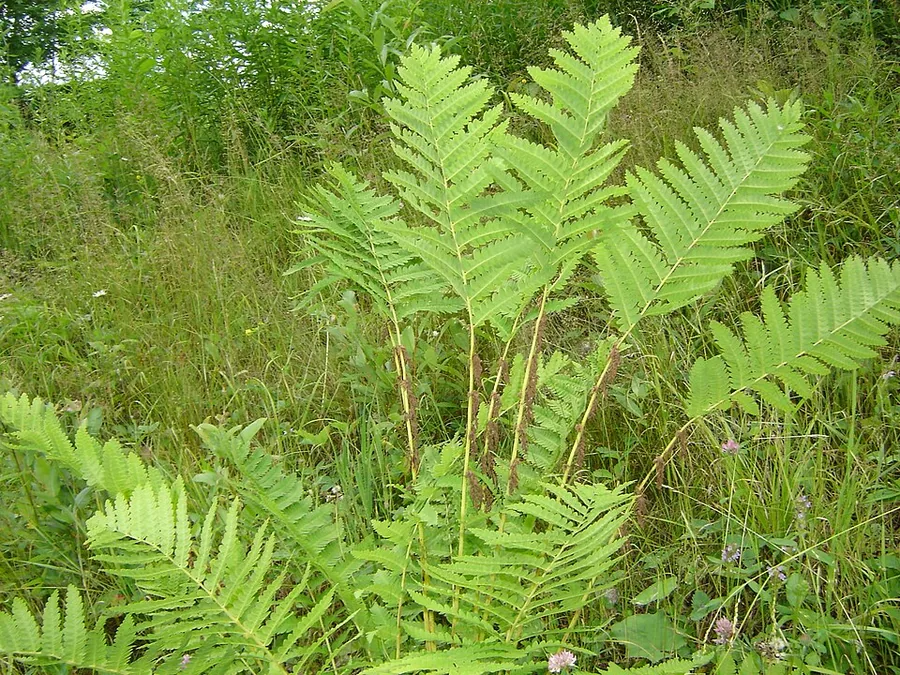
The interrupted fern belongs to the Osmundaceae, an ancient fern family, and it grows with little intervention in shade where the soil stays damp. Its common name records a distinctive habit: a few pairs of brown, spore-bearing pinnae occupy the middle of an otherwise sterile green frond, so the blade appears interrupted at its center. Those fertile pinnae emerge in mid to late spring and wither by summer once they have released their spores, after which the sterile green blade persists.
As a native of cool, moist temperate woodland, it carries exceptional cold tolerance, surviving to -40°F (-40°C) where few perennials endure. It also resists the deer and rabbit browsing that degrades less defended plants. Under steady moisture it develops a broad, vase-shaped clump on slow-creeping rhizomes, gaining size year on year.
Value it for architectural texture and durability rather than bloom, since ferns do not flower. Its nearest analogues are the cinnamon fern and the royal fern, yet the central band of brown fertile pinnae distinguishes this species from both at a glance.
Care
The short version: site it in part to full shade, hold the soil evenly moist and mildly acidic, and top-dress with compost each spring. Once established it needs little beyond supplemental water in dry weather.
Light
Partial shade is optimal, though the species is notably plastic and performs across full shade to full sun. The constraint under sun is moisture, since it only tolerates bright, open exposure where the soil remains constantly wet to offset the higher transpiration.
Water
Hold the soil consistently moist and never allow it to dry, increasing frequency through dry spells, because the root system is adapted to continuous water. As a wetland fern it even withstands saturated ground and brief standing water that would asphyxiate the roots of most plants.
Soil
It performs best in moist, humus-rich, acidic ground within a pH band of 4.5 to 6.5. Texture is secondary, so it adapts to clay, loam, or sand provided the moisture supply holds.
Temperature
Its cold tolerance is exceptional among garden plants. It operates across a range from -40°F to 86°F (-40°C to 30°C), surviving severe northern winters and resuming growth each spring from the persistent rhizome.
Humidity
Consistent with its woodland origin it favors humid air, ideally 50% to 80%. In the garden, sustained soil moisture and a shaded, sheltered position supply most of that requirement without misting.
Feeding
Nutrient demand is low. A single spring top-dressing of compost or leaf mold suffices, releasing nutrients slowly as forest leaf litter would in its native habitat.
Pruning
No routine pruning is warranted. Simply remove dead or tattered fronds in late winter or early spring before new growth emerges, which keeps the crown clear as the fiddleheads rise.
Repotting
It is not a container subject, so management centers on division rather than repotting. Lift and divide established garden clumps every 3 to 5 years, an operation that also renews a crown beginning to void at its center.
Size & spacing
A mature clump attains 2 to 5 feet (61 to 152 cm) in height and 2 to 4 feet (61 to 122 cm) in spread. Allow each plant its full spread so the arching fronds develop without competition at the crown.
When to plant
Establish this fern in spring, after the soil thaws and begins to warm, which is when its rhizomes resume active growth. New fronds unfurl as the season opens, the brown fertile pinnae differentiate in the middle of each blade by mid to late spring, and they wither by midsummer while the sterile green tissue continues into fall.
Northern hemisphere
Southern hemisphere
Typical months for a temperate climate: start earlier in warm zones, later where spring frosts linger.
- Plant: spring
- Harvest: Non-flowering; fertile pinnae appear in the middle of the frond in mid-to-late spring and typically wither by midsummer
Hardiness
USDA hardiness zones: 3–8
Temperature: down to -40°C
Troubleshooting
The interrupted fern presents few disorders, and the record ties nearly all of them to moisture deficit or excessive sun. Read the fronds and the crown for the early indications below, then correct the underlying cause rather than treating the visible symptom.
Fronds browning and crisping along the margins
Insufficient soil moisture drives this response, and strong sun without matching water accelerates the desiccation because the fronds transpire faster than dry roots can replace the loss. Water deeply to hold the root zone damp, since this species keeps its roots wet in the wild, and apply a mulch of leaf mold or compost to slow evaporation. Where a plant sits in full midday sun, relocating it to shade cuts the transpiration load that the roots cannot meet.
Fix:
- Water deeply to keep the soil consistently moist
- Mulch with leaf mold or compost to retain moisture
- Relocate to a shadier site if planted in full sun
Crown center voiding as the outer margin advances
This pattern reflects the natural aging of the rhizome crown rather than any pathogen, since the plant spreads outward on horizontal rhizomes and the oldest central tissue eventually exhausts itself. Lift the clump in early spring, divide it, and replant the vigorous outer sections while discarding the spent core. Dividing on a regular cycle renews the crown before decline sets in and holds the planting productive.
Fix:
- Divide the clump in early spring and replant the healthy outer sections
Toxicity
For pet-owning gardeners the assessment is favorable: this true fern carries no documented toxin, so it may be sited where cats, dogs, and other animals have access. It is not a food plant, but an exploratory nibble poses no hazard, and the species is on record for withstanding rabbit and deer browsing.
Safe for
People · Cats · Dogs · Horses · Rabbits · Livestock · Birds
Cats None
A cat can coexist with it safely, as the record documents no toxin in this true fern. Bear in mind that any plant taken in bulk may provoke transient gastric upset regardless of toxicity.
Dogs None
No documented toxin puts a dog at risk here, so chewing or contact with a frond causes no injury. At most, a large volume ingested might yield brief, self-limiting digestive upset.
Horses None
This true fern presents no poisoning hazard to horses on the record. In practice grazing animals bypass it, which limits exposure regardless.
Rabbits None
Rabbits face no toxic risk from it, and the species is documented for rabbit resistance. That resistance means it withstands browsing pressure rather than harming the animal.
Livestock None
Cattle, goats, and sheep incur no toxic hazard from it. Stock characteristically avoid it, and an incidental mouthful carries no consequence.
Birds None
The fronds hold no compound hazardous to birds, so poultry and wild species may forage around it without risk.
People None
Handling carries no irritant exposure, since the record notes no dermal or ingestion toxicity. It is not a food crop, so wash hands after soil work as standard garden hygiene rather than any specific precaution.
No documented toxicity. Handle normally and wash hands after working with soil.
Varieties
The named infraspecific selection for this fern is minimal. The single form worth recording is the wild type itself.
Osmunda claytoniana var. vera
This represents the typical wild form of the interrupted fern, an infraspecific taxon that Wherry described and that Kew's Plants of the World Online continues to accept.
How to propagate
Propagate the interrupted fern by dividing an established clump rather than by seed, since the plant reproduces through spores and produces no seed.
DivisionModerate
Early spring · 1-2 years
Division of an established clump in early spring is the dependable method. Lift the rhizome crown, separate it, and replant the divisions, allowing for the species' slow lateral spread by horizontal rhizomes and a 1 to 2 years establishment period before a division rebuilds mass. Spore culture from the fertile pinnae is possible but proceeds slowly and demands exacting conditions, which makes it the less practical route.
Myths
The interrupted fern produces flowers and seeds.
It neither flowers nor sets seed, since as a fern it reproduces by spores. Those spores form on a band of brown fertile pinnae inserted into the middle of an otherwise green, sterile frond.
Interrupted fern, cinnamon fern, and royal fern are a single species.
They constitute three distinct species within the family Osmundaceae. The reliable diagnostic for the interrupted fern is the brown fertile pinnae interrupting the middle of each frond, with green sterile leaflets above and below.