Ornamental · Osmundaceae
Royal Fern
Osmunda regalis
Rooted in constant moisture and acidic ground, this ancient fern raises fronds that can top most gardeners.
Partial shade
Every 2–4 days
USDA 3–9
2–6 ft · 0.6–1.8 m
Overview
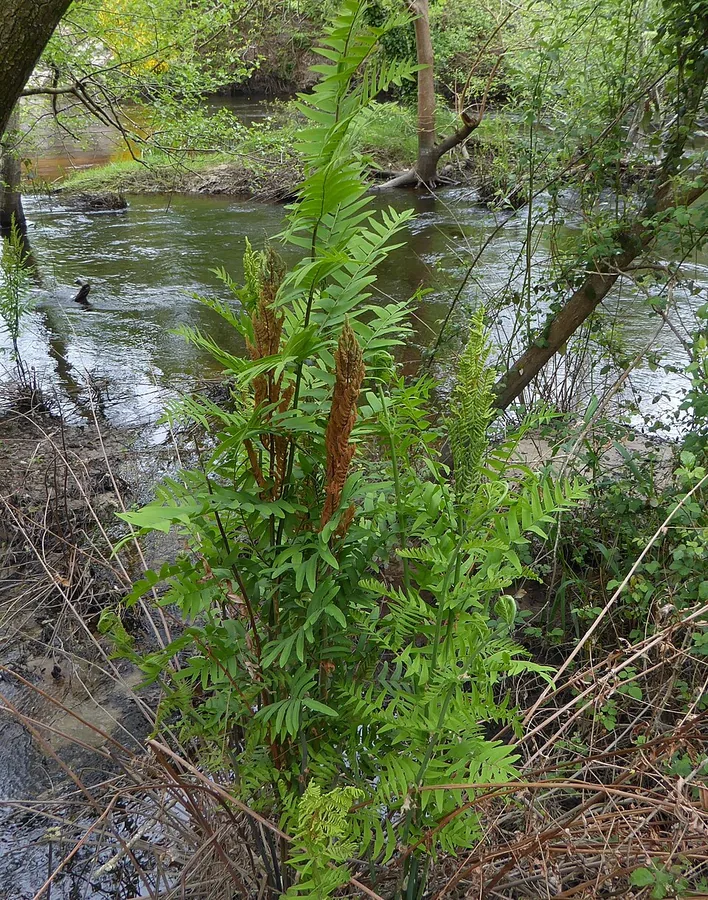
Osmunda regalis stands among the largest hardy ferns in cultivation, its arching fronds reaching 6 feet (180 cm) where moisture and shade allow. It belongs to the Osmundaceae, one of the oldest surviving fern lineages, and builds a dense, shrub-scaled clump that accounts for the royal epithet. The common name flowering fern is a misnomer: the fertile frond tips turn rusty brown as their sporangia ripen, but the plant is spore-bearing and does not bloom.
The single governing factor in its culture is root-zone moisture. In the wild it colonizes pond margins, bogs, and other ground that holds water, and in the garden it performs best where the soil stays moist to wet through the season, tolerating even shallow standing water. Pair that with acidic, humus-rich soil and partial shade, and its requirements are largely met.
Its hardiness is considerable: the crown withstands cold to -31°F (-35°C), which places it comfortably in northern gardens. Being deciduous, it sheds its fronds in autumn and overwinters as a woody crown, then flushes new fiddleheads once soil temperatures rise, so its cycle tracks the growing season closely.
Care
The short version: partial shade with permanently moist, acidic, humus-rich soil suits Osmunda regalis best. Hold the root zone consistently moist to wet, apply a light spring feed, and disturb it as little as possible once established.
Light
Partial shade, the dappled light beneath open canopy, matches its woodland origins. It will occupy full shade or full sun, but full sun is safe only where soil stays wet, because high light raises transpiration demand that dry roots cannot meet, and the fronds scorch.
Water
Moisture at the roots is the decisive requirement. Hold the soil consistently moist to wet and never dry, watering every 2 to 4 days and more frequently under heat or sun that accelerates loss. Its natural habitat of pond margins and bogs explains its tolerance of shallow standing water.
Soil
It prefers to avoid lime, thriving in moist, humus-rich, acidic ground at a pH of 4.5 to 6.5. Texture is secondary: clay, loam, or sand all serve provided they hold moisture, and incorporated leaf mold or compost supplies the organic content and acidity it favors.
Temperature
Its thermal range runs from -31°F to 86°F (-35°C to 30°C), an unusually wide band for a fern. The cold end underlies its success in far-northern gardens, and its deciduous strategy of dying back to the crown is how it passes the dormant season without damage.
Humidity
As a moisture-loving fern it prefers ambient humidity around 50% to 80%. Sites near water hold this reliably in still, sheltered air, which is why pond and stream margins suit it so well.
Feeding
It is a light feeder, and heavy fertilizer offers no benefit. A spring topdressing of compost or leaf mold meets its modest demand while maintaining organic matter, or a single balanced slow-release application as growth resumes will serve.
Pruning
Pruning is remedial rather than routine. Remove faded, browned, or frost-killed fronds in late autumn or early spring ahead of the emerging fiddleheads, and leave the plant otherwise untouched.
Repotting
Because it resents root disturbance, a containerized plant should be repotted only every 3 to 4 years. The reliable indicators are roots escaping the drainage holes, the woody crown rising above the soil line, and a decline in frond size and vigor.
Size & spacing
Allow for a substantial specimen: a mature clump attains 2 to 6 feet (60 to 180 cm) in height and 2 to 3 feet (60 to 90 cm) in spread. Space plantings on that basis so each crown can develop its full arching form.
When to plant
Its calendar follows the temperate season. Establish new plants in spring or early autumn, when cool, damp soil favors rooting, expect the fiddleheads to expand as temperatures climb, and look for fertile spore-bearing tips from late spring into summer.
Northern hemisphere
Southern hemisphere
Typical months for a temperate climate: start earlier in warm zones, later where spring frosts linger.
- Plant: Spring or early autumn
- Harvest: Non-flowering; spore-bearing fertile frond tips develop late spring to summer
Hardiness
USDA hardiness zones: 3–9
Temperature: down to -40°C
Troubleshooting
Most disorders in royal fern reduce to a single cause: a root zone that has dried below the plant's tolerance. Brown tips, premature yellowing, and weak growth each trace back to moisture, so assess the soil before drawing other conclusions. Identify the pattern below and correct it while the crown remains sound.
Frond Margins And Tips Browning And Turning Crispy
Crisp, brown margins signal drought stress, the disorder this species tolerates least. Because it requires soil that stays moist to wet, a dry root zone, excess sun, or desiccating wind burns the tips quickly. Correct it by watering deeply, mulching to hold moisture, and relocating container specimens to part shade.
Fix:
- Water deeply and keep soil consistently moist to wet
- Apply organic mulch to conserve moisture
- Move container plants to part shade or provide afternoon shade
- Trim badly damaged fronds at the base
Fronds Yellowing And Dying Back Prematurely In Summer
Under drought this deciduous fern can enter early dormancy, shutting down for the season ahead of schedule. The response looks severe, but the woody crown generally survives and refoliates the following spring. Reinstate deep, regular watering and cut away the collapsed fronds.
Fix:
- Resume deep, consistent watering to keep soil wet
- Cut back collapsed fronds; the crown usually re-flushes the following spring
Pale Or Yellow Fronds With Poor Vigor
Thin, chlorotic growth typically indicates soil that is too alkaline or too low in organic matter for an acid-preferring fern, with erratic moisture compounding it. Amend with fibrous, acidic material such as leaf mold or composted bark, and maintain even moisture to restore color and vigor.
Fix:
- Incorporate fibrous, acidic organic matter such as leaf mold or composted bark
- Maintain even moisture
Toxicity
For a household with pets or children, the assessment is favorable: as a true fern, royal fern is not regarded as toxic. Ingesting a frond may provoke brief gastrointestinal upset from plant matter alone, not from any poison. The chief practical concern is contact, since spores and fine frond hairs can irritate sensitive skin, so hands are best washed after prolonged handling.
Safe for
People · Cats · Dogs · Horses · Rabbits · Livestock · Birds
Cats None
As a true fern, royal fern presents no toxic risk to cats. Ingestion may at most produce transient salivation or mild gastric upset from the plant material itself.
Dogs None
The species contains no compounds hazardous to dogs. A chewed frond is likely to cause only brief, self-limiting digestive upset.
Horses None
Horses may graze in its vicinity without toxic risk, as the fronds hold no poison. Bulk ingestion of foliage can loosen the gut transiently, a mechanical rather than toxic effect.
Rabbits None
Rabbits can browse royal fern without harm. As with any novel forage, introduce it gradually so the digestive tract adapts.
Livestock None
Cattle, goats, and sheep are not poisoned by this fern, making it suitable for the wet margins of grazing land.
Birds None
The fronds and spores pose no toxic threat to garden or aviary birds, which have nothing harmful to ingest.
People None
No part of the plant is poisonous to people, including children. The young fiddleheads of some ferns are eaten after cooking, though spores and fine frond hairs can act as a minor contact irritant in sensitive individuals.
Royal fern is not known to be toxic, but as with any non-food plant, chewing fronds may cause mild, transient gastrointestinal upset, and spores or frond hairs can be a minor contact irritant.
Varieties
The species predominates in gardens, yet several named selections merit attention for distinct coloring or frond form. The following are the forms most often offered.
'Purpurascens'
Its emerging fronds and stipes are a pronounced purple-bronze that contrasts markedly with the mature green foliage.
'Cristata'
Its frond and pinna tips are crested and forked, producing a tasselled, frilled outline across the plant.
var. spectabilis
This is the North American royal fern, at times segregated as a distinct species, Osmunda spectabilis.
'Gracilis'
A more slender, compact selection whose emerging growth carries a reddish tint.
How to propagate
Royal fern increases by two routes, division of the established crown and sowing of its spores, the former the more dependable given how briefly the spores remain viable.
DivisionModerate
Early spring or autumn · 1 to 2 growing seasons
Division of the woody crown in early spring or autumn is the dependable method, each division retaining its own roots and active growing points. Since the plant resents disturbance, divide only occasionally, and allow a division 1 to 2 growing seasons to re-establish and gain bulk. Spore culture is the alternative: sow the short-lived green spores onto moist, sterile peat immediately at ripening, hold them humid and shaded, and expect several months before prothalli and then sporelings develop.
Myths
The name flowering fern indicates that royal fern produces flowers.
The species does not flower under any circumstances. What resemble flower clusters at the frond tips are aggregations of sporangia, and reproduction proceeds by spores rather than flowers or seed.
Ferns are propagated from seed.
Ferns produce no seed. Royal fern arises from the spores released by its fertile frond tips, or vegetatively by division of the crown.