Shrub · Lamiaceae
Bluebeard
Caryopteris × clandonensis
Renew bluebeard with a hard spring cut and it repays the work with a haze of blue flowers as the season turns.
Full sun
Every 7–14 days
USDA 5–9
24–35 in · 60–90 cm
Overview
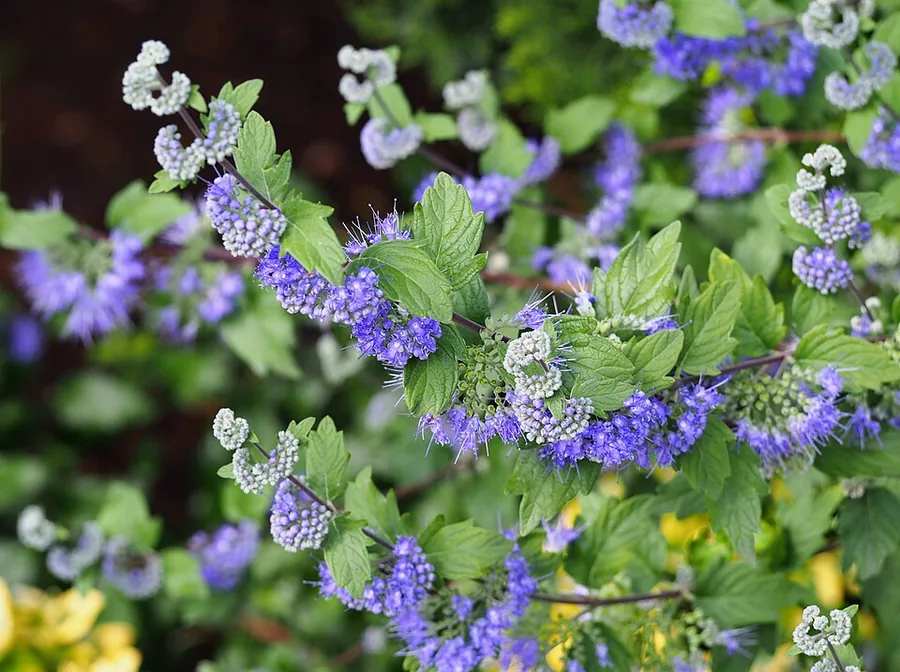
Bluebeard is a small deciduous shrub in the mint family, grown chiefly for the cloud of blue flowers it produces in late summer. Mature plants hold a compact frame of 2 to 3 feet (60 to 90 cm) in height with a comparable spread, a scale that suits a border or a confined sunny site. The gray-green foliage is aromatic, releasing a clean scent when the leaves are bruised.
Its horticultural value rests largely on bloom timing. Flowering runs from July into September, after most shrubs have finished, supplying nectar to bees and butterflies during a period when other sources decline. Because it flowers on new wood, the plant regenerates each season from a hard spring cut, which is the basis of its renewal pruning.
Cultural needs are modest once the shrub establishes. It performs in full sun with lean, fast-draining soil and tolerates heat and drought well. Its principal limitation is poor drainage, since saturated soil at the crown is the most common cause of loss.
Care
The short version: full sun, lean and well-drained soil, a deep drink only when the top of the soil dries, and a hard cut back to 6 to 12 inches every late winter or early spring.
Light
Site bluebeard in full sun, ideally 6 or more hours daily. It tolerates light partial shade, but inadequate light is the principal cause of weak, lax stems and sparse flowering, since the plant needs strong sun to set bloom.
Water
Established plants behave as a drought-tolerant shrub. Water deeply but only after the top half of the soil has dried, on the order of every 7 to 14 days, and never allow standing water, which drives the crown and root rot that the species is prone to.
Soil
Grow it in average, loose, well-drained soil, loamy or sandy. Excess fertility is counterproductive, and waterlogging at the roots is the one condition it cannot survive, so drainage outranks fertility in importance.
Temperature
Bluebeard is hardy over a wide band, from roughly -20°F to 100°F (-29°C to 38°C). Toward the cold extreme it behaves as a herbaceous perennial, dying back to the ground in winter and resprouting in spring, a habit consistent with its flowering on new wood.
Humidity
Ambient outdoor humidity meets its needs, so no monitoring is warranted. Air movement and a dry root zone matter far more to the plant's health than atmospheric moisture.
Feeding
Fertilize sparingly. A single balanced application or compost in spring suffices, because excess nitrogen promotes soft, lax stems that lodge and flower poorly.
Pruning
Pruning is the key cultural operation. Cut the entire plant back hard to 6 to 12 inches (15 to 30 cm) in late winter or early spring before growth resumes, since all flowering develops on the new wood produced afterward.
Repotting
As a landscape shrub it rarely needs repotting. For a container specimen, pot up only when roots circle the rootball or water passes straight through, both indications the root volume is exhausted.
Size & spacing
Plants develop a rounded mound of 2 to 3 feet (60 to 90 cm) in height and roughly equal width. Space each at about that interval to maintain air circulation and allow the form to fill in.
When to plant
Bluebeard follows a straightforward annual cycle. Set new plants out in spring once frost has passed, cut established shrubs back hard before they break dormancy, and flowering follows from midsummer into early fall.
Northern hemisphere
Southern hemisphere
Typical months for a temperate climate: start earlier in warm zones, later where spring frosts linger.
- Plant: spring after last frost
- Harvest: late summer to early fall (July-September)
Hardiness
USDA hardiness zones: 5–9
Temperature: down to -29°C
Troubleshooting
Bluebeard presents few problems, and nearly all of them trace to excess soil moisture or inadequate light. The early indications below usually resolve with attention to drainage, exposure, or pruning timing.
Wilt and basal blackening on a plant in saturated soil
Collapse and blackened lower stems on a well-watered plant point to crown and root rot, the disorder that develops when roots remain in airless, waterlogged ground and the fine feeder roots die. Confirm it by lifting the crown to find dark, soft tissue and soil that stays saturated long after irrigation. Discard plants too far gone to recover, amend the bed with grit or relocate the shrub to a raised, free draining position, and reduce watering so the root zone can breathe.
Fix:
- Remove and discard severely affected plants
- Improve drainage by amending soil with grit or replanting in a raised, well-drained site
- Reduce watering frequency
Sparse flowering on weak, lax stems
Lax stems and scant bloom signal insufficient light, a skipped spring prune, or excess fertility, each of which works against flower production. Because bluebeard sets its flowers only on the current season's wood, full sun and a hard cut in late winter or early spring force the vigorous new growth that carries bloom. Lean soil completes the correction, since surplus nitrogen pushes soft vegetative stems at the expense of flowers.
Fix:
- Site in full sun (6+ hours)
- Cut back hard in late winter or early spring to force vigorous flowering new growth
- Avoid overfeeding and overly rich soil
Toxicity
For households with animals, bluebeard is reassuring. The ASPCA lists it as non-toxic to pets, and no record documents harm to livestock, birds, or people. It can be sited wherever curious animals have access.
Safe for
People · Cats · Dogs · Horses · Rabbits · Livestock · Birds
Cats None
Cats face no toxic risk from this shrub, so an exploratory nibble carries no poisoning hazard. The only likely effect from a large volume of any plant material is transient stomach upset lasting about a day.
Dogs None
Dogs encounter no toxin in bluebeard. A chewed stem may at most produce brief loose stool from the bulk of plant matter, which resolves without treatment.
Horses Safe
Bluebeard is safe to establish in pasture margins where horses graze, as it contains nothing documented to harm them.
Rabbits Safe
Rabbits incur no risk from the shrub, and the aromatic foliage tends to deter browsing in any case.
Livestock Safe
Cattle, goats, and sheep are not endangered by this plant, and its pungent leaves seldom attract a grazing animal.
Birds Safe
Birds are at no risk near bluebeard. Its late summer flowers draw bees and butterflies, giving the shrub real value as a pollinator resource in the garden.
People Safe
No part of the plant is toxic to people. It is not cultivated as an edible, so there is no reason to consume it, but incidental contact with a leaf poses no harm.
No special handling required; as with any plant, ingestion of large amounts may cause mild gastrointestinal upset.
Varieties
A small set of named cultivars accounts for most nursery stock, separated chiefly by flower color, foliage color, and mature size. The following are the selections worth knowing.
Dark Knight
A compact selection forming a 2 to 3 foot mound with deep blue to bluish-purple flowers.
Longwood Blue
An upright cultivar reaching about 4 feet, pairing violet-blue flowers with silvery gray-green foliage.
Worcester Gold
Distinguished by golden-yellow foliage that contrasts with its light lavender-blue flowers in a two-tone display.
Blue Mist
A selection named for the soft powder-blue color of its flowers.
How to propagate
Bluebeard propagates readily, and the method depends on whether a true-to-type clone or some variation is acceptable.
Stem cuttingsEasy
Late spring to summer · Several weeks to root
Vegetative propagation by softwood or semi-hardwood cuttings, taken in late spring or summer, is the most reliable method and yields a true clone of the parent. Insert a prepared healthy shoot into a moist rooting medium, and adventitious roots form over the next several weeks.
SeedModerate
Spring · Weeks to germinate
Seed sown in spring germinates over a few weeks, but named cultivars will not come true from it because the hybrid does not breed reliably. Given the variable seedlings, cuttings remain the standard choice when a specific cultivar is required.
Myths
A hard spring pruning removes the season's flowers from bluebeard.
Bluebeard flowers exclusively on wood produced in the current season, so removing last year's growth in spring sacrifices no flower buds. The hard cut instead stimulates the vigorous new shoots that bear the bloom, which is precisely why annual renewal pruning is the standard recommendation.