Houseplant · Lamiaceae
Coleus
Coleus scutellarioides
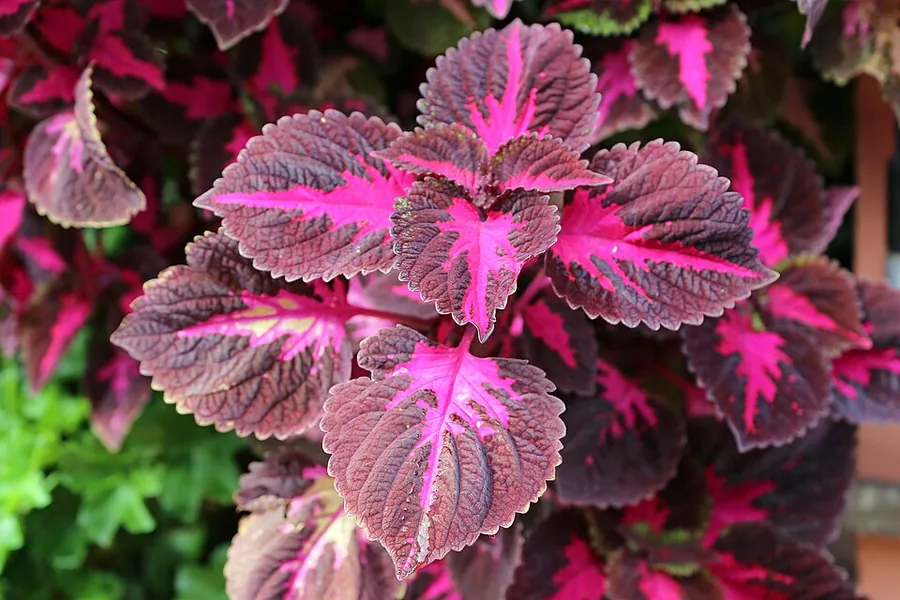
Grown for its bold, painted leaves, coleus delivers color to a shaded corner or a sunny bed with minimal demands on the grower.
Bright indirect
USDA 10–11
0–3 ft · 0.2–0.9 m
Overview
Coleus is a foliage plant, and the leaves carry the show, marked in greens, reds, purples, and gold in patterns no bloom rivals. It sits in the mint family, Lamiaceae, with origins in tropical Southeast Asia and northern Australia. That tropical heritage explains its narrow hardiness, since it persists outdoors only in the warmest zones, yet performs reliably as a houseplant or container subject almost anywhere.
Growth is fast and forgiving, which accounts for its standing with beginners. Pinching the apical tips removes apical dominance and triggers lateral branching, so the plant builds density instead of stretching tall and bare. Cultivar lineage governs light tolerance: older selections prefer shade and bleach under intense sun, while newer ones such as Wasabi and Pineapple retain pigment in full sun, so siting follows directly from the cultivar you hold.
Botanically a tender perennial, coleus is handled as an annual in most climates because the first frost terminates it. The practical workaround rests on how readily its stems form adventitious roots, which lets a grower overwinter a plant on a windowsill and return it outdoors in spring. Flowering diverts energy to seed set and reduces vigor, so the single recurring task is removing the bloom spikes to keep resources directed to the foliage.
Care
The short version: identify the cultivar's light class first, then supply bright indirect light indoors or the matching sun-shade balance outside, hold the soil lightly moist without letting it dry out or remain saturated, and pinch the tips routinely to drive the branching that produces a full, dense plant.
Light
Indoors coleus performs best in bright indirect light, while the correct outdoor exposure follows the cultivar's class. Shade-preferring types take part shade to full shade and bleach under intense sun, whereas sun-tolerant selections retain their pigment in full sun. Insufficient light reduces internode strength in every type, which is why low light produces leggy, washed-out growth.
Water
Hold the soil lightly moist at all times and never let it dry through, but stop short of saturation. Water once the top inch reads dry, and account for containers, which lose moisture faster and therefore need watering more often. Overwatering displaces soil oxygen, stunting growth and damaging the foliage, so always let excess drain.
Soil
Use a moist, rich, loose medium that drains freely and is amended with ample organic matter. The organic fraction holds the steady moisture coleus requires while the loose structure preserves drainage, and that balance keeps the root zone from staying wet long enough to rot.
Temperature
As a warm-climate tropical, coleus requires temperatures above 50°F (10°C) and carries no frost tolerance. The first frost destroys cellular tissue and kills the plant outright, so move containers indoors well before the season turns.
Humidity
Average household humidity is adequate, so there is no target figure to maintain. Air circulation is the more consequential factor, because stagnant, humid air around crowded plants creates the leaf-surface conditions that favor downy mildew and similar foliar problems.
Feeding
Fertilize across the active season, spring into summer, with a balanced bedding-plant fertilizer. A foliage-oriented formula such as 24-8-16 outperforms a high-phosphorus bloom product, since excess phosphorus promotes flowering and the elongated, leggy habit that follows.
Pruning
Pinch the stem tips frequently to release lateral buds and maintain a bushy, compact form. Remove the flower spikes as soon as they emerge in late summer, because seed set draws resources away from the leaves and pushes the plant toward decline.
Repotting
Repot as required under houseplant or container culture, and pot up rooted cuttings as they establish. Roots circling or escaping the drainage holes, water running straight through, and a measurable slowing of growth all indicate the plant has outgrown its container and needs a larger pot.
Size & spacing
Coleus develops to 6 to 36 inches (15 to 91 cm) in height, with a comparable spread, the final dimensions set by cultivar and pinching frequency. Routine pinching constrains height and increases density, producing a fuller, more compact specimen than the plant reaches unpruned.
Troubleshooting
Nearly all coleus disorders resolve to two variables: light that does not match the cultivar, or soil moisture that swings too low or too high. Because the symptoms register first in the leaves and stems, reading them tells you the cause before it advances. Match your observation below, then correct the underlying variable while intervention still helps.
Abrupt collapse with blackened stems post-frost
Coleus is a frost-sensitive tropical, and the first frost kills it outright, blackening the stems as the tissue dies and collapsing the plant. Frosted tissue does not recover, so discard the affected plant. To preserve a cultivar, take stem cuttings or lift and pot it for indoor overwintering before frost, since it persists outdoors only in USDA zones 10 to 11.
Fix:
- Take stem cuttings or dig and pot favorite plants before frost to overwinter indoors
- Move containers indoors before cold weather
- Discard frost-killed plants
Stunted growth and rot from soggy soil
Coleus needs steady moisture, but saturated soil excludes oxygen from the root zone and brings on root and stem rot. The roots turn brown and mushy, the stem bases soften, and growth stalls as the impaired roots fail to function. Reduce irrigation, confirm that the container or bed drains freely, and hold the soil lightly moist rather than saturated.
Fix:
- Reduce watering and let excess drain away
- Ensure pots and beds have excellent drainage
- Avoid wetting foliage when watering
Angular necrotic blotches, defoliation, and stunting
Yellowing, angular brown blotches, leaf curling, and premature drop indicate downy mildew. Examine the underside of the leaves for white, purple, or gray fuzzy sporangia, which form on the lower surface only and may require a hand lens. The pathogen advances between 60°F and 80°F (16°C to 27°C) once humidity exceeds 85%, so bag and discard infected tissue, increase spacing for airflow, and water at the base to keep the foliage dry.
Fix:
- Remove and discard infected material in the trash, not compost
- Improve air circulation by spacing, thinning, and pruning
- Water at the base with drip irrigation rather than overhead, and keep foliage dry
Emerging flower spikes with declining vigor
Because coleus is cultivated for foliage, the slender spikes of small blue-violet flowers signal a problem rather than an asset. Once the plant flowers and sets seed in late summer, reproductive demand draws resources from the leaves and the foliar display deteriorates. Remove the spikes as they emerge and continue pinching to redirect that energy back into vegetative growth.
Fix:
- Pinch or cut off flower spikes as soon as they appear
- Continue pinching to redirect energy into foliage
Wilting, drooping leaves
Coleus loses turgor quickly as the soil dries, and a container specimen wilts soonest because its limited soil volume depletes fastest. Inspect the soil first, since a dry plant generally recovers turgor within hours of irrigation. A shade-class cultivar can also flag under excess afternoon sun, so relocate it to a position with relief from the heat if the soil is adequate.
Fix:
- Water thoroughly and keep soil lightly moist
- Increase watering frequency for containers
- Provide afternoon shade for non-sun-tolerant cultivars
Sticky honeydew, leaf distortion, visible insects
Indoor coleus attracts sap-feeding insects, chiefly soft white cottony mealybugs, colonies of aphids, and clouds of small whiteflies. In warm, dry interior air, spider mites add fine webbing and the stippling left by their feeding. Rinse the foliage, isolate the affected plant to limit spread, and apply insecticidal soap, repeating because indoor infestations rebound from surviving stages.
Fix:
- Treat with insecticidal soap
- Rinse plants and isolate affected specimens
- Repeat treatments as needed for indoor infestations
Elongated bare stems, color fading out
Elongated stems and faded color define legginess, which traces to a light level that does not match the cultivar or to a failure to pinch. A shade type bleaches under intense sun while a sun type elongates and pales in deep shade, both producing long internodes and bare lower stems. Correct the exposure to the cultivar's class, pinch the growing tips on a routine schedule to release lateral buds, and cut the elongated stems back hard to force dense regrowth.
Fix:
- Move to the light level recommended for the cultivar (bright indirect light indoors; correct sun/shade outdoors)
- Pinch growing tips regularly to force branching
- Cut back leggy stems to encourage dense regrowth
Foliage bleaching and scorching under intense sun
Most older coleus belong to the shade-preferring class, and direct, intense sun degrades leaf pigment and can induce wilting in these cultivars. The corrective measure is relocation to part shade or dappled light. Where a full-sun position is fixed, select a sun-tolerant cultivar such as Wasabi or Pineapple, which holds pigment under that exposure.
Fix:
- Move shade-type cultivars to part shade or dappled light
- Choose sun-tolerant cultivars (e.g., 'Wasabi', 'Pineapple') for full-sun sites
Toxicity
Coleus is mildly toxic to pets. The essential oils in the foliage act as the toxic principle and produce vomiting, diarrhea, and skin irritation in cats and dogs, and the ASPCA records the same toxicity in horses. People are essentially safe, though contact with the sap can irritate skin, so site it out of reach of animals and wash your hands after pruning.
Toxic to
Cats · Dogs · Horses · Rabbits · Livestock · Birds · People
Cats Mild
The essential oils in the leaves are mildly toxic to cats. Ingestion typically produces salivation and gastrointestinal upset with vomiting or diarrhea, and contact with the sap can cause oral or dermal irritation.
Dogs Mild
A dog that consumes the foliage generally vomits, passes loose stools, and shows reduced appetite for a day. The systemic reaction is mild, though the sap can also redden the skin and oral tissue.
Horses Mild
The ASPCA lists coleus as toxic to horses, where the same essential oils produce gastrointestinal upset and a dull, off-feed presentation. Exclude grazing animals from planted beds.
Rabbits Caution
The aromatic oils that affect cats and dogs make coleus unsuitable around rabbits, so keep it out of reach rather than risk gastrointestinal upset.
Livestock Caution
Cattle, goats, and sheep are poorly documented with respect to coleus, but the same irritant oils warrant caution, so fence it off from grazing animals.
Birds Caution
Data on birds is limited, and pet species can prove sensitive to plant oils, so treat coleus as unsuitable and keep it clear of cages and aviaries.
People Caution
Coleus is essentially safe for people, although the sap can irritate the skin. Repeated, frequent handling occasionally induces allergic dermatitis, so wear gloves and wash after pruning.
Wear gloves or wash hands after handling or pruning; repeated, frequent skin contact can cause allergic dermatitis
Helpline numbers

United States
ASPCA Animal Poison Control: (888) 426-4435 (fee applies)
Poison Control: (800) 222-1222



Canada
Poison Centres: 1-844-764-7669
Varieties
Coleus runs to hundreds of cultivars, but they resolve cleanly into two functional classes defined by light tolerance: shade-preferring types and the newer sun-tolerant selections. The following names recur most often in the trade.
'Wizard' series
A widely available seed-grown series of compact, shade-preferring coleus selected for fast, even fill.
'Kong' series
A shade-class series grown for its outsized leaves, which exceed those of most other coleus in scale.
'Wasabi'
A sun-tolerant selection with bright chartreuse-green foliage that retains its pigment under full sun.
'Pineapple'
A sun-tolerant selection from the Pineapple group, reliable in high-light positions.
'Alabama Sunset'
A sun-tolerant cultivar that withstands bright exposure without the bleaching seen in older shade types.
How to propagate
Coleus propagates with unusual ease, either by rooting a stem cutting in water or by sowing seed, and both routes reflect its rapid, undemanding growth.
Stem cuttingsEasy
Spring through summer · Roots in about 2 weeks (often in water)
Coleus forms adventitious roots so readily that a tip cutting placed in plain water strikes roots in about two weeks. Cuttings may be taken at any point from spring through summer. This is the most direct method for overwintering a chosen cultivar, since the parent plant will not survive frost outdoors.
SeedEasy
Spring · Germinates in 10-15 days at 70-75°F
Many of the named series are produced from seed. Sow in spring and hold the tray warm, near 70°F to 75°F (21°C to 24°C), and germination follows in 10 to 15 days. Cuttings reproduce a plant identically, whereas seed is the efficient route to a full tray in one sowing.
Myths
Coleus is grown for its flowers.
Coleus is a foliage plant whose value lies in its bold, multicolored leaves, not its bloom. The small blue-violet flowers are insignificant, and their formation marks the point at which the plant begins to coast and lose vigor. Removing the spikes holds the foliage at its peak.
Coleus is harmless to pets.
The ASPCA records coleus as toxic to cats, dogs, and horses, with the essential oils in the leaves as the toxic principle. An animal that ingests it may drool, vomit, and pass loose stools, and the sap can irritate skin. The reaction is mild, but exclusion from pets remains the correct precaution.
All coleus must be grown in shade.
The shade requirement applies to older cultivars, which prefer part shade and bleach under intense sun, and that is the origin of the generalization. Many newer selections, however, are bred to retain pigment in full sun. Light requirement is cultivar-specific, not uniform across the species.