Shrub · Clethraceae
Summersweet
Clethra alnifolia
Supply steady moisture and light shade, and summersweet returns fragrant spikes at a point in the season when most shrubs have finished.
Partial shade
Every 3–7 days
USDA 3–9
3–8 ft · 0.9–2.4 m
Overview
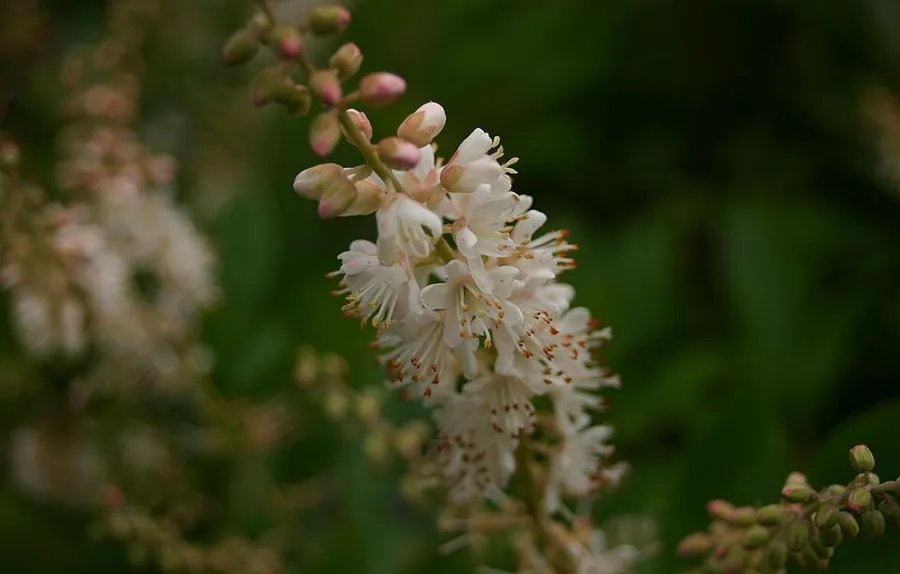
Summersweet is a native shrub whose value peaks in July and August, as bottlebrush spikes of fragrant white or pink flowers open while the surrounding garden declines. A member of the Clethraceae family, it occurs naturally along the eastern seaboard in damp woodland and on stream margins. That wetland origin governs its culture, because the plant is adapted to saturated ground rather than merely tolerant of it.
Its ease in cultivation follows from a broad hardiness range, zone 3 to zone 9, that lets it withstand severe winters while accepting clay, salt, and standing water lethal to most shrubs. The flowers supply nectar to bees and butterflies through summer, and the foliage develops a clean golden yellow before autumn leaf drop.
Meet its requirement for moist, acidic soil and the plant demands little further intervention. Its single real limitation is a hot, dry position, under which foliage bronzes and spider mites establish. Sited on damp ground with some afternoon shade, it extends by suckering into a fragrant, low-maintenance colony.
Care
The short version: partial shade to full sun, in moist to wet, acidic soil held from drying, with sustained watering through heat, dormant-season pruning in late winter, and a single spring feeding.
Light
Summersweet performs best in partial shade yet spans full sun to deeper shade. Direct light increases flower production, but because the species originates at woodland edges it continues to bloom under shade that suppresses most shrubs, which recommends it for a darker corner.
Water
Hold the soil evenly moist to wet and never allow it to dry, since the plant lacks drought adaptation. Irrigate every 3 to 7 days, and more frequently during establishment or a dry spell before roots reach available moisture. Its streamside origin means saturated ground serves it far better than water stress.
Soil
Grow it in moist to wet, acidic ground high in organic matter. A pH of 4.5 to 7.0 suits it, and unlike less adaptable shrubs it accepts heavy clay and poorly drained, low-lying positions where aeration is limited.
Temperature
Cold hardiness is not a constraint. The shrub withstands roughly -29°F to 100°F (-34°C to 38°C), a span that carries it through zone 3 winters and the heat of southern summers.
Humidity
Ambient outdoor humidity is sufficient, so no target value applies. Root-zone moisture is the operative factor, because dry air combined with dry soil is the condition under which spider mites establish.
Feeding
One spring application meets its nutrient demand. Use a balanced or acidifying fertilizer formulated for acid-loving plants, which helps maintain the low pH the roots require for nutrient uptake.
Pruning
Because flowering occurs on new wood, prune in late winter or early spring to shape the plant and limit its size without sacrificing bloom. Cut away the root suckers as well, unless a spreading colony is the objective.
Repotting
In open ground the root system rarely needs attention. In a container, repot only when roots circle the pot, emerge from the drainage holes, or water passes straight through without being absorbed, all indications the medium is exhausted.
Size & spacing
A mature specimen reaches 3 to 8 feet (91 to 244 cm) in height and 4 to 6 feet (122 to 183 cm) in spread. Allow for the full width at planting, and account for suckering that extends the clonal patch beyond the original crown.
When to plant
Establish summersweet in spring or fall, when moderate temperatures let the root system develop before the next period of heat or cold loads the plant. Flowering follows unaided in July and August, borne on shoots the plant produces within the same season.
Northern hemisphere
Southern hemisphere
Typical months for a temperate climate: start earlier in warm zones, later where spring frosts linger.
- Plant: Spring or fall
- Harvest: July to August
Hardiness
USDA hardiness zones: 3–9
Temperature: down to -40°C
Troubleshooting
Nearly every complaint against summersweet resolves to a single cause: a position that is too hot and too dry for a wetland species. Interpret the foliage early, since most symptoms reverse once soil moisture is corrected. Identify the pattern below, then intervene before the stress compounds.
Stippling and bronzing under fine webbing
The culprit is spider mites, which build up on foliage stressed by heat and drought because those conditions speed their reproduction and slow the plant's defenses. A forceful spray of water dislodges the colonies mechanically, and restoring even soil moisture removes the stress that drew them in. Where a heavier population persists, insecticidal soap or horticultural oil coats and smothers the remaining mites.
Fix:
- Spray foliage with a strong stream of water to dislodge mites
- Improve soil moisture and avoid hot, dry sites
- Apply insecticidal soap or horticultural oil to affected foliage if needed
Wilt and chlorosis on a droughted plant
The disorder is drought stress, a siting problem rather than a fault in your care. As a species adapted to wet ground, summersweet cannot draw enough water from a hot, dry root zone to hold turgor, so leaves wilt and yellow. Raising watering frequency restores that supply, mulch buffers soil temperature and evaporative loss, and relocating a chronically stressed shrub to a cooler, moister, partly shaded site addresses the root cause.
Fix:
- Increase watering frequency to keep soil evenly moist
- Mulch to conserve moisture and keep roots cool
- Relocate to a moister, partly shaded site if chronically stressed
Toxicity
For households with animals or young children, the assessment is favorable. Summersweet is absent from the ASPCA toxic-plant lists and is classed as non-toxic and pet-safe. The worst outcome from an incidental nibble is a brief, mild gastric upset, the same nonspecific response most garden plants provoke.
Safe for
People · Cats · Dogs · Horses · Rabbits · Livestock · Birds
Cats None
Clethra alnifolia carries no toxin of concern to cats and is absent from the ASPCA toxic list. Any leaf a cat samples may cause a brief, self-limiting gastric upset, which is the ordinary response to fibrous plant matter rather than a poisoning.
Dogs None
The shrub presents no documented toxin to dogs, so it can share their space without precaution. A dog that consumes a large volume of foliage at once may show transient drooling or a soft stool as the gut clears the excess.
Horses Safe
Summersweet holds no compounds known to harm horses. Incidental browsing of a few leaves has no toxicological consequence for them.
Rabbits Safe
Rabbits can forage beside the plant without exposure to any poison. The foliage contains nothing that would injure them if an occasional leaf is taken.
Livestock Safe
Cattle, goats, and sheep can graze in proximity to summersweet safely, since the tissue lacks the toxins that affect ruminant and equine stock. No withdrawal or fencing is warranted on toxicity grounds.
Birds Safe
The plant poses no hazard to garden or wild birds and, through its fragrant flower spikes, draws the bees and butterflies that make it a pollinator resource. Nothing in its tissues threatens avian visitors.
People Safe
Clethra alnifolia is non-toxic to people, though it is an ornamental rather than an edible. A leaf tasted out of curiosity, as a child might, would at most produce a mild gastric ache.
As with any plant, ingestion of large amounts of plant material may cause mild, transient stomach upset.
Varieties
Nurseries offer several named selections of summersweet, differentiated mainly by mature size and flower color. The following are the cultivars worth knowing.
Hummingbird
A compact dwarf selection that matures near 2 to 4 feet tall and carries an unusually dense set of white flower spikes.
Ruby Spice
Selected for deep pink flowers that retain their pigment through the full bloom period rather than fading.
Pink Spire
Opens from pink buds into pale pink, fragrant flower spikes.
Sixteen Candles
Carries upright white spikes held well clear of the foliage on a tidy, compact habit.
Companions
Summersweet pairs best with other natives that share its love of wet, acidic ground, the kind of partners that thrive in a rain garden or a damp, shaded border.
Plant near
Itea virginica (Virginia sweetspire): Shares the same moist, acidic soil and sun-to-part-shade conditions for wet-site and rain-garden plantings.
Ilex verticillata (winterberry): Native shrub that thrives in the same wet to moist soils and pairs well in naturalized and pollinator plantings.
How to propagate
Summersweet propagates readily, and the suckering habit that some gardeners regard as a nuisance is precisely what makes vegetative increase so straightforward.
DivisionEasy
Late winter to early spring · 1 to 2 growing seasons
The most reliable method exploits the plant's suckering habit: detach the already-rooted suckers at a colony's margin. Lifted in late winter or early spring and replanted, each develops into a full shrub across 1 to 2 growing seasons.
Stem cuttingsModerate
Early summer (softwood) · Several weeks to root, then 1 season to establish
Softwood cuttings taken in early summer root best under mist or a humidity cover, which limits water loss while the stem lacks roots. Rooting takes a few weeks, after which the young plant needs about a season to establish a working root system.
SeedModerate
Sow collected seed in fall or after cold stratification · 1 to 2 seasons
The fine seed is surface-sown in fall or after cold stratification because germination depends on both light and a chilling period to break dormancy. Reaching a usable plant takes 1 to 2 seasons, and seedlings of named cultivars will not reproduce the parent's traits.
Myths
Summersweet only blooms well in full sun.
It ranks among the few flowering shrubs that flower dependably under part shade, a trait tied to its woodland-edge origins. Fragrant, late-summer spikes still form in positions where most shrubs would bloom poorly.
Prune summersweet right after it flowers to get more blooms.
Because flower buds form on current-season wood, pruning belongs in late winter or early spring, before that growth develops. A cut at that stage removes none of the coming season's flowers, since the buds have not yet been set.