Shrub · Rosaceae
Raspberry
Rubus idaeus
Sited in full sun with rich, acidic loam and pruned by cane type, the raspberry fruits heavily year after year.
Full sun
Every 3–7 days
59–77°F · 15–25°C
USDA 3–8
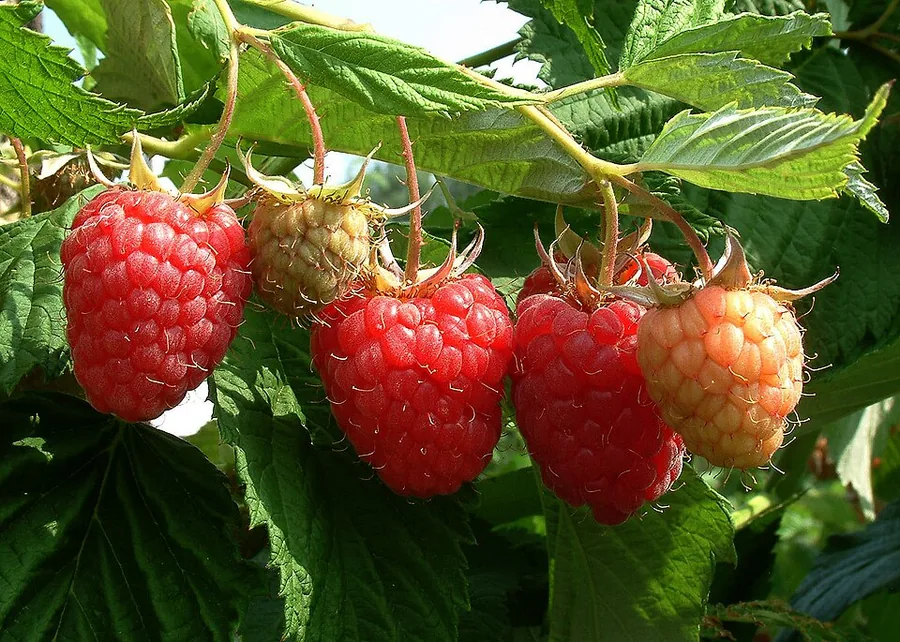
Overview
Rubus idaeus is a cane-forming shrub in the rose family, native to the temperate and boreal north, which explains its tolerance of severe cold. Its growth habit is a colony of erect canes, rated hardy from zone 3 through zone 8. Left to its own devices it extends by suckering, so the planting widens each season.
Cultivars fall into two fruiting classes, and the distinction drives every pruning decision. Summer-bearing (floricane) types crop once, early to midsummer, on canes in their second year. Everbearing (primocane) types set fruit on first-year canes in late summer and fall, so identifying your class tells you which canes to cut and when.
Cultural needs are modest: direct sun, consistent soil moisture, and free air movement through the row, the last of which suppresses fungal disease. Meet them and the planting yields heavily for years, though the vigorous suckering demands active containment. The canes bear sharp prickles, so protective gloves and sleeves are standard at harvest.
Care
The short version: full sun, deep well-drained loam amended with compost and held slightly acidic, and roughly an inch of irrigation weekly. Prune according to fruiting class each year, and contain the root system with a barrier or by removing suckers.
Light
Fruiting depends on light, so site raspberries in full sun with six or more hours of direct exposure daily. Partial shade is tolerated, but reduced light produces elongated, etiolated canes and a lighter crop.
Water
Supply about an inch of water per week, increasing during fruit development when demand peaks. Maintain even soil moisture without saturation, because waterlogged roots rot and saturated fruit softens.
Soil
Plant in deep, well-drained loam high in organic matter, held to a pH of 5.6 to 6.5. Raspberries require slightly acidic soil because iron availability falls as pH climbs, and the resulting deficiency yellows the new foliage.
Temperature
Optimal growth occurs in cool to mild conditions, 59°F to 77°F (15°C to 25°C). Cold tolerance extends to zone 3, but high summer heat imposes stress on the plants and can scorch developing fruit.
Humidity
Ambient humidity is not limiting; 40% to 70% is entirely adequate. Air circulation is the operative factor, since stagnant, moist air within a dense canopy creates the microclimate that Botrytis exploits.
Feeding
Apply a single feeding in early spring as growth resumes, using a balanced fertilizer such as 10-10-10 or a top-dressing of aged compost or manure. One seasonal application supplies the nutrients a full crop requires.
Pruning
Prune by fruiting class. On summer-bearing (floricane) plants, remove the spent floricanes after harvest and thin the emerging primocanes; on everbearing (primocane) plants, mow all canes to ground level in late winter to take a single fall crop.
Repotting
Raspberries are field-grown rather than potted, so repotting is seldom relevant. In the rare container culture, transplant when roots begin to circle the pot and the medium dries too quickly, both signs the plant has outgrown its volume.
Size & spacing
Mature canes stand 3 to 6 feet (90 to 180 cm) tall and form clumps 2 to 4 feet (60 to 120 cm) across. Allow adequate row spacing and provide a trellis to sustain airflow and keep the prickled canes off the harvester.
When to plant
Establish raspberries during dormancy, when the canes are inactive and soil temperatures are only beginning to rise. Plant in early spring, and the fruiting window then follows the type, running from early summer into fall.
Northern hemisphere
Southern hemisphere
Typical months for a temperate climate: start earlier in warm zones, later where spring frosts linger.
- Plant: Early spring while plants are still dormant
- Harvest: Summer-bearing types ripen early to midsummer; everbearing types crop late summer into fall
Hardiness
USDA hardiness zones: 3–8
Temperature: down to -40°C
Troubleshooting
Raspberry disorders concentrate on three organs: the fruit, the canes, and the newest foliage. Early identification matters, since a timely cut or a change in watering usually resolves the issue before it spreads. Match the symptom below and intervene before it advances along the row.
Softened berries with gray sporulation
The fungus behind soft, fuzzed fruit is gray mold (Botrytis cinerea), which proliferates where wet, humid air sits within a dense canopy. Harvest frequently and discard softened berries, because sporulation accelerates on stored fruit. Thin the canes to improve airflow and irrigate at the base to keep foliage and fruit dry.
Fix:
- Remove and discard infected berries promptly
- Harvest frequently and keep fruit dry
- Improve air circulation by thinning canes
Wilting canes with paired girdling rings
Two girdling rings encircling a cane below a wilted tip identify the raspberry cane borer, whereas dark, sunken lesions at the nodes indicate a cane disease such as spur blight. Excise the affected cane well below the injury and destroy it, and eliminate nearby wild brambles that serve as a reservoir. Annual removal of old and infected canes, combined with narrow rows, limits both problems.
Fix:
- Cut and destroy affected canes below the damage
- Remove all wild brambles nearby
- Maintain open, thinned plantings
Interveinal yellowing on the newest leaves
Chlorosis confined to new leaves with green veins is iron chlorosis, driven by soil pH above the ideal range. A soil test confirms the elevated pH, and chelated iron corrects the symptom while the underlying pH is adjusted. Incorporate organic matter, acidify toward a pH of 5.6 to 6.5, and reduce liming.
Fix:
- Test soil and acidify toward pH 5.6 to 6.5
- Apply chelated iron as a short-term correction
- Incorporate organic matter
Toxicity
From a toxicology standpoint the raspberry is unremarkable: no part carries a toxin harmful to animals or people. Fruit and foliage are safe to ingest, so a stray berry or chewed leaf presents no risk. The only hazard is mechanical, the sharp prickles on the canes, which can abrade or puncture skin.
Safe for
People · Cats · Dogs · Horses · Rabbits · Livestock · Birds
Cats None
No component of the raspberry is toxic to cats, so an ingested leaf or berry has no consequence. The only concern is the prickles, which may scratch an investigating nose.
Dogs None
Dogs may consume the ripe fruit without adverse effect, and the foliage and canes are equally safe. Attention should go to the sharp prickles, which are the actual hazard.
Horses None
A horse can graze both foliage and fruit safely, as the plant contains no toxin. Fencing off the thorny canes prevents a muzzle from being scratched.
Rabbits None
Rabbits ingest leaves and berries without harm, and many readily consume the foliage. The prickly stems are the only element requiring caution.
Livestock None
Cattle, goats, and sheep can browse raspberry safely, the plant being non-toxic. The prickles alone warrant monitoring.
Birds None
Birds consume ripe raspberries freely and disperse the seed widely. Nothing in the plant endangers them.
People None
Raspberries are eaten fresh and are entirely safe, foliage included. The single precaution is the prickles, so gloves are advisable when pruning or harvesting.
Most raspberry canes are armed with sharp prickles/thorns that can scratch or puncture skin; wear gloves and long sleeves when pruning or harvesting.
Varieties
Of the hundreds of named raspberries, a small group of cold-hardy reds dominates home cultivation. The cultivars below are the ones most worth knowing.
Heritage
An everbearing red that fruits on its first-season canes, giving a reliable autumn harvest.
Latham
A cold-hardy summer-bearing red heirloom long relied upon in northern gardens.
Boyne
A summer-bearing red of exceptional cold tolerance, productive in the coldest zones.
Caroline
A vigorous everbearing cultivar producing large, well-flavored fruit through fall.
Companions
Raspberries do best beside aromatic plants that push pests away, and worst near their nightshade neighbors, which trade soilborne wilt back and forth.
Plant near
Garlic: Aromatic alliums may help deter some pests around the planting.
Marigold: Often interplanted to discourage nematodes and some insect pests.
How to propagate
Raspberries propagate readily, and the appropriate technique follows the type: red forms throw suckers, while black and purple forms root from arching cane tips.
DivisionEasy
Early spring or fall while dormant · One growing season
Division of rooted suckers is the most efficient method. Lift suckers arising from the crown during dormancy in early spring or fall, replant the offsets, and they establish within one growing season.
LayeringModerate
Late summer · One season to root
Black and purple raspberries are propagated by tip layering. In late summer, bend an arching cane to the soil and bury the terminal tip; it roots in place over the season, producing a new plant that can be severed and transplanted.
Stem cuttingsModerate
Spring to early summer · Several weeks to root
Root cuttings and softwood cuttings both succeed when taken from spring into early summer, rooting in several weeks. In practice most growers rely on suckers, which yield new plants with considerably less effort.
Myths
Raspberries are poisonous to dogs and cats.
Toxicologically the plant is clear: fruit, foliage, and canes are all safe for cats and dogs, and the berries are a suitable treat. The prickles are the sole genuine hazard, capable of scratching a nose or paw.
All raspberry canes should be removed every winter.
That regime suits everbearing types, which fruit on first-year canes and can be cut to the ground. Summer-bearing types fruit on second-year canes, so a full winter cut eliminates the following season's crop.