Ornamental · Poaceae
Little Bluestem
Schizachyrium scoparium
Grown in full sun and lean, dry soil, this native grass holds its posture from summer through the depth of winter.
Full sun
Every 10–21 days
USDA 3–9
2–4 ft · 0.6–1.2 m
Overview
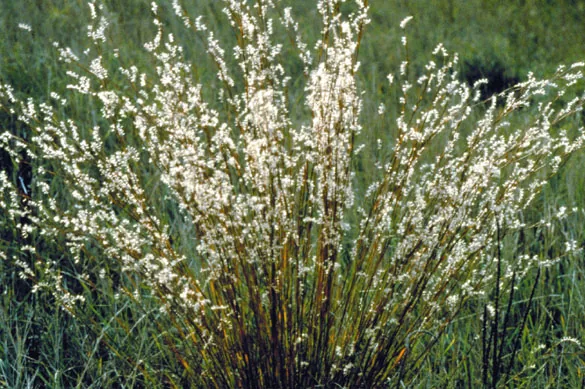
Little bluestem is a foundational grass of the North American prairie, a clump-forming warm-season native distributed from Canada well into the South. Its habit is a compact upright tuft, typically 2 to 4 feet (60 to 120 cm) tall, carrying fine blades that read blue-gray through the summer months. It is adapted to poor ground, which is why it performs where many ornamental grasses languish.
Its principal display is a late one. As night temperatures drop, the foliage shifts into copper, mahogany, and burgundy, and fluffy silvery seed heads intercept the low autumn light. Both the seed heads and the standing culms retain their form through winter, so the planting supplies forage for birds and vertical structure during the dormant season when little else contributes it.
Maintenance demands are minimal, but one condition is non-negotiable: keep the plant lean and fully exposed. Fertile soil, shade, or excess moisture all drive soft growth that ultimately splays open at the center. Grown hard, it holds its posture.
Care
The short version: full sun, lean and well-drained soil, and effectively no irrigation once established. Withhold fertilizer entirely, and cut the previous season's growth to the ground in late winter before the new shoots emerge.
Light
Site little bluestem in full sun; more exposure is consistently better. It accepts light shade, but beyond that the stems elongate and weaken as they reach for light, they lean over, and the autumn color diminishes along with them.
Water
Once established, this is a drought-tough grass that subsists on rainfall. Irrigate only to carry it through establishment, then withdraw the water, since plants in dry, lean ground stand appreciably straighter. Even in prolonged heat, roughly every 10 to 21 days is ample.
Soil
Infertility is the governing principle. Average, dry to medium, well-drained soil serves it well, and it performs equally in sandy, rocky, or clay ground. Wet or overly rich sites are the problem, because that is where the tissue softens and the clump flops. Any pH between 5.5 and 7.5 is suitable.
Temperature
Its cold and heat tolerance are exceptional among grasses. It withstands winter minima to -40°F (-40°C) and summer maxima beyond 109°F (43°C), which accounts for its distribution across most of the continent.
Humidity
Ambient humidity is immaterial to a prairie grass. What matters is good air movement through the clump, because moving air dries the foliage and denies the occasional rust infection the still, damp conditions it needs.
Feeding
Provide none. Fertilizer is the most direct way to compromise this plant, forcing the soft, lush growth that lodges and loses coloration. Lean soil is precisely the regime it is adapted to.
Pruning
A single annual cut is all it requires. Shear the previous season's growth to the ground in late winter or early spring before the new shoots break, and the clump regenerates from the crown unaided.
Repotting
Established clumps seldom require division. The indication is functional: when the center dies out or the clump opens and vigor declines, lift and split it in spring to restore it.
Size & spacing
Anticipate a clump 2 to 4 feet (60 to 120 cm) tall with a spread near 18 to 24 inches (46 to 61 cm). Space plants accordingly so each retains its upright form with air circulating between the clumps.
When to plant
Little bluestem is a warm-season grass, so its growth is keyed to soil warmth rather than the calendar and it starts slowly. Sow in early spring, transplant after the last frost, and expect the plant to color and set seed heads from late summer into winter.
Northern hemisphere
Southern hemisphere
Typical months for a temperate climate: start earlier in warm zones, later where spring frosts linger.
- Sow: Late winter to early spring, about 8-10 weeks before last frost
- Plant: Spring after last frost into early summer
- Harvest: August to February; reddish-brown flowers followed by fluffy silvery-white seed heads persisting through winter
Hardiness
USDA hardiness zones: 3–9
Temperature: down to -40°C
Troubleshooting
This grass presents few genuine disorders, and most that do arise trace to a site more generous than its biology wants. Interpret the early signs below and the correction is generally one of light, soil, and restraint rather than any chemical intervention.
Clumps lodge and splay by late season
Splayed, collapsing clumps are lodging, the predictable result of growth that outpaces the tissue strength holding it up. Shade lengthens the stems reaching for light, while rich soil and surplus water fuel that same soft, weak extension, so the culms buckle under their own weight. Return the plant to full sun, withhold fertilizer, and where the site stays inherently lush, favor a genetically stiff cultivar such as Standing Ovation or Blue Heaven.
Fix:
- Site in full sun
- Grow in lean, dry, well-drained soil with no added fertilizer
- Reduce supplemental watering once established
- Choose sturdy upright cultivars such as Standing Ovation or Blue Heaven
Volunteer seedlings recruiting nearby
As a vigorous native, this grass produces abundant viable seed, and self-seeding is simply that fertility expressing itself where conditions suit it. Where you want the planting held to its bounds, hand-pull volunteers while their root systems are shallow and easily lifted. Removing the seed heads before the caryopses ripen cuts off recruitment at its source.
Fix:
- Remove unwanted seedlings by hand
- Cut back seed heads before they mature if spread is unwanted
Rust pustules on the leaf blades
Powdery orange pustules that dislodge onto the fingers indicate rust, a foliar fungus that appears intermittently and remains almost entirely cosmetic. Because the pathogen thrives in still, moist air over the leaf surface, the corrective works on that microclimate: open the canopy for airflow and water at the base so blades dry quickly. Excise heavily infected blades to remove inoculum, and the clump typically outgrows the episode unaided.
Fix:
- Improve air circulation
- Avoid overhead watering
- Remove severely affected foliage
Toxicity
For households with animals, the assessment is straightforward: little bluestem is non-toxic to cats, dogs, horses, and the rest of the household. It is a native forage grass consumed by grazing livestock and heavily used by seed-eating birds, so it presents no toxic concern. The one qualification is that grass pollen can provoke symptoms in people with hay fever.
Safe for
People · Cats · Dogs · Horses · Rabbits · Livestock · Birds
Cats Safe
Poses no toxic risk to cats. A cat that ingests a quantity of blade may regurgitate the fibrous material, a mechanical response common to any grass rather than a sign of poisoning.
Dogs Safe
Contains no toxic principles that would harm a dog. A large mouthful of coarse blades can provoke transient vomiting through simple gut irritation, and nothing more serious follows.
Horses Safe
Grazed by horses without adverse effect. The species is a valued prairie forage grass, so it belongs in the pasture rather than on any hazard list.
Rabbits Safe
Presents no toxicity to rabbits, which browse the foliage freely.
Livestock Safe
Consumed by cattle, goats, and sheep on the open range. It has long functioned as native pasture and hay.
Birds Safe
Songbirds forage the persistent seed heads through winter and shelter within the standing clumps, an entirely benign relationship.
People Safe
Cultivation and handling carry no toxic hazard. The single caveat is that airborne grass pollen can provoke symptoms in individuals sensitized to it.
Pets that nibble grass blades may occasionally vomit or have mild stomach upset, as with any grass; grass pollen can affect allergy-sensitive people.
Varieties
Breeders have selected forms of little bluestem chiefly for sturdier posture and more intense coloration. The named cultivars below are the ones most commonly offered.
Standing Ovation
Retains a strictly upright habit even in richer soil, presenting blue blades tipped in red that resolve into a clean red-maroon in autumn without browning out.
Blue Heaven (MinnBlueA)
Developed at the University of Minnesota as a tall, narrow, upright clump whose blue-gray summer foliage transitions to burgundy-red suffused with pink and purple as temperatures fall.
The Blues
Selected for pronounced blue-tinted foliage and burgundy-red autumn color, though it tends to splay open in the later part of the season.
Twilight Zone
A patented selection valued for its distinctive silvery-mauve foliage overlaid with purple.
Carousel
A compact, smaller cultivar that condenses the same multicolor foliage into a more restrained clump.
Companions
Little bluestem looks most at home with other sun-loving prairie plants that share its taste for lean, dry, well-drained ground.
Plant near
Switchgrass (Panicum virgatum): Native warm-season prairie grass with the same lean, dry, full-sun requirements for naturalistic plantings
Purple coneflower (Echinacea purpurea): Drought-tolerant prairie perennial that pairs in full sun and well-drained soil
Black-eyed Susan (Rudbeckia): Sun-loving prairie companion thriving in the same dry, lean conditions
How to propagate
Propagate little bluestem from seed for economical mass plantings, or divide established clumps when the objective is to preserve a specific cultivar's coloration.
SeedEasy
Sow into a firm seedbed in early spring; can also start indoors 8-10 weeks before last frost · One to two growing seasons
Seed is the most economical route for broad coverage. Sow into a firm seedbed in early spring so seed-to-soil contact is sound, or start it indoors 8 to 10 weeks before your last frost, then rely on warming spring soil to break dormancy in this warm-season grass. Allow one to two growing seasons for full establishment, after which the planting will recruit its own seedlings.
DivisionEasy
Spring as new growth begins · One growing season
Division is the only reliable means of holding a named cultivar true, because those coloration traits do not come back dependably from seed. Lift and separate an established clump in spring as new growth resumes and root activity is high, so the divisions reestablish within a single growing season. The same operation rejuvenates an aged clump that has begun to die out through its center.
Myths
Little bluestem needs rich, watered, and fertilized soil to grow well.
The horticultural reality inverts that assumption. This is a prairie species adapted to lean, dry ground and full exposure, precisely the conditions under which it attains its greatest stature and richest coloration. Supplied instead with fertile soil, supplemental water, or fertilizer, it produces soft, weak tissue that ultimately splays open at the center.