Ornamental · Poaceae
Switchgrass
Panicum virgatum
Sited in full sun and lean soil, switchgrass holds a firm vertical form from summer well into winter.
Full sun
Every 7–14 days
60–90 days
USDA 3–9
Overview
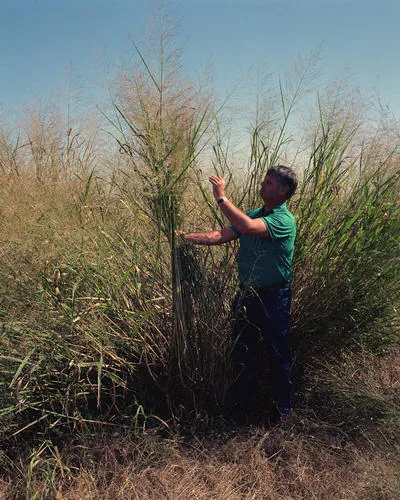
Switchgrass is a warm-season perennial of the North American tallgrass prairie, and that origin explains its resilience in cultivation. It builds an upright, vase-shaped clump of narrow blades that extend into airy, pink-tinged panicles by midsummer. As temperatures fall the tissue matures to golden-tan, and the standing structure persists through winter.
The plant demands remarkably little. Cold hardiness reaches -40°F (-40°C), and an extensive prairie root system underlies its tolerance of both drought and inundation across clay, sand, poor, and even saline soils. Excess is the real risk: rich, moist ground and shade produce soft, etiolated stems that lodge, whereas lean, sunny conditions keep the culms rigid and erect.
Its garden value rests on structure and motion more than floral display. The foliage responds to the faintest air movement, the seed heads supply forage for birds, and the intact winter clump provides cover and seasonal interest once neighboring perennials have collapsed. A single hard cutback in late winter completes essentially all required maintenance.
Care
The short version: provide full sun and lean, well-drained soil, minimal irrigation after establishment, and almost no fertilizer. Cut the clump to the ground in late winter, and divide at intervals of a few years as the crown begins to decline at the center.
Light
Switchgrass performs best in full sun. It tolerates partial sun to light shade, but reduced light yields soft, leaning growth, so maximizing exposure is what produces a rigid, upright habit.
Water
Irrigate consistently through the first season to establish the root system, after which supplemental water is largely unnecessary. Once established the plant withstands both drought and inundation, performing across the full range from wet to dry soils.
Soil
The species is broadly adaptable, succeeding from wet to dry and from clay to sand, and it tolerates salinity. It performs best on lean substrates within a pH of 5.0 to 8.0, since fertile ground encourages the weak growth that leads to lodging.
Temperature
Cold tolerance is exceptional, extending to -40°F (-40°C), with heat tolerance to 100°F (38°C). This amplitude accommodates nearly every temperate garden without supplemental protection.
Humidity
Ambient outdoor humidity is not a management variable for this grass. Air circulation is the relevant factor, because congested, poorly ventilated clumps are where occasional rust establishes.
Feeding
Fertilizer is generally unnecessary and often counterproductive. Rich or over-fertilized soil drives weak, lodging-prone growth, so apply at most a light spring feeding, and only where the substrate is genuinely impoverished.
Pruning
Cut the clump to within a few inches of the ground in late winter or early spring, before new growth emerges. Retaining the foliage and seed heads over winter serves both ornamental interest and the wildlife they shelter.
Repotting
Lift and divide the clump every few years, or once the center dies out and leaves a hollow crown. Diminishing vigor, reduced flowering, or an outer ring of growth around a bare middle indicate that division is due.
Size & spacing
Mature height runs 3 to 6 feet (91 to 183 cm), greater when in flower. Allow 2 to 3 feet (61 to 91 cm) between clumps so air moves freely and the erect habit has room to develop.
When to plant
Because switchgrass is a warm-season grass, growth is keyed to soil temperature rather than the calendar. Sow indoors in late winter following a cold-moist stratification that satisfies the seed's dormancy, transplant in spring after frost or in early fall, and expect panicles from midsummer into an extended winter presence.
Northern hemisphere
Southern hemisphere
Typical months for a temperate climate: start earlier in warm zones, later where spring frosts linger.
- Sow: Late winter to early spring, 6 to 8 weeks before last frost; seed benefits from cold-moist stratification
- Plant: Spring after last frost, or in early fall; warm-season grass that establishes as soils warm
- Harvest: Airy pink-tinged panicles from mid to late summer (July onward), maturing to golden-tan and persisting into winter
Hardiness
USDA hardiness zones: 3–9
Temperature: down to -40°C
Troubleshooting
Switchgrass presents few genuine disorders, and most reflect siting rather than pathogens or pests. Interpreting the early signs below usually points to one corrective: greater sun exposure, leaner soil, or timely division.
Volunteer seedlings appear and the aging crown hollows
Under favorable conditions switchgrass sets abundant seed and advances on short rhizomes, so volunteers colonize the surrounds and the stand naturalizes. Remove the seed heads in fall before dispersal, and dig out unwanted seedlings. With age the crown center senesces, the signal to lift the clump, discard the exhausted middle, and replant the vigorous outer divisions.
Fix:
- Cut back and remove seed heads before they drop if self-seeding is unwanted
- Dig and remove unwanted seedlings
- Lift, divide, and replant vigorous outer divisions when the center dies out
Culms lodge and the clump opens at the center
Lodging is driven mainly by insufficient light or by soil too rich and moist, both of which produce soft, weak stems. Relocate the plant to full sun and restrict water and fertilizer so the culms firm up. On inherently fertile sites, specify rigidly upright cultivars such as 'Northwind' or 'Heavy Metal', and cut the clump back hard in late winter to reset growth.
Fix:
- Move or plant in full sun
- Withhold fertilizer and avoid rich, overly moist soil
- Choose sturdy strongly upright cultivars such as 'Northwind' or 'Heavy Metal'
- Cut back hard in late winter to renew growth
Orange rust pustules or dark smut on the foliage
Hot, humid weather favors rust, which raises orange-brown pustules on the blades, and occasionally smut blackens the tissue. Neither is materially damaging. Improve airflow through wider spacing and division, keep the plant in full sun where air moves, and remove the affected foliage at the late-winter cutback.
Fix:
- Improve air circulation by proper spacing and dividing crowded clumps
- Cut back and remove affected foliage in late winter
- Site in full sun with good airflow
Toxicity
As an ornamental, switchgrass is safe around cats, dogs, rabbits, birds, and people, since the cultivated clump contains nothing toxic to them. The qualification concerns grazing herbivores: the steroidal saponins present in Panicum can induce photosensitization in livestock, principally sheep and secondarily horses, when consumed in quantity as forage or hay.
Safe for
People · Cats · Dogs · Horses · Rabbits · Livestock · Birds
Cats None
The ornamental grass contains no toxin, so an exploratory nibble causes no harm to cats. A large mouthful of fibrous foliage may be regurgitated, but it presents no real danger.
Dogs None
Dogs may chew or brush against switchgrass without consequence. The cultivated clump contains no compound toxic to them.
Horses Caution
Occasional grazing of a few blades is harmless, but sustained intake of large amounts can produce liver-associated photosensitization, presenting as jaundice and sunburn-like lesions on pale or exposed skin. Monitor grazing where the grass dominates a pasture.
Rabbits Safe
Switchgrass is a safe forage for rabbits, as the blades and stems contain no toxin.
Livestock Caution
Sheep are the most susceptible, with goats and cattle also affected: heavy grazing or switchgrass hay can cause liver injury and photosensitization, manifesting as jaundice and sunburn-like lesions on unpigmented skin. Limit this grass to a modest fraction of the ration.
Birds Safe
Birds consume the seed and shelter within the foliage without harm, so the plant functions as food and cover rather than a hazard.
People Safe
Cultivating and handling switchgrass carries no risk to people, and the ornamental clump is safe around children.
Safe for pets and people as a garden ornamental. However, switchgrass and other Panicum species contain steroidal saponins (yielding diosgenin) that can cause hepatogenous photosensitization (liver damage with sunburn-like skin lesions) in grazing livestock, especially sheep, goats, and horses, when they graze or are fed large amounts. This is a grazing/forage concern only and does not affect the safety of the ornamental clump for cats, dogs, or humans.
Varieties
The species is serviceable on its own, but the named cultivars offer the meaningful distinctions, differentiated chiefly by stature, rigidity of habit, and autumn coloration. The following selections are the ones to know.
Heavy Metal
A narrow, rigidly upright selection with metallic blue-green blades that transition to clear yellow in autumn.
Northwind
Among the most reliably self-supporting forms, this sturdy, strongly vertical cultivar maintains an olive-green column that seldom lodges.
Shenandoah
Its foliage develops a red cast that intensifies to wine-red through late summer and into fall.
Cheyenne Sky
A compact, shorter cultivar that colors precociously, reaching wine-red well ahead of the taller selections.
Cloud Nine
A tall cultivar attaining 6 feet or more, with blue-green blades and a soft, billowing outline.
Companions
Switchgrass shines next to sun-loving prairie flowers that share its taste for lean, dry ground, setting off their bloom with its upright blades and seed heads.
Plant near
Echinacea purpurea (purple coneflower): Classic prairie/meadow companion with matching full-sun, lean-soil needs and contrasting flower form
Rudbeckia (black-eyed Susan): Native prairie partner sharing sun and soil tolerance for naturalistic plantings
Sedum / Hylotelephium (autumn stonecrop): Sun-loving, drought-tolerant companion that complements the grass for fall and winter interest
How to propagate
Switchgrass propagates by two methods, and the appropriate choice depends on whether cultivar fidelity must be preserved.
DivisionEasy
Spring as new growth begins, or early fall · One growing season
Division is the dependable method and the only one that preserves a named cultivar true to type. In spring as growth resumes, or in early fall, excavate an established clump, discard the dead center, and replant the vigorous outer sections. These reestablish and fill in within a single growing season.
SeedModerate
Sow indoors in late winter or direct sow in spring; cold-moist stratification improves germination · One to two growing seasons
Seed propagation is straightforward, though the resulting seedlings are variable and will not reproduce a named cultivar. Sow indoors in late winter or direct sow in spring, preceded by a cold-moist chill that improves germination. As a warm-season species it germinates once soils warm, then requires one to two growing seasons to reach maturity.
Myths
A hardy native prairie grass such as switchgrass has no cultivation problems and poses no hazard to anything nearby.
It is undemanding, but not without issues. It lodges in shade or on rich, moist ground, self-seeds sufficiently to naturalize, and its crown declines with age and requires division. It remains harmless to pets and people, yet its steroidal saponins can induce photosensitization in grazing livestock, chiefly sheep and to a lesser extent horses, that consume large quantities.