Vegetable · Brassicaceae
Kale
Brassica oleracea Acephala Group
Cold-hardy and productive, kale yields tender leaves from spring right through winter.
Full sun
Every 3–7 days
55–75 days
USDA 2–11
Overview
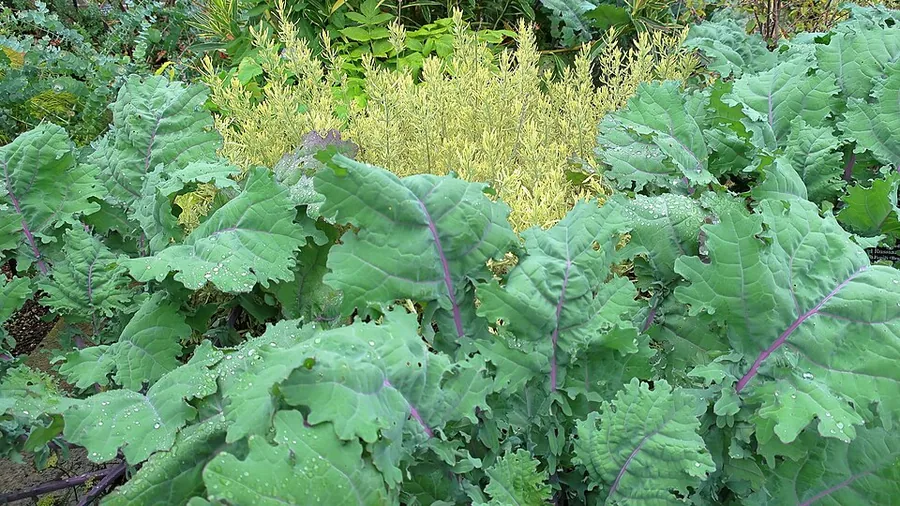
Kale is a leaf-forming member of the cabbage family, grown for the loose, open rosette it produces rather than a solid head. The group spans a broad range of leaf forms, from the ruffled blue-green curls of the standard cultivars to the long, puckered straps of the Italian heirlooms. Its tolerance of a wide range of conditions makes it one of the least demanding vegetables for a beginning grower.
Kale is fundamentally a cool-season crop, performing best in the moderate temperatures of spring and fall and enduring frost that ends a warm-season plant like tomato. The reason cold favors it lies in its physiology: chilling prompts the plant to convert stored starch to sugar, so the leaves grow sweeter and milder rather than coarser.
Supplied with full sun, consistent moisture, and fertile soil, a single planting remains productive for months. Because harvest takes the outer leaves while the central growing point continues to expand, the yield is spread across the season rather than concentrated in one cutting.
Care
The short version: kale wants full sun and rich, evenly moist soil supplied with about an inch to an inch and a half of water per week. Feed it through the season, plant it for both a spring and a fall crop, and take the lower leaves progressively as they mature.
Light
Kale requires full sun, a minimum of 6 hours daily, to develop full, leafy growth. It tolerates partial shade, which is useful where summer heat is intense, but under deep shade photosynthesis is limited and the plants grow thin, slow, and sparsely leaved.
Water
Maintain evenly moist soil by supplying about 1 to 1.5 inches of water a week. Consistent moisture keeps the leaves tender and mild instead of tough and bitter, and a mulch layer conserves that moisture between waterings.
Soil
Grow kale in fertile, well-drained loam amended with generous organic matter. A pH of 6.0 to 7.5 is optimal, and raising acidic soil toward the upper end of that range serves the added purpose of suppressing clubroot.
Temperature
This cool-season crop performs across a range of 10°F to 81°F (-12°C to 27°C). It endures hard frost without injury, and cold in fact sweetens the leaves, whereas sustained summer heat turns them bitter and induces bolting.
Humidity
Ambient outdoor humidity fully meets kale's needs, so no target level applies. Adequate airflow is the more important factor, because crowded, damp foliage favors the aphids and diseases common to brassicas.
Feeding
Incorporate a balanced fertilizer into the bed at planting according to a soil test, then side-dress with nitrogen about 4 to 6 weeks afterward to sustain leaf production. Avoid excess nitrogen, since the soft, succulent growth it produces attracts aphids.
Pruning
Kale needs no formal pruning. Harvest the lower, outer leaves once they are large but still tender, leave the central growing point intact so production continues, and remove any leaf that yellows or sustains pest damage.
Size & spacing
Mature plants stand 1 to 3 feet (30 to 100 cm) tall with a spread nearly equal to their height. Spacing them 12 to 18 inches (30 to 45 cm) apart provides the air movement and room each plant needs to develop fully.
When to plant
Kale is adapted to cool weather and a long cropping window. Sow in early spring for an early summer cutting, then sow again in midsummer for a fall and winter crop whose flavor sweetens as temperatures drop.
Northern hemisphere
Southern hemisphere
Typical months for a temperate climate: start earlier in warm zones, later where spring frosts linger.
- Sow: Start seed indoors 6-8 weeks before the last spring frost; for a fall crop, start in mid-summer
- Plant: Set transplants out 3-4 weeks before the last spring frost, or direct sow as soon as soil is workable; sow again in mid- to late summer for fall harvest
- Harvest: Harvest spring sowings in late spring to early summer before heat turns leaves bitter; harvest fall crops into winter - flavor sweetens after light frosts
Hardiness
USDA hardiness zones: 2–11
Temperature: down to -46°C
Troubleshooting
Most kale problems present on the foliage, where the chewing and sap-feeding pests operate in full view. Because early detection limits their spread, examine the leaf undersides on a regular schedule. Match the symptom below, then intervene before the injury advances.
Plants wilting and stunted with swollen, distorted roots
Afternoon wilting with yellowing and stalled growth signals impaired roots, so lift a suspect plant and inspect them. Thick, club-shaped galls confirm clubroot, a soilborne pathogen that distorts the roots and, once established, has no cure in that soil; tunneled roots holding small white grubs instead indicate cabbage root maggot. Remove and destroy affected plants rather than composting them, rotate brassicas onto clean ground, and lime the infested bed toward pH 7.0 or above, since the pathogen is suppressed in less acidic soil.
Fix:
- Remove and destroy infected plants; do not compost them
- There is no cure in infested soil - grow brassicas elsewhere
Ragged holes chewed through the leaves
Ragged feeding holes and green frass on the foliage identify cabbageworms and cabbage loopers, frequently accompanied by diamondback moth larvae. Because these larvae feed on the leaf surface, handpicking removes most of them, and Bt or spinosad finishes off later hatches by disrupting the caterpillar gut. A floating row cover applied at transplanting denies the adult moths access, so no eggs are laid on the crop to begin with.
Fix:
- Handpick caterpillars
- Apply Bacillus thuringiensis (Bt) or spinosad according to label directions
Curled, sticky leaves with clusters of small insects
Waxy gray-green colonies sheltered in the leaf folds are cabbage aphids, and their sap feeding is what curls and puckers the foliage. A forceful jet of water dislodges the bulk of them, and insecticidal soap applied to the sheltered undersides handles those that remain. Their natural enemies, lady beetles and parasitic wasps, suppress following generations, so preserving those predators keeps the colony from rebuilding.
Fix:
- Dislodge with a strong spray of water
- Apply insecticidal soap, covering leaf undersides thoroughly
- Encourage natural enemies such as lady beetles and parasitic wasps
Tiny shothole pits peppering young leaves
The small round pits are surface feeding by flea beetles, glossy black beetles that jump away when disturbed. Their damage falls hardest on seedlings in warm, dry spring conditions and seldom checks a plant that is already growing strongly. Because vigor is the real defense, holding young plants under row cover and pushing rapid growth lets them outgrow the injury.
Fix:
- Protect young plants with row cover
- Apply a labeled insecticide if damage is severe on seedlings
Toxicity
Kale is an edible crop in every part, safe for people and for the animals kept near the garden. No toxic principle is present, so the sole qualification is one of quantity: very large amounts of the raw brassica foliage, consumed day after day, act as a mild goitrogen in grazing livestock.
Safe for
People · Cats · Dogs · Horses · Rabbits · Livestock · Birds
Cats None
Kale carries no toxin that affects cats, so an exploratory nibble has no consequence. A large volume of raw leaves eaten at once may produce transient gas or a soft stool, and nothing more serious follows.
Dogs None
Plain kale is non-toxic to dogs and features in many home-prepared diets. Because a sudden large serving of the raw leaves ferments in the gut, keep portions small to avoid gas or a mild digestive upset.
Horses Safe
Kale presents no poisoning hazard to horses and suits an occasional supplemental feed. Reserve it as an extra rather than a staple, since sustained intake of brassica greens exerts a mild goitrogenic effect over time.
Rabbits Safe
Rabbits tolerate kale well within a varied selection of leafy greens. Introduce it gradually and hold the quantity modest so it does not displace the hay their digestion requires.
Livestock Safe
Cattle, goats, and sheep graze kale without toxic effect, and it is cultivated deliberately as a forage crop. Because prolonged heavy intake of the foliage is goitrogenic, balance it against the rest of the ration.
Birds Safe
Chickens and other birds readily consume kale, leaf and stalk alike. It serves as a wholesome green with no toxic tissue to exclude.
People Safe
Kale is a nutritious culinary vegetable eaten raw in salads or cooked. Wash it before use, the standard food-safety step for any garden leaf.
Like other brassicas, kale contains goitrogenic compounds; very large quantities of raw kale fed routinely could affect thyroid function or cause digestive gas in pets and livestock - a moderation note, not a poisoning risk.
Varieties
The kale group contains dozens of cultivars, but a limited set recurs consistently in gardens and on extension recommendation lists. The following are the ones worth identifying by name.
Lacinato (Tuscan, Dinosaur)
An Italian heirloom distinguished by narrow, dark blue-green strap-like leaves with pronounced puckering, and one UF/IFAS recommends for Florida gardens.
Winterbor
A hybrid selected for exceptional cold hardiness, growing tall and productive with finely curled blue-green foliage.
Redbor
A curly hybrid in deep red-purple whose color intensifies as temperatures fall, ornamental enough for the flower bed as well as the kitchen.
Red Russian
Ranked among the sweetest types, bearing tender, flat, toothed gray-green leaves marked by purple veins and stems.
Vates Dwarf Blue Curled
A compact, low-growing curly standard prized for bolt resistance and long established as an extension favorite.
Companions
Kale grows best beside aromatic herbs and alliums that throw pests off the scent, and worst beside its brassica cousins, which trade the same diseases and pests back and forth.
Plant near
Dill: Aromatic herb whose flowers attract parasitic wasps and other beneficial insects that prey on cabbageworm and aphid pests of brassicas
Onion: Aromatic allium interplanted with brassicas may help confuse or deter common insect pests and competes little for space
Beet: Compatible cool-season root crop that occupies a different root zone and shares similar growing conditions without hosting brassica pests
Keep apart
Cabbage and other brassicas: Crops in the same family share pests and diseases (cabbageworms, aphids, clubroot, black rot); grouping them in the same bed and skipping rotation lets problems build up
Strawberry: Traditionally listed as a poor neighbor for brassicas; the perennial bed also conflicts with the crop rotation brassicas need
How to propagate
Kale is among the most straightforward vegetables to propagate, establishing readily from seed sown directly in the bed or raised as transplants.
SeedEasy
Direct sow in early spring as soon as soil can be worked and again in mid- to late summer for a fall crop, or start indoors 6-8 weeks before the last spring frost · Seed germinates in about 5-10 days; transplants reach setting-out size in 4-6 weeks and plants mature in roughly 55-75 days
Kale propagates reliably from seed, whether direct-sown or raised as transplants. Sow directly in early spring once the soil is workable, sow again in mid- to late summer for a fall crop, or start seed indoors 6 to 8 weeks ahead of the last frost. Sow at a depth of 1/4 to 3/4 inch and space plants 12 to 18 inches apart to allow full development. Germination follows in about 5 to 10 days, transplants reach setting-out size in 4 to 6 weeks, and plants mature in roughly 55 to 75 days.
Myths
Frost ruins kale, so the crop must be finished before cold weather arrives.
Kale ranks among the most cold-tolerant vegetables grown, withstanding frost and light freezes that destroy tender crops. Cold triggers the plant to convert stored starch into sugar, so the flavor improves rather than degrades after a frost. Fall and winter are when kale reaches its best flavor.
The whole kale plant must be pulled to harvest it.
Removing the large lower leaves while leaving the apical growing point intact allows the plant to continue producing new foliage. That habit lets a single plant yield for weeks or months of successive harvest rather than one destructive cut.