Ornamental · Asteraceae
False Sunflower
Heliopsis helianthoides
Site it in full sun and lean soil, and false sunflower yields gold from midsummer to first frost.
Full sun
Every 5–10 days
90–120 days
USDA 3–9
Overview
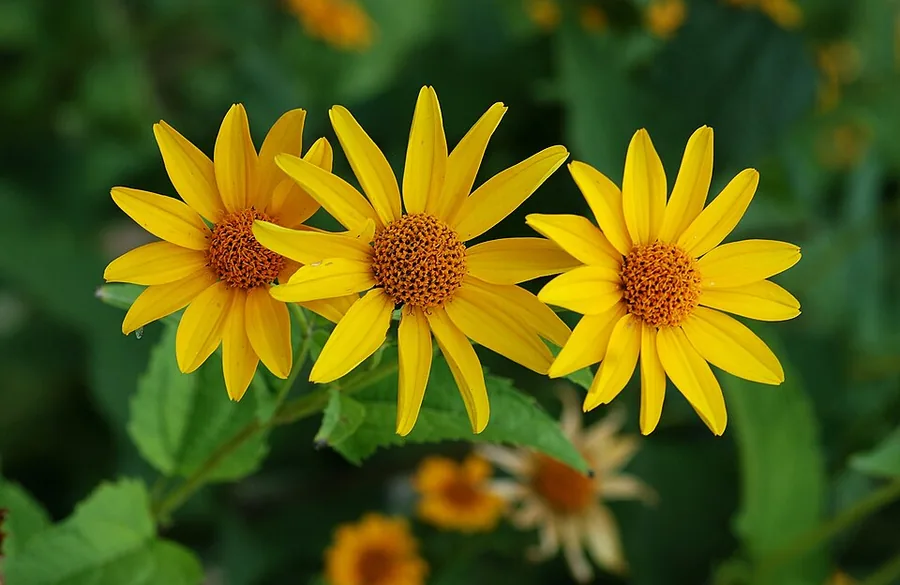
False sunflower supplies a sustained display of golden, daisy-like flowers across the summer garden. A North American member of the aster family, it withstands heat, drought, and impoverished ground once its root system establishes. The common name records a resemblance rather than a relationship: it reads as a true sunflower yet, being perennial, returns from its own crown each year.
It rewards the gardener who wants performance with minimal input. Its requirements are full sun and average to dry soil, conditions under which it provisions bees and butterflies through the season while demanding almost no supplementary feeding. Fertile ground is in fact counterproductive, since the surplus nutrients drive soft, etiolated stems prone to lodging.
Where space allows, it expands. The crown broadens annually and the plant self-sows freely, behavior well suited to a meadow or prairie matrix but requiring restraint in a formal border. Routine deadheading and division confine it, and so managed it persists for decades.
Care
The short version: full sun and lean, well-drained soil. Irrigate only through establishment, withhold fertilizer, and deadhead across the season to extend flowering and limit self-seeding.
Light
Provide full sun, defined as 6 or more hours of direct light daily. The plant tolerates light partial shade, but reduced light induces the weak, elongated stems that lodge, so the brightest available position is the correct one.
Water
Irrigate consistently through the first season while the root system develops, then reduce. Once established the plant is drought tolerant and prefers dry to medium soil, so allow the top half of the profile to dry between waterings and avoid waterlogging.
Soil
It is undemanding and accepts clay, rocky, poor, and dry soils, requiring only that the medium drains freely. A pH between 5.5 and 7.5 is suitable. Fertile, rich beds are best avoided, since high fertility produces lodging-prone growth.
Temperature
This is a cold-hardy perennial rated to winter lows of -40°F (-40°C) and summer highs of 100°F (38°C). That tolerance spans most of the country, and the top growth dies back to the crown each winter to resume from the base in spring.
Humidity
Ambient outdoor humidity is immaterial, so no target value applies. Air circulation is the more relevant factor, since open spacing keeps the foliage dry and limits problems.
Feeding
Fertilize rarely, if at all. A light dressing of compost or a balanced feed in spring is the maximum the plant warrants, because surplus nutrition drives the soft, lodging-prone growth that is best avoided.
Pruning
Deadhead spent flowers to prolong bloom and reduce self-seeding. Cutting the stems back by one-third to one-half in late May yields shorter, sturdier plants, and a final cut to the ground in late fall or early spring removes spent top growth ahead of regrowth.
Repotting
There is no repotting, as false sunflower is not container-grown. The equivalent operation is to divide the clump every 3 to 4 years when the center declines or the planting becomes crowded, which restores vigor and contains the spread.
Size & spacing
Mature plants attain 3 to 6 feet (91 to 183 cm) in height and 2 to 4 feet (60 to 122 cm) in spread. Allotting each plant its full spread maintains air movement and gives the tall stems room to lean without congesting neighbors.
When to plant
False sunflower follows a straightforward seasonal sequence. Sow it in fall or start seed indoors 6 to 8 weeks before the last frost, transplant after the cold has passed, and the bloom period extends from June into September.
Northern hemisphere
Southern hemisphere
Typical months for a temperate climate: start earlier in warm zones, later where spring frosts linger.
- Sow: 6-8 weeks before last spring frost, or direct sow
- Plant: After last spring frost
- Harvest: June to September (mid summer to early fall)
Hardiness
USDA hardiness zones: 3–9
Temperature: down to -40°C
Troubleshooting
False sunflower is durable and seldom diseased, so its problems are predominantly aesthetic rather than threatening to survival. Aphids, lodging stems, and a colonizing habit account for most of them. Identify the symptom below and intervene early.
Soft-bodied colonies massing on tender growth
Those clustered specks are aphids, which favor the nitrogen-rich sap concentrated in the soft stem tips and unopened buds of false sunflower. As they feed they excrete honeydew, the sticky residue you see, and their feeding distorts the expanding leaves. A strong jet of water dislodges the colony mechanically, insecticidal soap dissolves the cuticle of a heavy infestation, and resident lady beetles will suppress what remains.
Fix:
- Spray off with a strong jet of water
- Apply insecticidal soap if heavy
- Encourage lady beetles and other natural predators
Stems elongating and bending under their own weight
Flopping traces back to either insufficient light or excess soil fertility, since both etiolate the stem and leave it too weak to carry its own height. Cutting the plants back by one-third to one-half in late May forces lower, denser regrowth that stands on its own. The durable correction is full sun and lean soil, which keep internodes short, with a stake reserved for the tallest stems.
Fix:
- Cut stems back by one-third to one-half in late May to make plants shorter and sturdier
- Stake or provide support for tall plants
- Move or plant in full sun
Colonizing the bed by seed and clump expansion
False sunflower advances on two fronts: it self-seeds prolifically and its crown widens outward each season, so an unmanaged plant reads as weedy in a formal border. Removing spent flower heads before the achenes mature interrupts the seed pathway, and pulling volunteer seedlings clears the rest. Periodic division of the crown checks the lateral spread.
Fix:
- Deadhead spent flowers before seed sets
- Remove unwanted seedlings
- Divide and thin clumps
Toxicity
For households with pets and children, the assessment is favorable: false sunflower is not toxic to people or animals and is absent from the ASPCA poison list. It is a native pollinator plant that can be grown without concern. The single caveat, common to plants generally, is that a large ingested quantity may produce a transient upset stomach.
Safe for
People · Cats · Dogs · Horses · Rabbits · Livestock · Birds
Cats None
No toxic compounds have been documented in the foliage, stems, or flowers, so the species is safe in a garden cats frequent.
Dogs None
Nothing in the plant is poisonous to dogs, which may investigate or brush against it without consequence.
Horses Safe
The species contains none of the compounds implicated in equine poisoning, leaving horses at no risk.
Rabbits Safe
Foliage browsed by rabbits causes no ill effect, although in the garden they often graze the new growth back.
Livestock Safe
Cattle, goats, and sheep can graze it without harm, as the plant holds no toxins documented in livestock.
Birds Safe
The maturing seed heads are a food source rather than a hazard, sustaining finches and other songbirds into fall and winter.
People Safe
Handling and cultivating it presents no toxicity to people, and the species carries no record of skin irritation.
No special handling required; routine garden hygiene and washing hands after handling soil is sufficient.
Varieties
The wild species is ornamental in its own right, but breeding has produced shorter forms, pigmented stems, and darker flower centers. The named selections below are the ones worth acquiring.
Summer Sun (Sommersonne)
A widely grown cultivar bearing golden-yellow single to semi-double flowers on a tidy, compact habit.
Tuscan Sun
A dwarf selection of roughly 18 inches suited to smaller beds and to container culture.
Burning Hearts
Reaching 3 to 4 feet on dark purple stems, it carries reddish-orange centers within each flower.
Lorraine Sunshine
Selected chiefly for its variegated cream-and-green foliage, beneath the yellow flowers it also produces.
Summer Nights
Red stems and deep mahogany-red flower centers under golden rays give it a markedly darker, richer character.
Companions
False sunflower pairs best with other sun-loving natives that share its taste for dry-to-medium soil and bring the same pollinators to the bed.
Plant near
Bee balm (Monarda): Shares full sun and supports pollinators in native and prairie-style plantings
Purple coneflower (Echinacea): Similar sun, soil and moisture needs and complementary summer bloom for pollinator gardens
Little bluestem and other native grasses: Provide support and contrast in meadow plantings with matching dry-to-medium soil needs
How to propagate
False sunflower propagates readily by three routes: dividing a clump, sowing its seed, or rooting a cutting to hold a cultivar true to type.
DivisionEasy
Spring or fall · One season
Division is the most reliable method for sustaining a vigorous clump. Lifting and splitting the crown in spring or fall every 3 to 4 years rejuvenates a declining center and curbs lateral spread at once, and the resulting divisions reestablish within a single season.
SeedEasy
Fall or early spring · Blooms typically by the second year from seed; can self-seed and form colonies
Seed germinates readily but the plant invests its first year in establishment. Direct sow in fall or early spring, or start it indoors, and expect flowering to begin in the second year. Once established it self-sows freely, which is how it forms colonies.
Stem cuttingsModerate
Late spring to early summer · Several weeks to root
To reproduce a named cultivar true to type, take basal stem cuttings from fresh new growth in late spring or early summer. The method is more demanding than division and requires several weeks for roots to form before the cuttings are transplanted.
Myths
False sunflower is poisonous to cats and dogs.
No toxicity has been documented, and the species is absent from the ASPCA toxic list. It is a native ornamental valued for its pollinator support, and the only foreseeable consequence is the mild, transient gastrointestinal upset that ingesting any plant material in quantity can provoke.
False sunflower and sneezeweed are the same plant.
The two occupy separate genera within the daisy family. False sunflower is Heliopsis helianthoides whereas sneezeweed is Helenium, and the morphological similarity within Asteraceae does not make them interchangeable.