Vegetable · Fabaceae
Soybean
Glycine max
A nitrogen-fixing legume that thrives on full sun, warm soil, and steady moisture at pod fill.
Full sun
Every 5–7 days
59–95°F · 15–35°C
75–100 days
Overview
Soybean is a warm-season legume in the family Fabaceae, cultivated for immature green edamame and for the mature dry beans that yield tofu, soy milk, and oil. Its low input demand traces to a symbiosis: Rhizobium bacteria in root nodules convert atmospheric nitrogen into a form the plant can use, which is why it draws so little from the soil. That self-sufficiency makes it an undemanding crop and a sound choice for a first-time grower.
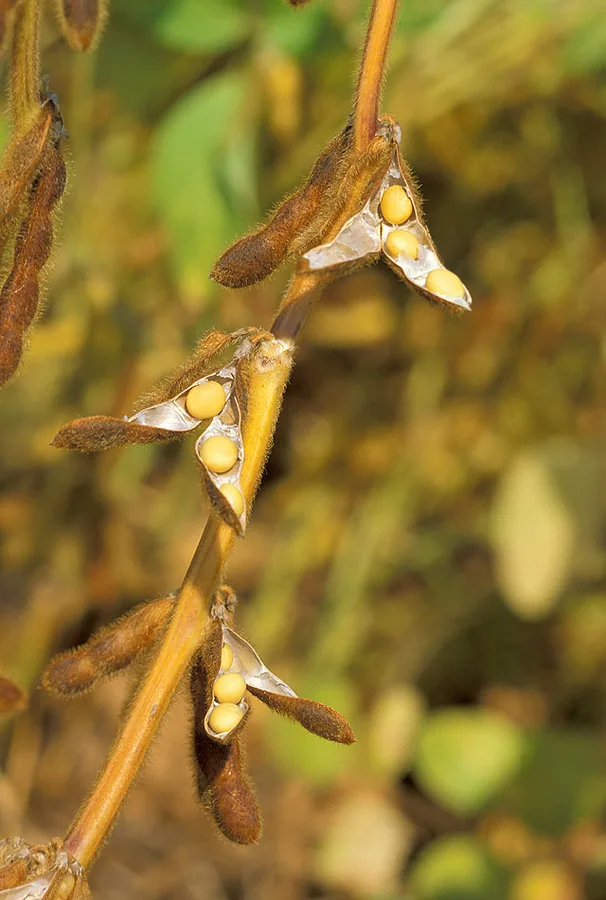
Growth habit is upright and bushy, typically 1.5 to 3 feet (45 to 100 cm) in height, with pubescent stems and pods borne in clusters along the branches. Harvested young and bright green, the pods serve as edamame. Left to mature and dry in place, the same seeds are threshed for storage and later cooking.
A key distinction from snap beans and garden peas is that mature soybeans are unsuited to raw consumption. They contain heat-labile compounds that interfere with protein digestion until cooking denatures them, so thorough cooking precedes any use of the mature bean.
Care
The short version: full sun on warm, well-drained soil, with roughly 1 inch of water a week kept even through flowering and pod fill, when demand peaks. Withhold heavy nitrogen, since nodule-based fixation already supplies most of the plant's requirement.
Light
Soybean is a full-sun crop, needing eight or more hours of direct light daily. Below that, plants etiolate, growing thin and drawn out, and set far fewer pods.
Water
Supply about 1 inch of water a week, held even, because moisture demand is highest during flowering and pod fill and shortfalls there cost yield. Avoid waterlogging, which drives root rot in this warm-season legume.
Soil
Plant into well-drained loam enriched with organic matter. Aim for a pH of 6.0 to 6.8, the slightly acidic to near-neutral range that suits the crop and that most garden soils already hold.
Temperature
Soybean performs across a broad warm range of 59°F to 95°F (15°C to 35°C). Sowing into cold soil yields poor, uneven germination, so wait until the ground has warmed before planting.
Humidity
Average outdoor humidity near 40% to 70% meets the crop's needs. Air movement matters more than the reading, because still, humid air among crowded leaves favors rust and other foliar diseases.
Feeding
Fertility needs are modest. Nodulated roots fix atmospheric nitrogen, so a low-nitrogen starter is generally sufficient, with phosphorus and potassium added at planting only on poor soils. Heavy nitrogen is counterproductive, because it suppresses nodulation and the fixation that goes with it.
Pruning
No pruning is warranted on this annual. The useful task is early weed control while plants are small, done carefully so the roots and their nitrogen-fixing nodules stay undisturbed.
Size & spacing
Mature plants reach 1.5 to 3 feet (45 to 100 cm) tall and 12 to 24 inches (30 to 60 cm) across. Spacing that leaves clear air movement between rows lowers canopy humidity and, with it, disease pressure.
When to plant
Because germination is poor in cold, wet soil, timing hinges on soil temperature rather than the calendar. Direct sow after the last frost, once the ground reaches at least 60°F (16°C). Edamame follows in late summer, while beans left on the plant dry down for storage.
Northern hemisphere
Southern hemisphere
Typical months for a temperate climate: start earlier in warm zones, later where spring frosts linger.
- Plant: Direct sow after the last spring frost once soil has warmed to at least 60°F (about 15-16°C); soybean germinates poorly in cold, wet soil.
- Harvest: For edamame, harvest when pods are plump and bright green and seeds fill 80-90 percent of the pod (about the R6 stage); for dry soybeans, leave on the plant until pods and seeds dry and rattle.
Hardiness
USDA hardiness zones: 3–10
Temperature: down to -40°C
Troubleshooting
The foliage is the first place soybean signals trouble, whether from chewing beetles, sap-feeding aphids, or fungal rust. Early recognition matters because each disorder progresses, and intervention is cheaper before defoliation or infection builds. Identify the symptom below, then respond at the appropriate threshold.
Pustules on lower leaves with premature drop
Tan to reddish-brown pustules on the lower leaf surface, with yellowing and early leaf drop, indicate soybean rust, caused by Phakopsora pachyrhizi. The pathogen advances rapidly under favorable conditions, so confirm identity through an extension diagnostic service in regions where it occurs. A labeled fungicide applied at first detection, combined with removal of infected debris at season end, limits its spread.
Fix:
- Apply a labeled fungicide preventively or at first detection in regions where rust occurs
- Remove and destroy severely infected debris at season end
Round holes and skeletonized leaf feeding
Two chewing beetles account for most of this damage. Bean leaf beetles, reddish to tan with black spots, and Japanese beetles, metallic green-bronze, both rasp leaves into a lacy pattern. In small plantings, hand-picking into soapy water suffices, and a labeled insecticide is justified only once defoliation exceeds roughly 20 to 30 percent in vegetative stages or 10 to 15 percent during pod fill, the points at which feeding begins to cost yield.
Fix:
- Hand-pick beetles into soapy water in small plantings
- Use a labeled insecticide only if defoliation exceeds roughly 20-30 percent during vegetative stages or 10-15 percent during pod fill
Colonies of green insects and sticky honeydew
Colonies on new growth and leaf undersides are soybean aphids, and their excreted honeydew supports sooty mold and attracts ants. Natural enemies, chiefly lady beetles, usually hold low populations in check, so treatment is unwarranted early on. Intervene only as counts approach 250 aphids per plant and continue rising, the economic threshold for this pest.
Fix:
- Tolerate low populations, which natural enemies often control
- Treat only when populations reach economic thresholds (about 250 aphids per plant with rising counts)
Flower and pod abortion under stress
Blossoms and young pods that yellow and drop without setting seed reflect heat and drought stress during the reproductive phase, not a pathogen. The plant sheds reproductive structures it cannot support when soil dries and temperatures run high. Maintaining even soil moisture through flowering and pod fill, and mulching to buffer soil temperature, prevents most of the loss.
Fix:
- Maintain even soil moisture through flowering and pod fill
- Mulch to moderate soil temperature and conserve water
Toxicity
From a toxicology standpoint soybean is straightforward: it is an edible crop, not a poisonous one, and the ASPCA does not list it as toxic to cats or dogs. Nothing about the living plant endangers horses or grazing livestock, and soy is a routine feed ingredient. The single caveat is culinary rather than toxic, since mature beans require cooking before consumption.
Safe for
People · Cats · Dogs · Horses · Rabbits · Livestock · Birds
Cats None
The ASPCA does not classify Glycine max as toxic to cats, so ingestion of the foliage poses no poisoning risk.
Dogs None
Dogs face no toxic hazard from soybean, and soy protein is in fact incorporated into some commercial pet foods.
Horses Safe
Horses can graze the foliage safely, and soybean meal is a standard protein component of many equine feeds.
Rabbits Safe
Rabbits tolerate the leaves well, though green pods and beans are best limited to a portion of a mixed diet.
Livestock Safe
Cattle, goats, and sheep graze soybean without issue, and it is grown extensively as forage and feed.
Birds Safe
Poultry and other birds consume soybean, a common ration ingredient, though raw mature beans are better cooked beforehand.
People Safe
Soybeans are a dietary staple and safe once cooked; because raw mature beans hold trypsin inhibitors, boil or steam edamame and dry beans before serving.
This is a food-preparation note, not a poisoning hazard: raw mature soybeans contain trypsin inhibitors and lectins and should be thoroughly cooked before eating. Edamame is boiled or steamed before consumption.
Varieties
Home cultivation centers on edamame types, and a small group of cultivars appears consistently in that context. The following are the ones most worth knowing.
Midori Giant
A widely grown, large-seeded edamame selected for large, sweet beans and dependable yields.
Be Sweet
An early edamame noted for sweet flavor and reliable ripening within a shorter growing season.
Tohya
A compact edamame that matures relatively early and sets pods well.
Envy
A short-season edamame favored in northern gardens for its early harvest.
Companions
Soybean pairs well with corn, which feeds on the nitrogen the legume leaves behind, but it sulks next to onions and garlic, which hold back bean growth.
Plant near
corn: Corn is a traditional non-competitive companion that benefits from the nitrogen fixed by the legume.
How to propagate
Propagation is exclusively by seed sown where the crop will grow, consistent with an annual that dislikes root disturbance. Direct sowing is the only practical method.
SeedEasy
Direct sow in late spring after the last frost once soil reaches at least 60°F (about 15-16°C). · Seedlings typically emerge in 7-14 days under warm soil conditions.
Soybean is established directly from seed. Sow in late spring after the last frost, once soil has reached at least 60°F (16°C), placing each seed 1 to 1.5 inches deep. Emergence follows in 7 to 14 days in warm soil, and on ground with no prior soybean history, inoculating the seed with Rhizobium establishes the nitrogen-fixing nodules from the start.
Myths
Soybeans can be eaten raw from the pod, as garden peas are.
They cannot be treated that way. Mature soybeans contain trypsin inhibitors and lectins that impede digestion until heat inactivates them. Boiling or steaming edamame accomplishes this, rendering it safe and readily digestible.
Soybeans require heavy nitrogen fertilizer to crop well, as most vegetables do.
They do not. Through symbiosis with Rhizobium bacteria in its root nodules, soybean fixes most of the nitrogen it needs. Additional nitrogen is superfluous and can suppress the very nodulation responsible for that supply.