Ornamental · Asparagaceae
Solomon's Seal
Polygonatum biflorum
Site it in shaded, humus-rich, evenly moist soil, and Solomon's seal colonizes slowly by rhizome for years.
Full shade
Every 3–7 days
USDA 3–9
3–6 ft · 0.9–1.8 m
Overview
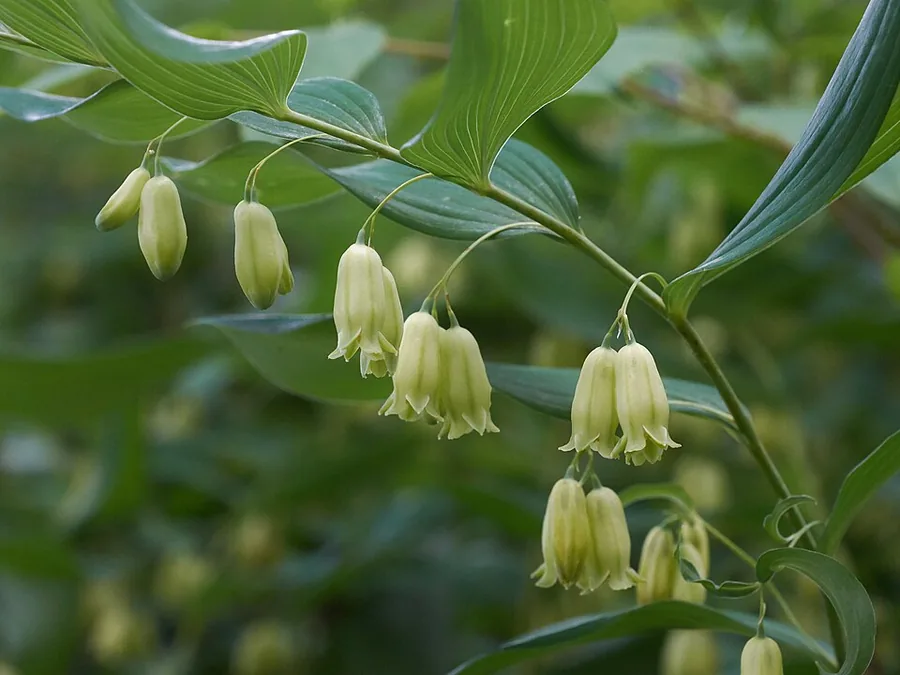
Solomon's seal, Polygonatum biflorum, is a rhizomatous woodland perennial valued for the arching architecture of its stems rather than a conspicuous flower. In spring, paired bell-shaped flowers hang from the leaf joints along the underside of each stem, positioned out of sight until the stem is lifted. The plant advances by a horizontal rhizome, extending a slow colony through the shaded understory it evolved in.
Its native habitat explains its tolerance: it grows where light is scarce and competition is low, so it performs where sun-demanding plants fail. Cold hardiness spans a wide range of zones, and the plant asks chiefly for shade and a soil kept moist and organically rich. Once the rhizome establishes, the colony returns and enlarges each season with minimal intervention.
After flowering, the fruit matures to blue-black berries by late summer. These are ornamental but inedible; only the emerging shoots are eaten, and then cooked, much as asparagus is treated in certain cuisines. The berries and the uncooked tissue are best left undisturbed.
Care
The short version: grow it in part to full shade in humus-rich soil held at even moisture, and allow the rhizome to extend the colony on its own.
Light
As an understory species, Solomon's seal is adapted to part to full shade and photosynthesizes efficiently under low light. It withstands some morning or filtered sun, but a hot, exposed position exceeds what its foliage is built for, leaving stems thin and leaves scorched.
Water
The rhizome and shallow roots draw on the steady moisture of leaf-covered ground, so keep the soil evenly moist. Irrigate every 3 to 7 days in dry periods and more often under heat. An established clump tolerates brief drought, yet consistent moisture sustains fuller growth.
Soil
Provide rich, humusy, well-drained soil amended generously with organic matter, which both holds moisture and feeds the rhizome. The plant accepts a broad pH band from 5.5 to 7.0, so structure and organic content matter more than exact acidity.
Temperature
This is an exceptionally cold-hardy perennial, enduring winter lows near -40°F (-40°C) and summer highs to about 86°F (30°C). The rhizome overwinters below frost and regenerates new shoots once soil temperatures rise in spring.
Humidity
Ambient outdoor humidity is sufficient, so no target figure applies. What the plant depends on is the cool, moist microclimate of a shaded bed rather than the drier air of an exposed, sunlit site.
Feeding
Nutrient demand is modest. A balanced fertilizer in spring, or a compost top-dressing applied as shoots emerge, meets it, and a genuinely humus-rich soil may supply enough on its own without supplemental feeding.
Pruning
Structural pruning is unnecessary. Cut spent, yellowed stems to ground level in late fall or after the first frost, once the season's top growth has died down, and otherwise leave the colony undisturbed.
Repotting
As a long-lived perennial, it rarely requires division and resents needless disturbance. Lift and split a clump only when crowding reduces vigor or when rhizomes begin surfacing above the soil, both signs that the colony has outgrown its space.
Size & spacing
Mature clumps attain 3 to 6 feet (91 to 183 cm) in height and 2 to 4 feet (61 to 122 cm) in spread over successive seasons. Allow that footprint at planting so each crown can arch fully and colonize without competing with neighbors.
When to plant
Solomon's seal is established from divisions or plants rather than rushed from seed. Plant in spring or fall, when cool, moist soil favors root recovery, and expect the paired flowers through April and May as the season's stems extend.
Northern hemisphere
Southern hemisphere
Typical months for a temperate climate: start earlier in warm zones, later where spring frosts linger.
- Plant: spring or fall
- Harvest: April to May
Hardiness
USDA hardiness zones: 3–9
Temperature: down to -40°C
Troubleshooting
Problems are few and site-driven, which is what you would expect of a shade-adapted understory perennial. Each of the two common complaints reflects a mismatch between the plant and its conditions, so the early signs point directly to the cause. Identify the symptom below and correct the underlying condition.
Elongated, weak stems with sparse foliage
Etiolated, sparse growth indicates excess sun or depleted, dry soil, conditions at odds with the species' shade adaptation. Foliage in a hot, open position scorches and yellows prematurely. Relocate the plant to part or full shade, mulch and irrigate for even moisture, and incorporate compost to restore the exhausted ground.
Fix:
- Move or plant in part to full shade
- Mulch and water to keep soil evenly moist
- Amend soil with compost or organic matter
Irregular holes eaten through the foliage
Ragged holes point to slugs and snails, nocturnal feeders favored by the cool, damp shade Solomon's seal occupies. The silvery slime trails they deposit confirm the diagnosis. Remove them by hand after dark, apply iron phosphate bait, and eliminate the leaf litter and residual moisture that sustain their habitat.
Fix:
- Hand-pick slugs in the evening
- Use iron phosphate slug bait
- Reduce excess moisture and remove debris near plants
Toxicity
Toxicity here is low but real. The young shoots are edible after cooking, yet the blue-black berries and the raw tissue contain saponins and anthraquinones, compounds that irritate the digestive tract. Because the fruit concentrates the risk, keep the berries from children, cats, dogs, and grazing animals.
Toxic to
Cats · Dogs · Horses · Rabbits · Livestock · Birds · People
Cats Mild
A cat that chews the foliage or ingests a berry may exhibit drooling, vomiting, or loose stools. The species is absent from the ASPCA toxic list and the hazard remains low, but the berries hold the concentrated compounds and belong out of reach.
Dogs Mild
A dog that consumes a leaf or a dropped berry generally develops mild gastric upset and transient diarrhea. Serious reactions are uncommon, though the saponins present justify discouraging repeated ingestion.
Horses Mild
Horses typically reject the bitter foliage, and a small quantity passes with no more than minor gastrointestinal irritation. The berries carry the greater risk and should be kept beyond reach.
Rabbits Mild
A rabbit that samples the leaves or fruit may develop soft stools and gastric discomfort. No part of the plant should be offered as forage.
Livestock Mild
Grazing stock usually avoid it, and the bitter taste limits intake. The saponins and anthraquinones can nonetheless produce mild digestive upset should a hungry animal consume a substantial amount.
Birds Mild
Wild birds consume the ripe berries and disperse the seed, an ecological role the plant depends on, but a caged bird of far smaller mass can react adversely to the same fruit. Keep pet birds away from berries and foliage alike.
People Caution
Only the young shoots are consumed, and only after cooking, as certain cuisines prepare them in the manner of asparagus. The blue-black berries and the raw tissue contain saponins and anthraquinones that provoke nausea and diarrhea, so the fruit should be avoided and kept from children.
Keep the ornamental berries away from pets and children; wash hands after handling.
Helpline numbers

United States
ASPCA Animal Poison Control: (888) 426-4435 (fee applies)
Poison Control: (800) 222-1222



Canada
Poison Centres: 1-844-764-7669
Varieties
The straight green species predominates in cultivation, but several named selections reward the grower who wants a specific stature or leaf coloring.
Polygonatum biflorum var. commutatum
Polygonatum biflorum var. commutatum, the giant or great form, is the largest, raising stout arching stems 3 to 7 feet tall that suspend up to 8 or more flowers from each leaf axil.
Polygonatum odoratum var. pluriflorum Variegatum
Grown chiefly for foliage, this variegated selection carries light green leaves cleanly margined in white together with fragrant flowers, earning it standing in the shade garden.
Polygonatum humile
Polygonatum humile, dwarf Solomon's seal, is a low Asian species reaching only 8 to 12 inches, suited to a compact shade planting or the front of a border.
Companions
Solomon's seal belongs in the shade garden, beside the moisture-loving woodland plants that share its cool, dappled corner.
Plant near
Ferns: Share the same moist, shady woodland conditions and contrast in texture.
Hostas: Thrive in the same rich, shaded soil and complement the arching habit.
Astilbe: Enjoys similar moist shade and adds flower color beneath the foliage.
Wild ginger: A low woodland groundcover that pairs well in cool, dappled shade.
How to propagate
Two routes exist, and they differ mainly in speed. Division exploits the existing rhizome for a quick, reliable increase, while seed relies on natural cold stratification and a much longer timeline.
DivisionEasy
Spring or fall · 1 to 2 growing seasons
Division is the efficient, dependable method. In spring or fall, lift a clump and separate the rhizome into segments, each retaining a viable growth bud. The resulting divisions root and develop over 1 to 2 growing seasons.
SeedModerate
Fall (sown fresh) for cold stratification · 2 to 3 years or more
Seed propagation demands patience and cold. Extract seed from ripe berries and sow it outdoors in fall so winter temperatures satisfy the dormancy requirement. Even under stratification, expect 2 to 3 years or more before seedlings reach appreciable size.
Myths
True Solomon's seal and False Solomon's seal are the same species.
They are not. Superficial resemblance masks a difference in genus. True Solomon's seal (Polygonatum) suspends paired, bell-shaped flowers beneath the arching stem, whereas False Solomon's seal (Maianthemum racemosum) presents its flowers and later berries in a single terminal plume. The position of the inflorescence is the definitive character.
The blue-black berries of Solomon's seal are edible.
They are not. The berries are inedible and mildly toxic, containing anthraquinone that induces vomiting and diarrhea on ingestion. Their color and gloss attract children, which makes clear labeling of the plant worthwhile.