Ornamental · Asparagaceae
Mondo Grass
Ophiopogon japonicus
Grown in shade with steady moisture, mondo grass forms a soft, dark green carpet that demands almost no upkeep.
Partial shade
Every 5–10 days
USDA 7–10
6–12 in · 15–30 cm
Overview
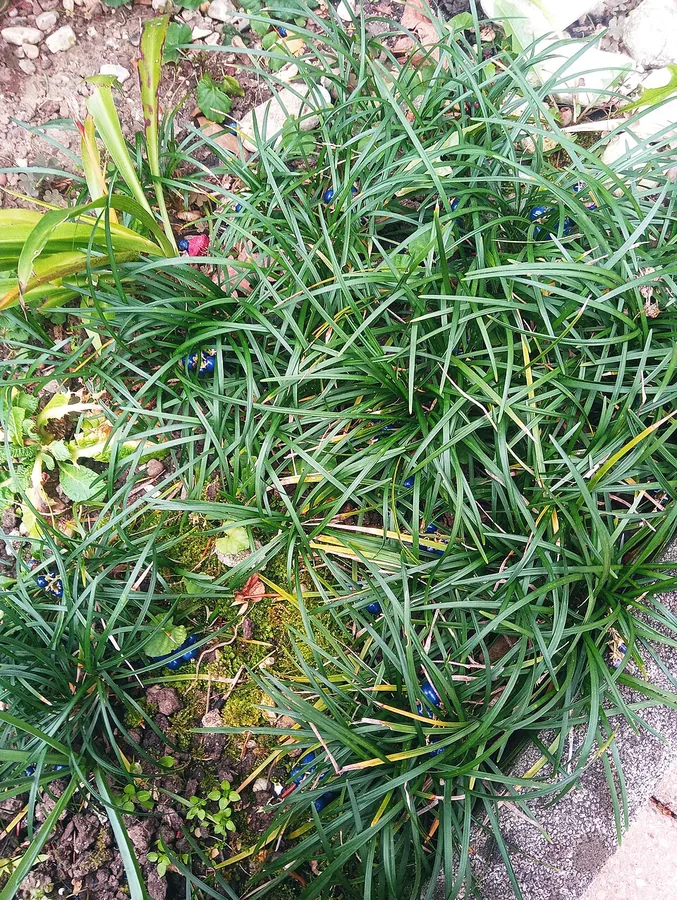
Mondo grass reads at a glance as a fine, dark green lawn, yet it belongs nowhere near the true grasses. It is Ophiopogon japonicus of the asparagus family, an East Asian evergreen cultivated as a groundcover. Its narrow, arching blades sit in low tufts and advance on short underground stems until they close into a dense, uniform mat.
Its horticultural value lies in performing where turf declines. It occupies shade beyond the tolerance of most plants, retains its color year round in mild climates, and withstands drought once its root system is established. In summer, small white to lilac flowers sit concealed within the foliage and give way to small blue berries.
The single demand it makes is time. Extension by short rhizomes makes it a slow spreader, so a new planting is measured in seasons before it closes, but the mature stand is among the most durable and low-input covers available.
Care
The short version: site it in part to full shade in moist but well-drained soil, supply steady water through establishment, and feed sparingly once the root system has taken hold.
Light
Mondo grass performs best in part to full shade, the exposure under which the blades develop their deepest dark green. It tolerates full sun, but only with supplemental water, since hot direct sun bleaches or scorches the foliage. Dappled light beneath a tree canopy is an ideal placement.
Water
Maintain consistently moist soil through establishment, irrigating every 5 to 10 days according to conditions. Once the roots are settled the plant endures short dry intervals, though any specimen in sun draws more water. Keep the profile moist while stopping short of waterlogging.
Soil
Average well-drained soil meets its needs across clay, loam, or sandy textures. The exposures to avoid are soggy, poorly drained ground and strongly alkaline sites, each of which predisposes the roots to rot. Incorporating organic matter improves the medium at planting.
Temperature
Mondo grass withstands a broad thermal range from roughly 0°F to 95°F (-18°C to 35°C). That cold and heat tolerance underpins its year-round color across zones 7 to 10.
Humidity
Ambient outdoor humidity satisfies it, leaving no target figure to manage. It acclimates to humid and drier climates alike, provided its moisture and shade requirements are met.
Feeding
As a light feeder it requires very little fertilizer. A single light application of a balanced product in spring suffices, and then only where the planting appears to warrant it.
Pruning
Mondo grass is low maintenance, calling for one renovation each year. Shear or mow the tattered old foliage in late winter or early spring ahead of new growth, an operation that also removes overwintering scale.
Repotting
Clumps seldom need lifting and are best allowed to close the ground. Divide and replant only when the center thins or the clump becomes congested and loses vigor.
Size & spacing
Plants attain 6 to 12 inches (15 to 30 cm) in height with a comparable spread, so space divisions at about 6 to 12 inches (15 to 30 cm). A tighter interval closes the cover sooner, an appreciable gain given the slow creeping habit.
When to plant
Mondo grass is hardy through zones 7 to 10 and is planted whenever the soil is workable. Establish new plants in spring once frost has cleared, or in fall, and expect the concealed flowers to open in summer around June and July.
Northern hemisphere
Southern hemisphere
Typical months for a temperate climate: start earlier in warm zones, later where spring frosts linger.
- Plant: Spring after frost, or fall
- Harvest: Summer (about June to July)
Hardiness
USDA hardiness zones: 7–10
Temperature: down to -18°C
Troubleshooting
Mondo grass is largely trouble-free, and the few disorders that arise trace to a mismatch between the plant and its site. In practice the causes reduce to excess sun, excess water, or the interval before it fills in. Identify the pattern below and correct the underlying condition.
Root rot and decline in waterlogged, alkaline soil
Yellowing, thinning clumps generally signal root rot, driven by soggy soil that starves the roots of oxygen, and strongly alkaline ground compounds the decline. Confirm it by excavation, because rotted roots go dark and soft where sound tissue stays firm. Correcting the drainage and reducing irrigation restores the oxygen balance, and replanting survivors into well-drained soil amended with organic matter gives the recovering roots a sound medium.
Fix:
- Improve drainage and stop overwatering
- Replant in well-drained soil amended with organic matter
- Remove and discard severely rotted clumps
Slow rhizomatous spread leaves open, weedy gaps
Because mondo grass extends only by short rhizomes, it is a slow grower by nature, and a new planting needs several seasons before those clumps merge into a closed mat. Tightening the spacing shortens that interval, since neighboring clumps have less distance to bridge. Mulching and weeding the interspaces suppresses competitors, while steady soil moisture drives the rhizome growth that finally closes the cover.
Fix:
- Be patient; allow several seasons for clumps to knit together
- Space divisions more closely for faster coverage
- Mulch between plants and weed regularly until the mat closes in
- Keep soil evenly moist to encourage establishment
Sun-bleached, scorched foliage from excess light and heat
Hot, direct sun overloads the foliage and both bleaches the pigment and scorches the tips, a reaction that intensifies under the extreme heat of the Deep South. Foliage holds its darkest green under filtered sun through full shade, where light and heat stay within the plant's comfort. In open exposures the additional water offsets the heat load, so raising the irrigation there reduces the damage.
Fix:
- Provide afternoon shade or relocate to part to full shade
- Increase watering for plants grown in full sun
- Site in filtered sun to shade where foliage stays darkest
Foliar damage from slugs, snails, and scale
Ragged holes accompanied by slime trails identify slugs and snails, whereas fixed, immobile bumps along the blades identify scale insects such as false oleander scale and fern scale. Hand-picking or baiting removes the mollusks, while shearing heavily infested foliage in late winter strips out the overwintering scale before spring growth. A 2 percent horticultural oil spray smothers scale that persists after shearing.
Fix:
- Hand-pick or bait for slugs and snails
- Shear and dispose of infested foliage in late winter to reduce scale
- Apply a 2 percent horticultural oil spray for scale if needed
Toxicity
For households with pets or children, the record is clear: mondo grass is safe. It is absent from the ASPCA toxic-plant lists, and its kinship with the lilies does not place it among the genuinely dangerous true lilies. Ingesting a large quantity of any foliage may unsettle a stomach, but the plant carries no toxic principle.
Safe for
People · Cats · Dogs · Horses · Rabbits · Livestock · Birds
Cats None
For cats, mondo grass carries no toxin and does not appear on the ASPCA toxic list. A blade or two poses no problem, and only the mechanical load of a large mouthful would prompt slight drooling or a brief digestive upset.
Dogs None
For dogs, a garden of mondo grass presents no poisoning hazard, since the plant holds no dangerous toxin. The worst outcome in a persistent chewer is transient gastrointestinal upset traceable to the volume of foliage consumed.
Horses Safe
Horses face no toxic risk from mondo grass, which contains no poisonous principle. As with any large intake of fresh forage, an oversized helping could produce a day of loosened digestion through bulk alone.
Rabbits Safe
Rabbits can browse mondo grass without harm, because no part of it holds a toxic compound. Portions should stay moderate all the same, since an abrupt excess of any new green tends to loosen a rabbit's stool.
Livestock Safe
Cattle, goats, and sheep incur no poisoning from mondo grass, a non-toxic species. Only after an unusually large quantity would the sheer bulk bring on mild digestive upset.
Birds Safe
Birds, backyard hens among them, may take the foliage and the blue berries of mondo grass without harm. The plant presents no poisoning risk to avian species.
People Safe
Mondo grass is cultivated as an ornamental rather than a crop, yet it poses no poisoning threat to a person who tastes it. Children face no genuine hazard past the mild upset that follows eating a large amount of any leaf.
No special handling required. It is an outdoor groundcover and is not among the truly toxic lilies; mild GI upset is possible only if large amounts are eaten.
Varieties
A handful of selections dominate the trade, spanning miniature dwarfs to a near-black relative. The following are the ones worth distinguishing.
'Nana' / 'Kyoto Dwarf' (Dwarf Mondo Grass)
A miniature dwarf reaching only about 2 to 4 inches tall with a slow creeping habit, valued as a low turf substitute and for planting into the joints between stepping stones.
'Gyoku Ryu'
A compact dwarf selection distinguished by dense, low tufts of dark green, grass-like foliage.
Black Mondo Grass (Ophiopogon planiscapus 'Nigrescens')
A distinct species rather than true O. japonicus, grown for near-black purple foliage that supplies strong color contrast within a planting.
Lilyturf (Liriope) - look-alike, not the same plant
A separate genus routinely confused with mondo grass, distinguished by its wider leaves, flower spikes carried above the foliage, and black berries, against the narrower leaves, concealed flowers, and blue berries of mondo grass.
How to propagate
Mondo grass is propagated by division of established clumps rather than from seed, a straightforward operation well within any gardener's reach.
DivisionEasy
Spring or early in the growing season · Slow; may take years to fill large areas
Division is the standard method of propagating mondo grass, seed being little used. Lift an established clump in spring or early in the growing season and separate it into sections, retaining as much root as possible with several leaves per division. Each section re-establishes readily, but the slow rhizomatous spread means a broad planting still requires years to fill in.
Myths
Mondo grass is a true grass.
The resemblance is superficial. Mondo grass is Ophiopogon japonicus, placed in the asparagus family, so it is grass-like in appearance yet botanically not a grass. It is likewise a distinct plant from the visually similar lilyturf (Liriope), the species with which it is most often confused.