Ornamental · Aristolochiaceae
Wild Ginger
Asarum canadense
A woodland rhizomatous groundcover that depends on shade and unbroken soil moisture.
Full shade
Every 3–7 days
USDA 4–6
6–12 in · 15–30 cm
Overview
Asarum canadense is a low, rhizomatous native of eastern deciduous woodland, valued as a groundcover for the dense mat of hairy, heart-shaped leaves it forms over the shaded floor. Its common name traces to the rhizome, which carries a faint ginger aroma, yet the species sits in the birthwort family, Aristolochiaceae, and is unrelated to culinary ginger. Growth stays low, seldom exceeding 6 to 12 inches (15 to 30 cm).
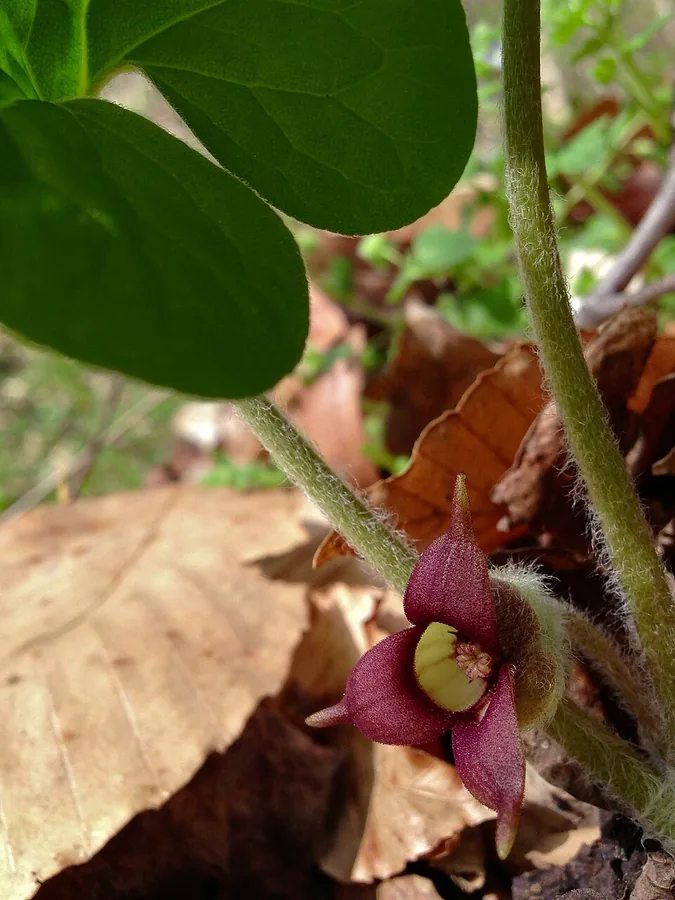
In spring the plant produces inconspicuous brownish-purple, bell-shaped flowers at soil level, held beneath the foliage where the leaves must be parted to see them. Seed dispersal falls to ants, which carry the seeds away to found new colonies. In suitable ground a single planting expands slowly by rhizome into a broad, self-sustaining stand.
Its role is that of a shade groundcover rather than a specimen. Sited in the damp, humus-rich, dappled position where turf and most flowering plants fail, it colonizes steadily season on season. One point stands outside cultivation and matters most: despite the historical use of the dried root as flavoring, no part of wild ginger is safe to eat.
Care
The short version: full to part shade, a rich humusy soil, and unbroken moisture through the season, because the species has no drought tolerance to fall back on.
Light
The species is adapted to full to part shade, the dappled understory light beneath a canopy. Limited morning or partial sun is tolerated where soil moisture holds, but full sun raises transpiration faster than the shallow roots replace it, so the foliage scorches.
Water
Hold the soil constantly moist, because the species has poor drought tolerance and little reserve to buffer a dry spell. Irrigation of roughly every 3 to 7 days, adjusted for heat and shade, keeps the root zone from drying. It also tolerates occasionally wet soils without harm.
Soil
Grow it in rich, humusy soil that retains moisture yet drains, the loose organic profile of a woodland floor, which both feeds the plant and buffers water supply. It performs across an acidic to neutral range, a pH of 4.5 to 7.0.
Temperature
Cold hardiness extends to about -29°F (-34°C), with an upper tolerance near 84°F (29°C). The deciduous leaves senesce and die back in autumn as a normal dormancy response, then re-emerge in spring.
Humidity
Ambient outdoor humidity is sufficient, so no target figure applies. What governs performance is consistent root-zone moisture and the cool, sheltered air of a shaded bed rather than atmospheric humidity.
Feeding
Supplemental feeding is largely unnecessary in a fertile woodland soil. A spring top-dress of leaf mold or compost supplies a slow release of nutrients and reproduces the leaf-litter cycle the plant evolved with.
Pruning
Little pruning is warranted. Remove tattered or damaged leaves as needed, and allow the balance of the deciduous foliage to die back through autumn as part of its natural cycle.
Repotting
The plant is managed as an in-ground groundcover rather than a container subject, so repotting does not apply. Every few years an established colony can be lifted and divided if it becomes congested or thins at the center.
Size & spacing
Mature height holds at 6 to 12 inches (15 to 30 cm), with an individual spread of 6 to 18 inches (15 to 45 cm). Spacing to that spread lets adjacent plants close into a continuous mat as the rhizomes extend.
When to plant
Establishment succeeds best while the soil is cool and moist, which is why divisions are set out in spring or fall. The species is hardy through zones 4 to 6, and the ground-level flowers open in early to mid spring.
Northern hemisphere
Southern hemisphere
Typical months for a temperate climate: start earlier in warm zones, later where spring frosts linger.
- Plant: Spring or fall
- Harvest: Brownish-purple bell-shaped flowers in early to mid spring (April-May), hidden at ground level beneath the foliage.
Hardiness
USDA hardiness zones: 4–6
Temperature: down to -34°C
Troubleshooting
Wild ginger presents few problems for the grower. Nearly every complaint reduces to slug pressure in damp shade or to moisture stress once the soil dries, and both read clearly from their symptoms.
Wilting, yellowing, and general decline in the stand
Because the species has poor drought tolerance, dry soil is the first cause to rule out. Water deficit shows as flagging and marginal browning, and it always worsens in the sunnier, drier zones of a planting where evaporative demand is highest. Deep watering restores the root-zone moisture, a leaf-mold mulch conserves it, and relocation to a shadier, damper site resolves a recurring problem.
Fix:
- Water deeply to restore even soil moisture
- Mulch with leaf mold or compost to retain moisture
- Relocate to a shadier, moister site if needed
Irregular holes rasped through the foliage
The damage is caused by slugs and snails, whose feeding peaks in damp shade and after rain when their activity rises. Slime trails and their nocturnal presence under the leaves confirm them. Hand-picking after dark reduces the population, clearing sheltering leaf litter removes their harborage, and iron-phosphate bait checks heavier outbreaks.
Fix:
- Hand-pick slugs and snails in the evening
- Remove leaf litter and debris that shelter them
- Use iron-phosphate slug bait if damage is heavy
Skin reaction after bare-handed contact with the foliage
Handling the leaves triggers contact dermatitis in susceptible people, producing redness or itching on the exposed skin, which subsides once contact ends. Washing the area with soap and water clears the residue, and wearing gloves during handling or division prevents recurrence.
Fix:
- Wash the affected skin with soap and water
- Wear gloves when handling or dividing the plant
Toxicity
Regard every part of the plant as inedible. All tissues contain aristolochic acid, a documented nephrotoxin and known carcinogen, which is why the historical practice of seasoning with the root cannot be justified. Exclude it from consumption by people, pets, and grazing stock, and wear gloves when handling the foliage, since contact can provoke dermatitis.
Toxic to
Cats · Dogs · Horses · Rabbits · Livestock · Birds · People
Cats Caution
A cat that ingests the leaves or roots may salivate and develop gastrointestinal upset. The more serious concern is the aristolochic acid present throughout the plant, which is nephrotoxic, so access should be denied to inquisitive cats.
Dogs Caution
Ingestion in dogs typically produces oral irritation and gastric upset. Because the tissues carry aristolochic acid, a recognized kidney toxin, any substantial ingestion warrants veterinary consultation.
Horses Caution
Horses have little occasion to graze it in the shaded sites it occupies, but the aristolochic acid in foliage and roots is nephrotoxic to them. It should be excluded from pasture and from cut hay.
Rabbits Caution
The plant is not an appropriate forage for rabbits. The aristolochic acid distributed through every part is a renal toxin, so even minor ingestion is best prevented.
Livestock Caution
Cattle, goats, and sheep that browse the plant absorb the same nephrotoxic aristolochic acid. Grazing access should be fenced off and the plant kept out of harvested forage.
Birds Caution
Poultry and other birds should be prevented from feeding on the leaves or rhizomes, which contain the carcinogenic, nephrotoxic aristolochic acid. No tissue of the plant is safe for them to consume.
People Caution
Despite the historical use of the root as a seasoning, no part of wild ginger is fit to eat. Its aristolochic acid is nephrotoxic and a known human carcinogen, and handling the foliage can additionally irritate the skin.
Wear gloves when handling, dividing, or pruning to avoid skin irritation, and keep the plant and its roots from being eaten by people or pets.
Helpline numbers

United States
ASPCA Animal Poison Control: (888) 426-4435 (fee applies)
Poison Control: (800) 222-1222



Canada
Poison Centres: 1-844-764-7669
Varieties
The plant is grown as the straight species, so cultivation comes down to a single taxon.
Asarum canadense (species)
The native deciduous species is identified by its hairy, heart-shaped leaves and a brownish-purple, three-lobed bell flower borne concealed at ground level.
Companions
Wild ginger pairs naturally with the other plants of the shaded woodland floor, the trilliums, violets, and ferns that want the same damp, rich, dappled ground.
Plant near
Trillium grandiflorum: Shares the same moist, shady woodland niche and naturalizes well alongside wild ginger as a groundcover.
Viola pubescens: A native woodland companion that thrives in the same part-to-full shade and rich soil conditions.
Ferns and woodland wildflowers: Combine well in shade and woodland gardens where wild ginger forms a low groundcover layer.
How to propagate
Increase is straightforward once the plant is established, largely because its creeping rhizomes accomplish much of the spread without intervention.
DivisionEasy
Spring or fall · One to two growing seasons
Division is the most dependable method of increase and the least demanding. An established clump is lifted in spring or fall, then the rhizomes are cut into sections that each retain several growth buds. The resulting divisions re-establish and fill in over the following one to two growing seasons.
LayeringModerate
Growing season · One growing season once rooted
The rhizome habit performs a natural layering. Creeping rhizomes root along their length as they advance across the ground during the growing season, coalescing into wider colonies. Once a rooted length has developed, generally within a single season, it can be severed and lifted as an independent plant.
SeedDemanding
Sow fresh seed in summer to fall · Several years to reach groundcover size
Seed propagation is slow and best reserved for the patient. Sow fresh from summer into fall, because the seeds bear an oily elaiosome that ants collect and disperse in the wild. Several years pass before a sown stand attains groundcover density.
Myths
Wild ginger is a safe wild substitute for culinary ginger because the root shares its aroma and taste.
The shared aroma is coincidental: Asarum canadense is unrelated to true ginger and contains aristolochic acid, a documented kidney toxin and known carcinogen. The historical practice of drying the root as a seasoning does not establish safety. No part of the plant should be eaten.