Ornamental · Melanthiaceae
Large-flowered Trillium
Trillium grandiflorum
Grow it in shade over deep, humusy woodland soil, and this rhizomatous native flowers on the forest's own schedule each spring.
Partial shade
Every 3–7 days
USDA 4–8
8–18 in · 20–46 cm
Overview
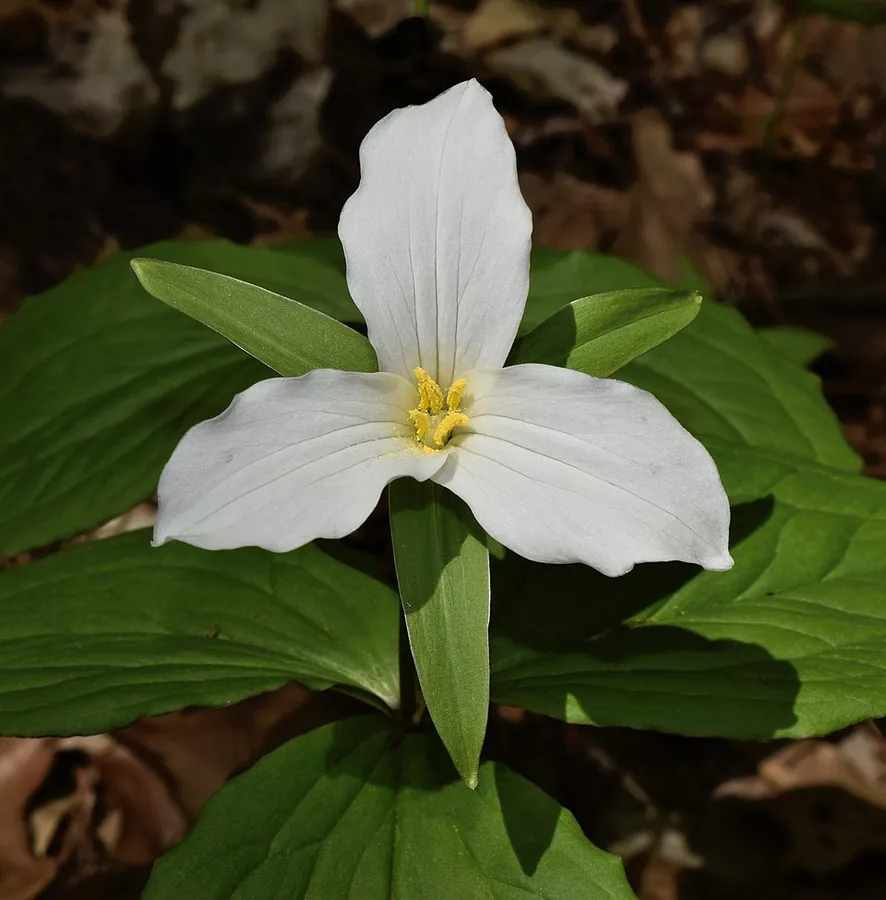
Trillium grandiflorum stands out on the spring forest floor: a solitary white flower borne above a whorl of three broad leaves. It sits among the lily allies and occurs naturally across the rich, shaded hardwood forests of eastern North America. The petals open white and shift toward pink with age, a normal change over time rather than a sign of trouble.
Its pace reflects its biology. The plant grows from a rhizome and spreads slowly by that rootstock, while seedlings need close to a decade to reach flowering size. In an undisturbed woodland setting it persists for many years and forms a long-lived colony.
The demands trace back to its native habitat. Because it evolved on a shaded, moist, leaf-littered forest floor, it requires shade, consistent moisture, and humus-rich soil, and once established it performs best left alone. The single non-negotiable point is provenance: never lift a plant from the wild.
Care
The short version: give it broken to full shade and deep, humus-rich soil, hold even moisture through spring growth, then leave the established rhizome undisturbed to build reserves.
Light
As an understory species, trillium is adapted to partial to full shade. Dappled light beneath deciduous trees suits it precisely, because the plant flowers early, before the overhead canopy expands and cuts off the light, then tolerates the deeper shade that follows.
Water
Maintain consistent soil moisture without waterlogging, watering through dry spells while the plant is in active spring growth. Once the foliage dies back by late summer, the dormant rhizome draws little and needs far less water.
Soil
Provide deep, humus-rich soil high in organic matter and freely draining, which mirrors the leaf-mold layer of its native forest floor and supplies nutrients as it breaks down. A pH between 5.0 and 7.0 is suitable, spanning most woodland soils.
Temperature
The species is fully cold-hardy across -29°F to 84°F (-34°C to 29°C). It requires a sustained winter chill to break dormancy and initiate flowering, a vernalization requirement that rules it out of hot, frost-free climates.
Humidity
Ambient outdoor humidity is adequate, so no target value applies; the record lists it as average. A cool, shaded, moisture-retentive site with leaf mulch serves the plant better than any measured humidity level.
Feeding
Rich, humusy woodland soil generally meets the plant's nutrient needs on its own. In fall, apply a thin layer of leaf mulch or leaf mold, no more than 2 inches, which decomposes to feed the soil much as natural leaf fall does.
Pruning
No pruning is warranted. Allow the foliage to senesce naturally after flowering, because those leaves are translocating reserves into the rhizome for the following season; removing them prematurely reduces stored energy and weakens the plant.
Repotting
Trillium is best left in place and divided only rarely, since it strongly resents root disturbance. Lift a clump only when overcrowding has reduced vigor or flowering, and anticipate a slow recovery even then, given how poorly the species re-establishes.
Size & spacing
At maturity the plant reaches 8 to 18 inches (20 to 46 cm) in height with a spread of 9 to 12 inches (23 to 30 cm). Space plantings to accommodate that slow clumping habit without crowding adjacent specimens.
When to plant
Trillium follows the phenology of the temperate woodland. Set the dormant rhizomes out in fall so roots establish over winter, and expect bloom from April to June, timed to exploit the light window before the deciduous canopy closes overhead.
Northern hemisphere
Southern hemisphere
Typical months for a temperate climate: start earlier in warm zones, later where spring frosts linger.
- Plant: Plant dormant rhizomes in fall; sow fresh seed outdoors in fall
- Harvest: Blooms April to June
Hardiness
USDA hardiness zones: 4–8
Temperature: down to -34°C
Troubleshooting
An established trillium is largely trouble-free, and the problems that do arise concentrate on the foliage, where they are easiest to read. Use the guide below to identify the cause and intervene early, before damage compounds. The one genuine setback is self-inflicted: disturbing the plant's roots.
Failure to establish or decline following relocation
The cause is transplant shock, an expected response in a species that transplants poorly and resents any root disturbance. The reliable remedy is to avoid moving it. When division is unavoidable, wait until the foliage has died back, replant the rhizome immediately at its original depth, and hold even moisture while roots regenerate. Sourcing nursery-propagated stock sidesteps the disturbance entirely and avoids uprooting a wild clump unlikely to recover.
Fix:
- Leave established plants undisturbed where possible
- If dividing, do so after foliage dies back and replant rhizomes promptly at the same depth
- Keep newly set plants evenly moist while they re-establish
Ragged holes in leaves and petals accompanied by slime trails
The culprits are slugs and snails, mollusks that feed nocturnally in the damp shade trillium favors and leave diagnostic silvery trails. Hand-pick them after dark or at dawn, remove the sheltering debris and boards that serve as daytime refuges, and reduce surface moisture. Where pressure is sustained, an iron-phosphate bait provides control.
Fix:
- Hand-pick slugs and snails in the evening
- Reduce excess moisture and remove debris that shelters them
- Apply iron-phosphate slug bait if pressure is heavy
Spots, blotches, or powdery discoloration developing on the foliage
These symptoms indicate fungal leaf spot, rust, or smut, pathogens that establish where foliage remains wet and air is stagnant. Remove and destroy the affected leaves, improve spacing and air circulation to dry the foliage faster, and irrigate at soil level rather than overhead. Clearing fallen debris in fall removes the overwintering inoculum and limits carryover.
Fix:
- Remove and destroy affected leaves
- Improve air circulation and avoid wetting foliage
- Clean up fallen plant debris at season end
Toxicity
Trillium ranks as a low-severity poison rather than a systemic hazard. The mechanism is saponins concentrated in the berries and rhizome, irritant compounds that can provoke digestive upset in a pet, a grazing animal, or a person that ingests them. The ASPCA does not list the species. Keep the fruit and rootstock out of reach, and, because this woodland native is protected in places, never collect it from the wild.
Toxic to
Cats · Dogs · Horses · Rabbits · Livestock · Birds · People
Cats Mild
The saponins present in the berries and rhizome act as gastrointestinal irritants, so a cat that swallows a fragment may drool or vomit. Most cats decline the plant, and a minor nibble seldom produces meaningful effects.
Dogs Mild
In dogs, chewing the fruit or excavating the rhizome exposes them to the same saponins, which may cause drooling, vomiting, or loose stools. The reaction is mild and self-limiting, though a habitual digger is best kept away from the rootstock.
Horses Mild
For grazing horses, the saponins render the rhizome and berries a mild gastrointestinal irritant. Clinical trouble is improbable, as the species occupies shaded woodland and seldom enters grazed pasture.
Rabbits Mild
A rabbit ingesting appreciable amounts of the fruit or roots may develop mild digestive upset from the saponins. The foliage poses less risk, but the berries and rhizome warrant exclusion from a rabbit's reach.
Livestock Mild
Browsing livestock, whether cattle, goats, or sheep, may develop mild digestive upset if they consume the rhizome or fruit, again through the saponins. Serious poisoning is not anticipated from this species.
Birds Caution
Ripe berries attract birds, which serve as the plant's seed dispersers, yet the saponin content still makes the fruit a mild irritant. For that reason it is classed as a caution for pet birds rather than a safe food.
People Caution
None of the plant is intended for consumption, and its saponin-laden berries and rhizome can produce gastric upset if ingested. Ensure children do not taste the fruit, and do not gather it as food.
Keep fruits and rhizomes away from pets and children. This is a slow-growing native protected or restricted in some areas; source only nursery-propagated plants rather than digging from the wild.
Helpline numbers

United States
ASPCA Animal Poison Control: (888) 426-4435 (fee applies)
Poison Control: (800) 222-1222



Canada
Poison Centres: 1-844-764-7669
Varieties
Trillium grandiflorum is cultivated chiefly as the wild type, though a single naturally arising color form is recognized.
f. roseum
A wild color form whose flowers open a soft pink in place of the typical white.
How to propagate
Two routes propagate the species, division of the rhizome and seed, and both demand patience because the plant develops slowly at every stage.
DivisionModerate
After foliage dies back in late summer to fall · 1 to 2 years
Divide only during dormancy. Once the foliage has died back in late summer to fall, lift the clump and separate the rhizomes, then replant the divisions without delay. Recovery is slow because the species resents disturbance, and a division typically needs 1 to 2 years to resume active growth.
SeedDemanding
Sow fresh seed in fall outdoors · Several years to flowering
Seed propagation is the demanding route. Sow fresh seed outdoors during fall and account for double dormancy, a mechanism that staggers germination across two or more years before seedlings even emerge, with several further years required to reach flowering size. Each seed bears an oil-rich elaiosome that attracts ants, which disperse and effectively sow it.
Myths
Collecting a trillium from the woods or transplanting one into the garden is harmless.
Removing the flower also removes the plant's sole set of leaves, cutting off photosynthesis and depriving the rhizome of the reserves it needs, which can suppress the plant for years or kill it. The species also transplants poorly and enjoys legal protection across much of its range. Obtain nursery-propagated stock rather than collecting wild plants.