Shrub · Aristolochiaceae
Dutchman's Pipe
Aristolochia macrophylla
A fast woody twiner that builds a wall of overlapping leaves and hosts the pipevine swallowtail.
Full sun
Every 5–10 days
USDA 4–8
20–30 ft · 6.1–9.1 m
Overview
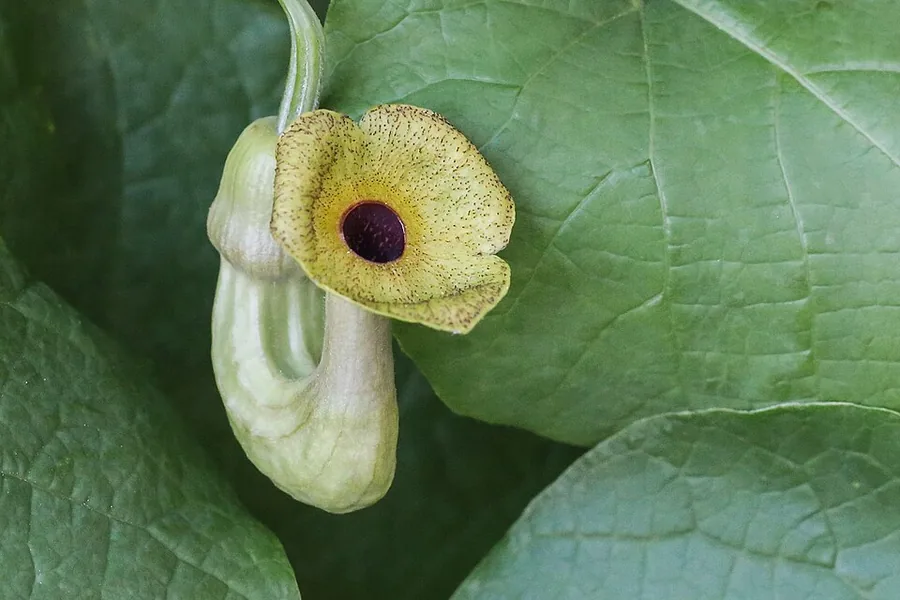
Dutchman's pipe is a vigorous native woody vine valued chiefly for the dense green screen it produces. Because its large heart-shaped leaves are held flat and overlap heavily, they intercept most of the light and read as solid cover over a porch, arbor, or pergola within a season or two. The small pipe-shaped flowers that give the species its name sit hidden among that foliage in late spring, a minor ornamental note on a plant grown for structure.
Its ecological value matches its screening. The vine is the principal larval host of the pipevine swallowtail, and the larvae feed on the leaves and sequester the plant's own aristolochic acid, which renders them unpalatable to birds. Because that defoliation is the intended function of the host relationship, insecticides work against you and the chewing should be left alone.
The plant warrants strict ornamental use and nothing more. Every tissue contains aristolochic acid, a documented nephrotoxin and carcinogen in humans, which is why it has no legitimate culinary or medicinal application. Grown outdoors on adequate support and renewed by annual pruning, it stays both vigorous and largely problem-free.
Care
The short version: site it in full sun to part shade, hold rich soil at steady moisture because it cannot tolerate drought, give it support engineered for a heavy woody vine, and renew it with a hard cutback each late winter.
Light
Site it in full sun to part shade, since light availability drives the density of the screen. Push it into deep shade and photosynthetic gain falls, so the canopy thins and growth turns weak and sparse instead of forming solid cover.
Water
Hold the soil consistently moist, because this vine is intolerant of drought and checks quickly when the root zone dries. Irrigate through dry spells, soaking it roughly every 5 to 10 days during establishment. A mulch layer over the roots buffers soil moisture and cuts evaporative loss.
Soil
Give it rich, well-drained loam amended with ample organic matter, which supplies both fertility and the moisture-holding it depends on. It is indifferent to reaction across a 6.0 to 8.0 range, so the limiting factors are moisture and fertility rather than pH.
Temperature
It is exceptionally cold-hardy, tolerating roughly -29°F to 95°F (-34°C to 35°C). That low-temperature tolerance is the trait that allows it to persist as a perennial vine as far north as zone 4.
Humidity
Ambient outdoor humidity is sufficient, so there is no atmospheric requirement to manage. Performance tracks root-zone moisture far more closely than any condition in the air surrounding the foliage.
Feeding
Apply a light feed in spring using a balanced fertilizer or incorporated compost at the base. As a vigorous native its nutrient demand is modest, and a fertile soil will frequently sustain it without supplemental feeding.
Pruning
Cut it back hard in late winter to restrain its rapid, heavy growth and renew the screen on a sound framework. It responds well to severe reduction, so prune without timidity, and thin congested stems to restore air movement through the canopy.
Repotting
As a ground-grown vine rather than a container subject, repotting is seldom relevant. Where a young plant is held temporarily in a nursery pot, pot it on before the roots circle and water begins passing through without uptake.
Size & spacing
Plan for substantial scale, since it climbs to 20 to 30 feet (6 to 9 m) and spreads 15 to 20 feet (4.5 to 6 m). A single specimen covers a large arbor, so place one plant deliberately rather than crowding multiples into the space.
When to plant
Dutchman's pipe is hardy through zones 4 to 8 and carries no narrow planting window. Seed needs cold to break dormancy, so stratify and start it in late winter to early spring, or sow outdoors in fall and let the winter supply the chilling. Move young plants out in spring once frost has passed and the soil is workable, and expect the small pipe-shaped flowers in late spring, around May and June.
Northern hemisphere
Southern hemisphere
Typical months for a temperate climate: start earlier in warm zones, later where spring frosts linger.
- Sow: Late winter to early spring (seed needs cold stratification); can also direct sow outdoors in fall
- Plant: Spring after last frost, once soil is workable
- Harvest: Late spring (May to June), with small pipe-shaped flowers hidden among the foliage
Hardiness
USDA hardiness zones: 4–8
Temperature: down to -34°C
Troubleshooting
An established Dutchman's pipe presents few real disorders, and the issues that arise trace to scale and siting rather than pathogens. Assess foliage density and the load on the support, since most complaints resolve through renewal pruning or relocation. The symptom most often mistaken for damage, heavily chewed leaves, signals a functioning host relationship.
The vine outgrows its space and overloads its support
What looks like a fault is an overgrown vigorous vine behaving normally, climbing 20 to 30 feet and accumulating a heavy leaf screen faster than most trellises can carry. Renew the framework and reduce the tangle with a hard cutback in late winter, and specify a substantial arbor or pergola at planting. A support not rated for a mature woody vine will sag or bend under the load.
Fix:
- Prune hard in late winter to reduce size and renew the framework
- Provide a sturdy, substantial support (heavy trellis, arbor, pergola, or strong wires) rated for a heavy woody vine
- Thin tangled stems to improve airflow and keep the screen tidy
Thin, sparse foliage and weak, stunted growth
Thin, weak growth most often reflects a soil too dry for a species with no drought tolerance. Deep shade and infertile, low-organic soil compound the decline by limiting both light and nutrient supply. Restore vigor by holding the soil moist under mulch, incorporating compost, and siting it in full sun to part shade for maximum canopy density.
Fix:
- Keep soil consistently moist; mulch to conserve moisture
- Site in full sun to part shade for best density
- Improve soil with compost/organic matter
Leaves chewed or stripped by dark, orange-spotted caterpillars
These are pipevine swallowtail larvae, and their feeding expresses the plant's role as their host rather than a pest outbreak. As the principal larval host, the vine supplies leaves from which the larvae sequester aristolochic acid for their own chemical defense. Leave them undisturbed, since an established vine recovers fully from defoliation, and add a few plants where both the butterflies and continuous cover are wanted.
Fix:
- Do NOT spray or remove the caterpillars - leaf feeding is desirable, not a pest problem
- Tolerate the chewing; a vigorous, established vine readily recovers from defoliation
- Plant extra vines if you want both butterflies and full leaf cover
Toxicity
Regard the entire plant as toxic, from root to flower. All tissue carries aristolochic acid, a potent nephrotoxin and proven human carcinogen, so it must never be ingested or prepared as any remedy. Casual browsing may produce only mild gastrointestinal upset in a pet, but because no part is safe for people or animals, children and grazing livestock should be excluded from it.
Toxic to
Cats · Dogs · Horses · Rabbits · Livestock · Birds · People
Cats Toxic
A cat that samples the leaves may drool and vomit, but the consequential hazard is the aristolochic acid and its damage to the kidneys, so keep cats from chewing any tissue.
Dogs Toxic
A dog browsing the foliage can drool and vomit, and the same nephrotoxic compound is involved, so a genuine ingestion of the plant warrants a veterinary call.
Horses Toxic
Horses must never browse this vine, since the aristolochic acid distributed through every part is a kidney poison, so fence it well away from grazing.
Rabbits Toxic
Keep rabbits clear of the leaves and stems, because the toxin presents no safe dose to them and the plant offers no edible portion.
Livestock Toxic
Cattle, goats, and sheep sustain the same kidney injury from the aristolochic acid in the foliage, so exclude this vine from pastures and from any fence line within reach.
Birds Toxic
The entire plant is unsafe for birds to ingest, with a single field exception in which pipevine swallowtail caterpillars store the toxin and deploy it against the birds that would predate them.
People Caution
No part is food or medicine. The aristolochic acid it contains is a proven kidney poison and an established human carcinogen, so it must never be prepared as a tea, tincture, or remedy, and hands should be washed after pruning.
Grow as an outdoor ornamental only. Never consume any part and never use it in teas, tinctures, or herbal remedies - aristolochic acid causes irreversible kidney damage and cancer. Keep pets and children from eating the leaves, stems, fruit, or roots; wash hands after pruning.
Helpline numbers

United States
ASPCA Animal Poison Control: (888) 426-4435 (fee applies)
Poison Control: (800) 222-1222



Canada
Poison Centres: 1-844-764-7669
Varieties
Several pipevines circulate under the Dutchman's pipe name, and the distinction governs both leaf size and the plant's value to the swallowtail. The following are the taxa worth separating.
Aristolochia macrophylla (syn. A. durior)
This is the classic native Dutchman's pipe, distinguished by very large smooth heart-shaped leaves that overlap into a dense shade screen and by small pipe-shaped flowers, yellowish-green with brownish-purple lobes, concealed among the foliage.
Aristolochia tomentosa (woolly Dutchman's pipe)
A smaller native counterpart from the central and southern states, it is identified by the woolly hairs covering its leaves and stems and functions as a pipevine swallowtail host as effectively as the larger species.
Aristolochia littoralis / A. elegans (calico or elegant Dutchman's pipe)
Avoid this showy non-native, which operates as an egg-trap where female pipevine swallowtails oviposit but the larvae starve rather than feed, and plant the native species in any region the butterfly occupies.
How to propagate
Dutchman's pipe propagates readily by more than one method, so the choice comes down to whether you favor seed or a vegetative copy of an existing vine.
SeedModerate
Sow in fall outdoors or stratify and start in late winter/early spring · 1-2 seasons to a well-rooted young vine; several years to mature size
The species sets seed freely and a cold spell improves germination, so either sow outdoors in fall or stratify and start in late winter to early spring. A well-rooted young vine develops within a season or two, with several years required to reach mature dimensions.
Stem cuttingsModerate
Take softwood/semi-ripe cuttings in late spring to summer · 1-2 months to root, then grow on
Collect softwood or semi-ripe cuttings from late spring through summer to obtain a true copy of the parent. Rooting takes a month or two, after which the rooted material is grown on before it is planted out.
LayeringEasy
Spring to summer · One growing season for rooted layers
The simplest method is layering, since the long flexible stems form roots wherever they contact moist soil. Peg one down from spring through summer and it yields a rooted plant within a single growing season.
Myths
The caterpillars stripping the leaves are pests to spray or remove.
These are pipevine swallowtail larvae on their host plant. They sequester aristolochic acid from the leaves to make themselves unpalatable to predators, so the defoliation is precisely the function the vine serves. Leave them in place and let a vigorous plant regenerate its own foliage.
Because butterflies depend on it, the plant must be safe to eat or brew.
The same compound the larvae exploit, aristolochic acid, is a potent nephrotoxin and a Group 1 human carcinogen. It produces irreversible kidney damage and urinary tract cancers. No part of this plant is ever safe to ingest or use as a remedy.
Any pipevine, native or not, supports pipevine swallowtails.
Certain non-natives, such as the calico flower A. littoralis, act against the butterfly. Females oviposit on them, but the larvae generally fail to develop. Plant the native pipevines, A. macrophylla or A. tomentosa, to sustain the swallowtails.
Sources
- NC State Extension Gardener Plant Toolbox
- Missouri Botanical Garden Plant Finder
- NC State Extension Gardener Plant Toolbox
- ASPCA Animal Poison Control (Toxic and Non-Toxic Plants list)
- University of Florida IFAS Extension (Featured Creatures, Pipevine Swallowtail Battus philenor)
- NIH/NCBI PMC (Systematic Overview of Aristolochic Acids: Nephrotoxicity, Carcinogenicity, and Underlying Mechanisms)