Shrub · Hamamelidaceae
Chinese Fringe Flower
Loropetalum chinense
Site loropetalum in acidic, well-drained soil and it delivers colored foliage and fringed bloom with minimal intervention.
Full sun
Every 5–10 days
USDA 7–9
6–8 ft · 1.8–2.4 m
Overview
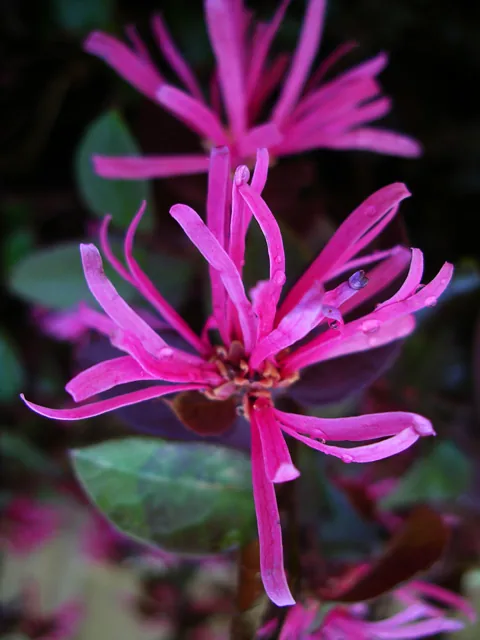
Loropetalum, the Chinese fringe flower, is an evergreen shrub of the witch-hazel family valued for two features working together: its colored foliage and the spidery, strap-petaled flowers that open in spring. On the widely grown selections the leaves carry burgundy through deep plum to near-black and retain that pigmentation year-round, whereas green-leaved forms recede visually. The inflorescences resemble tassels and appear in pink, red, or white.
Its low demands follow from a broad tolerance: once established it withstands drought, performs in full sun through partial shade, and needs little beyond a post-bloom trim. The single non-negotiable is acidic soil, because neutral to alkaline ground renders iron unavailable, and most of the disorders growers report can be traced to that pH mismatch.
Mature size deserves attention before planting. The diminutive cultivar names understate the plants, many of which considerably exceed expectation, and a vigorous selection can approach small-tree dimensions within a few years. Match the selection to the site and you reduce corrective pruning to a minimum.
Care
The short version: full sun to part shade, rich acidic soil with free drainage, consistent water during establishment and much less thereafter, and a light cut immediately after the spring bloom.
Light
Flowering and foliar pigmentation are strongest in full sun, since both depend on ample light, though the shrub accepts partial sun and partial shade. Under deep shade the dark-leaved selections lose color intensity and bloom density declines.
Water
During establishment, water on the order of once a week, increasing that under extreme heat as demand rises. Once rooted, the plant becomes drought tolerant and requires little supplement; allow roughly the top inch of soil to dry between waterings, and mulch to conserve moisture and buffer the root zone.
Soil
Soil chemistry governs this plant's health. It requires rich, moist, well-drained soil on the acidic side, ideally a pH between 5.0 and 6.5, amended generously with organic matter. Above that range iron is immobilized in the soil and the foliage yellows.
Temperature
Cold and heat tolerance are broad, extending from lows near 5°F (-15°C) to highs about 100°F (38°C), which corresponds to USDA zones 7 through 9 where it persists outdoors all year.
Humidity
Ambient outdoor humidity is sufficient, so no target value applies. The more consequential variable is drainage: keeping the root zone free of standing water forestalls the disorders that most threaten it.
Feeding
Apply a single spring feeding of an acidic, azalea- or camellia-type fertilizer, to which the plant responds at a medium rate. The acidifying formulation also assists in holding the soil within its preferred range.
Pruning
Pruning demand is minimal. Because flower buds form largely on old wood, prune directly after the spring bloom so shaping does not remove the following season's buds.
Repotting
Container specimens seldom require moving up. Repot only on evidence of restriction: roots circling or emerging from drainage holes, water passing straight through, or new growth stalling in the pot.
Size & spacing
Anticipate a shrub near 6 to 8 feet (183 to 244 cm) in height with a comparable spread, and considerably larger from vigorous selections. Allow each plant its full spread so air circulates freely and you avoid recurrent size-management pruning.
When to plant
Loropetalum is a woody shrub established once and grown for years, so the decisive timing is the planting itself. Set new stock out in spring or fall once frost danger has passed; the principal flush of fringed flowers follows from late March into April, with sporadic rebloom through the warmer months.
Northern hemisphere
Southern hemisphere
Typical months for a temperate climate: start earlier in warm zones, later where spring frosts linger.
- Plant: Spring or fall after frost danger passes
- Harvest: Late March to April with sporadic rebloom into fall
Hardiness
USDA hardiness zones: 7–9
Temperature: down to -18°C
Troubleshooting
In suitable soil loropetalum remains largely trouble-free, so most complaints are edaphic problems presenting as foliage or root symptoms. The leaves and roots register the fault early. Identify the pattern below and correct the underlying cause rather than the visible sign.
Wilting plus branch decline traced to dark, decayed roots
When a plant wilts and branches die back in soil that is clearly wet, the roots, not thirst, are failing: waterlogged ground has driven out oxygen and brought on root rot. Lift a section and you'll find tissue that is dark and soft rather than firm and pale. Reduce watering, correct the drainage, and relocate any sound survivors to a raised, free-draining bed, since a root system this far gone rarely recovers and is best replaced.
Fix:
- Improve drainage and reduce watering
- Remove and discard severely rotted plants
- Replant in raised, well-drained beds amended with organic matter
Woody galls at the branch nodes followed by dieback above
Rough, corky galls that swell at the branch nodes and leave dieback beyond them are the signature of bacterial gall disease, which colonizes wounded tissue and disrupts flow past the swelling. Prune each infected branch well below the gall to reach clean wood, then destroy the prunings rather than composting them. Disinfect tools between cuts so the bacteria don't travel from wound to wound, and remove any shrub too heavily colonized to save.
Fix:
- Prune out and destroy galled branches well below the gall
- Disinfect pruning tools between cuts
- Remove and replace severely infected plants
Interveinal yellowing on new growth while the veins remain green
That yellow tissue between still-green veins is chlorosis, and on this shrub it traces to soil pH high enough that iron stays chemically locked and unavailable to the roots. Because the deficiency strikes tissue as it forms, it appears on the newest growth first. Confirm with a pH test, then acidify with elemental sulfur or an acidic fertilizer to free up iron, and apply chelated iron as an immediate bridge while the soil correction takes hold.
Fix:
- Acidify soil with elemental sulfur or an acidic fertilizer
- Apply chelated iron as a temporary correction
- Mulch with organic matter to lower pH over time
Toxicity
For households with pets or children, loropetalum is not toxic. It appears in neither the major poison databases nor the ASPCA list, and the bitter tannins in its foliage discourage animals before appreciable ingestion. It can be sited without concern for the animals or people who pass it.
Safe for
People · Cats · Dogs · Horses · Rabbits · Livestock · Birds
Cats None
A cat can contact or sample the foliage without harm, since the plant carries no toxin. In practice the bitter tannins in the leaves deter it well short of a meaningful dose.
Dogs None
A dog chewing a stray branch is at no toxicological risk. The only likely effect is transient gastrointestinal upset from a large volume of plant matter, which any bulky mouthful of vegetation can cause.
Horses Safe
Horses may graze in proximity to the shrub without concern, as it contains no compound documented to poison them.
Rabbits Safe
The foliage and flowers pose no toxic hazard to rabbits, and the bitterness of the leaves tends to limit how much they consume in any case.
Livestock Safe
Cattle, goats, and sheep can browse around the plant safely, with no compound in it known to induce poisoning.
Birds Safe
Garden birds forage and perch in the branches with no adverse effect.
People Safe
The species is safe around children, as no part is poisonous; a child who tastes a leaf comes to no harm.
No special handling needed; foliage contains bitter tannins that discourage browsing.
Varieties
The trade selects these chiefly for leaf color and habit rather than flower form. The following are the cultivars most often encountered.
Ruby (var. rubrum 'Ruby')
Its emerging leaves flush deep burgundy-red, a backdrop against which the hot-pink fringe flowers stand out sharply.
Purple Pixie
A low, weeping dwarf carrying purple foliage and pink blooms, its trailing habit suiting containers, wall plantings, and groundcover alike.
Plum Delight
Reddish-purple foliage provides the contrast that makes its bright pink flowers read clearly.
Ever Red (Chang Nian Hong)
The darkest selection of the group, with near-black red foliage, red flowers, and a pronounced tendency to rebloom later in the season.
Zhuzhou
A vigorous purple-leaved selection whose growth potential is large enough to attain tree-like stature if left unchecked.
Companions
Loropetalum pairs naturally with the other acid-loving shrubs, which want the same rich, well-drained ground and gentle shade it does.
How to propagate
Loropetalum propagates readily in the home garden by either of two vegetative methods: rooting cuttings, or layering a low branch pinned into the soil until it forms roots in place.
Stem cuttingsModerate
Late spring through summer · Roots in roughly 15 days to several months depending on cultivar and warmth
From late spring through summer, take semi-hardwood cuttings from shoots that have begun to lignify, since firming wood roots more dependably than soft growth. Warm soil near 75°F (24°C) drives root initiation, and rooting spans about 15 days to a few months according to the cultivar and the warmth maintained.
LayeringEasy
Spring to summer · Several months to root
Layering in spring or summer is the most reliable method, because the shoot draws on the parent while it roots. Bend a low branch to the ground, pin it into the soil, and leave it attached through several months of rooting before severing it as an independent plant.
Myths
Loropetalum foliage contains compounds that poison dogs and cats.
The species is absent from the toxic-plant databases and from the ASPCA list. Loropetalum is regarded as non-toxic to pets, so foliage a cat or dog samples presents no documented hazard.
Cultivars sold as dwarf Loropetalum are genetically fixed at a small size.
Many nominal dwarfs exceed their stated dimensions, and the species and vigorous selections reach 10 to 20 feet or more. Allow for the true mature size when siting, and verify the specific cultivar before committing to a location.