Shrub · Hamamelidaceae
Dwarf Fothergilla
Fothergilla gardenii
Honey-scented spring catkins and multicolored fall foliage on a slow, acid-loving native of the witch hazel family.
Full sun
Every 5–10 days
USDA 5–8
2–6 ft · 0.5–1.8 m
Overview
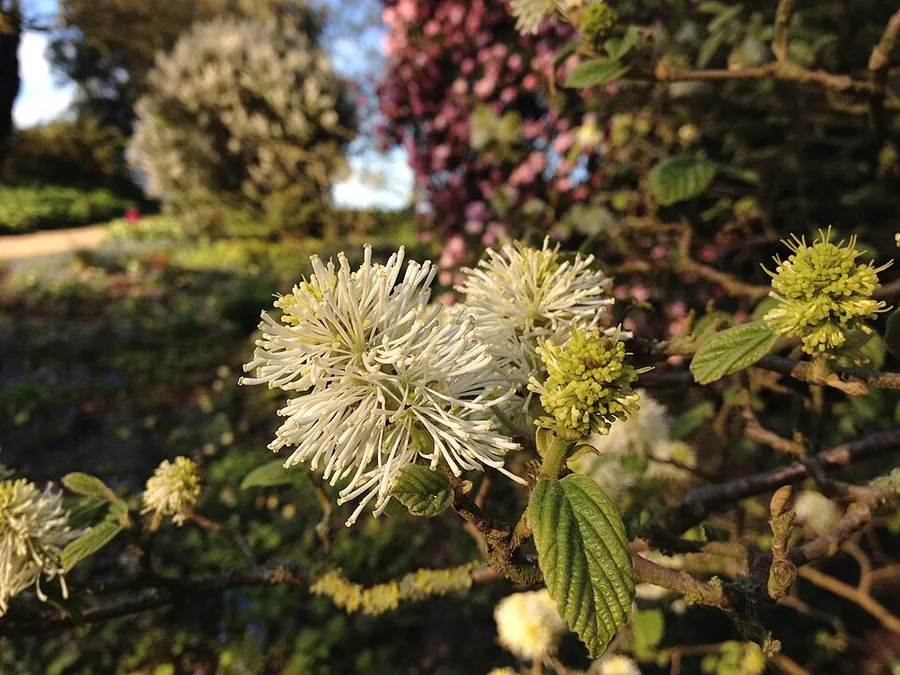
Fothergilla gardenii is a slow-growing native shrub of the southeastern United States and a member of the witch hazel family, sharing that group's tolerant disposition. In early spring, before leaf-out, it produces fragrant white bottlebrush inflorescences that carry a faint honey scent, the apetalous flowers reading as massed stamens rather than petals. Mature height stays modest at 1.5 to 6 feet (46 to 183 cm), which suits a mixed border or a smaller planting.
The species earns its place through two distinct seasonal displays. Spring flowering draws pollinators to the early nectar source, while autumn brings strong anthocyanin and carotenoid expression that turns the foliage yellow, orange, and red, frequently within a single plant. It runs clean horticulturally, with no serious pest or disease pressure, and browsing deer generally avoid it.
Soil chemistry governs nearly everything that follows. Fothergilla requires acidic, moist, well-drained ground and develops chlorosis on limed or alkaline sites where iron becomes unavailable, but supplied with correct pH and adequate sun it is remarkably self-sufficient.
Care
The short version: establish it in acidic, moist, well-drained soil under full sun, where iron stays available and bud set runs high, irrigate through establishment, mulch to conserve moisture and acidity, and prune only after bloom to protect old-wood buds.
Light
Site it in full sun to maximize flower bud initiation and the high-light conditions that drive autumn pigment synthesis. It persists in partial sun or light shade, yet deep shade suppresses both bloom and the carotenoid and anthocyanin response, leaving color muted. In hot regions, modest afternoon shade limits heat and moisture stress without much loss of color.
Water
Maintain the soil consistently moist, especially through establishment and during hot, dry intervals, since a shallow native root system draws steadily on soil water. Irrigate roughly weekly that first season, on the order of every 5 to 10 days. Established plants tolerate brief drought, but water deficit reduces both floral display and the intensity of fall color.
Soil
This is the controlling variable. The species demands acidic, organically rich, well-drained loam or sandy loam near a pH of 5.0 to 6.0, the range that keeps iron in plant-available form, and it will not perform on limed or alkaline ground. Incorporate generous organic matter to buffer moisture and acidity, and avoid any previously limed site.
Temperature
The shrub is both cold-hardy and heat-tolerant, withstanding -20°F to 95°F (-29°C to 35°C). That envelope spans zones 5 through 8, so winter low temperatures pose little practical risk within its range.
Humidity
Ambient outdoor humidity is sufficient, with no specific level to manage. Air circulation is the operative factor, because persistently wet, crowded foliage creates the leaf-surface conditions Pseudocercospora exploits.
Feeding
Nutrient demand is low. A single early-spring application of an acidic, slow-release shrub fertilizer meets it, and is itself optional on decent ground. Building soil organic matter contributes more to vigor than concentrated feeding, which can do more harm than good.
Pruning
Prune only as needed, and only immediately after flowering in late spring, because flower buds differentiate on old wood the prior season. Cuts made later in the year remove that wood and the buds it carries, sacrificing the next spring's bloom. Removing suckers restrains lateral colony spread.
Repotting
The species rarely needs repotting and performs best established in open ground rather than confinement. In a container, roots circling the pot or water passing through without wetting the rootball indicate the plant has outgrown the vessel.
Size & spacing
Expect a mature 1.5 to 6 feet (46 to 183 cm) in height and 2 to 6 feet (61 to 183 cm) in spread. Space to accommodate the rounded habit and to sustain the air movement that suppresses foliar fungal infection.
When to plant
Rated for USDA zones 5 to 8, fothergilla transplants best in spring or fall, when cool, moist soil favors root extension before the stress of heat. Flowering runs early, in April and May ahead of leaf-out, because the blooms open on buds set the previous season.
Northern hemisphere
Southern hemisphere
Typical months for a temperate climate: start earlier in warm zones, later where spring frosts linger.
- Plant: Spring or fall
- Harvest: Early to mid spring (April to May), before leaves emerge
Hardiness
USDA hardiness zones: 5–8
Temperature: down to -29°C
Troubleshooting
Most fothergilla disorders are abiotic, traced to soil chemistry or siting rather than aggressive pests. Diagnose to the underlying cause below and correct the growing conditions, since symptom-chasing rarely holds.
Yellow leaves with green veins and stalled growth
Interveinal yellowing with retained green veins is classic iron chlorosis, induced when soil pH rises too high and renders iron insoluble for this acid-loving shrub. Test the soil and acidify with elemental sulfur or an acidic amendment, then mulch with pine bark or leaf mold to sustain that condition. Exclude lime from the root zone entirely.
Fix:
- Test and lower soil pH using elemental sulfur or an acidic soil amendment
- Mulch with acidic organic matter such as pine bark or leaf mold
- Avoid liming the area around the plant
Brown blotches spreading across the leaves
These lesions indicate Pseudocercospora leaf spot, a foliar fungus that establishes where leaf wetness persists on an already stressed plant. Remove and dispose of fallen foliage to interrupt spore carryover, convert to drip or early-morning irrigation so leaves dry quickly, and widen spacing to improve canopy airflow. A labeled fungicide is justified only in a severe season.
Fix:
- Rake up and remove fallen infected foliage to reduce spore carryover
- Switch to drip irrigation or water early morning so leaves dry quickly
- Improve spacing and air movement around the plant
- If severe, apply a labeled fungicide such as chlorothalonil, myclobutanil, or propiconazole on the recommended interval
Few flowers and washed-out fall color
Two factors typically depress the display: excess shade and mistimed pruning. Bud initiation and pigment synthesis both depend on high light, so relocate a deeply shaded plant to a brighter position. Because buds are borne on old wood, confine pruning to the window just after bloom, or later cuts will remove the following season's flowers.
Fix:
- Site or transplant where the shrub receives more sun, ideally full sun with some afternoon shade in hot climates
- Prune only immediately after flowering so flower buds on old wood are preserved
Toxicity
From a safety standpoint, fothergilla carries no documented toxicity. It is absent from the ASPCA's toxic plant list, and no poisoning is recorded in animals or people. Any reaction is limited to mild, mechanical gut irritation from a pet ingesting a large volume of foliage.
Safe for
People · Cats · Dogs · Horses · Rabbits · Livestock · Birds
Cats None
Fothergilla is absent from the ASPCA toxic list, so a cat that samples a leaf is at no real risk. Any plant material can still provoke transient drooling or mild gastric upset through simple irritation.
Dogs None
No known toxin is present in any part of the shrub, so dogs are unaffected by its presence. The worst likely outcome is a passing stomachache in a dog that ingests a large quantity of foliage.
Horses Safe
No equine toxicity is documented, making the shrub appropriate near a paddock. As with any unfamiliar forage, large intake could yield mild digestive upset, but no specific toxicosis applies.
Rabbits Safe
Rabbits face no poisoning risk from fothergilla. Its woody stems and leaves fall outside a sound rabbit diet, so they suit an occasional treat rather than a dietary component.
Livestock Safe
Cattle, goats, and sheep may share pasture with this shrub safely, since no livestock toxicity is recorded. Heavy single-species browsing is inadvisable generally, but no particular hazard exists here.
Birds Safe
Birds are unharmed by fothergilla, and pollinators work the spring flowers as an early nectar source. Backyard fowl can forage in its vicinity without consequence.
People Safe
The plant presents no poisoning risk to people, children included. It is not a culinary species, however, so there is no reason to ingest any part of it.
No special handling precautions for toxicity; as with any plant, discourage pets from chewing foliage to avoid mild stomach upset.
Varieties
Several named selections diverge in flower fragrance, foliage color, and autumn pigment, which is what makes each worth specifying by name.
'Mount Airy'
A vigorous hybrid selected for the most fragrant white bottlebrush flowers and a reliable autumn sequence of yellow, orange, and red.
'Blue Mist'
Distinguished by unusual powdery blue-green summer foliage, this selection trades away a measure of the intense fall coloration seen in others.
'Jane Platt'
A compact selection whose narrow flower spikes show a pink tint, concluding the season with rich, multicolored autumn foliage.
'Suzanne'
A dwarf, dense form suited to confined gardens, developing strong orange-red autumn color.
How to propagate
Vegetative routes, cuttings, suckers, and layering, all outperform seed here, since seed germination is slow and erratic by the species' nature.
Stem cuttingsModerate
Early to mid summer (June to mid August) · Several weeks to root, then grow on for a season or more
Softwood cuttings give the most consistent results, with June the optimal window for tissue maturity. Treat them with rooting hormone, insert into a moist 1:1 peat and perlite medium, and expect rooting over several weeks before growing on for a season or more.
DivisionModerate
Late winter to early spring while dormant · One growing season to establish
Because Fothergilla gardenii spreads by root suckers into a loose colony, division supplies ready-made plants. Lift a rooted sucker or root segment during dormancy in late winter or early spring, replant it, and allow one growing season for establishment.
SeedDemanding
Sow fresh; germination is slow · 9 to 15 months to germinate, plus further growing time
Seed is the least reliable and slowest route. The deep double dormancy requires warm then cold moist stratification, after which germination still takes 9 to 15 months before any meaningful growth follows.
LayeringModerate
Spring · One to two growing seasons
Layering exploits the species' low, flexible stems. In spring, pin a stem into moist acidic soil and allow it to root over one to two growing seasons before severing it from the parent.
Myths
Fothergilla grows easily from seed like most shrubs.
In practice the seed carries a deep double dormancy and requires roughly 9 to 15 months to germinate even under correct warm-then-cold stratification. Vegetative propagation is the practical standard, with softwood cuttings or rooted suckers replacing seed for all but specialist work.
Fothergilla will thrive in any garden soil.
It does not, because the species requires acidic, moist, rich, well-drained ground and becomes chlorotic and weak where soil is alkaline or limed and iron is locked up. Soil acidity is a precondition, not a preference, so test the site beforehand and keep lime out of the root zone.