Shrub · Hamamelidaceae
Witch Hazel
Hamamelis virginiana
Supplied with moist, acidic soil and space to develop its frame, witch hazel produces ribbon-like flowers after the rest of the garden has entered dormancy.
Full sun
Every 5–10 days
USDA 3–8
15–20 ft · 4.6–6.1 m
Overview
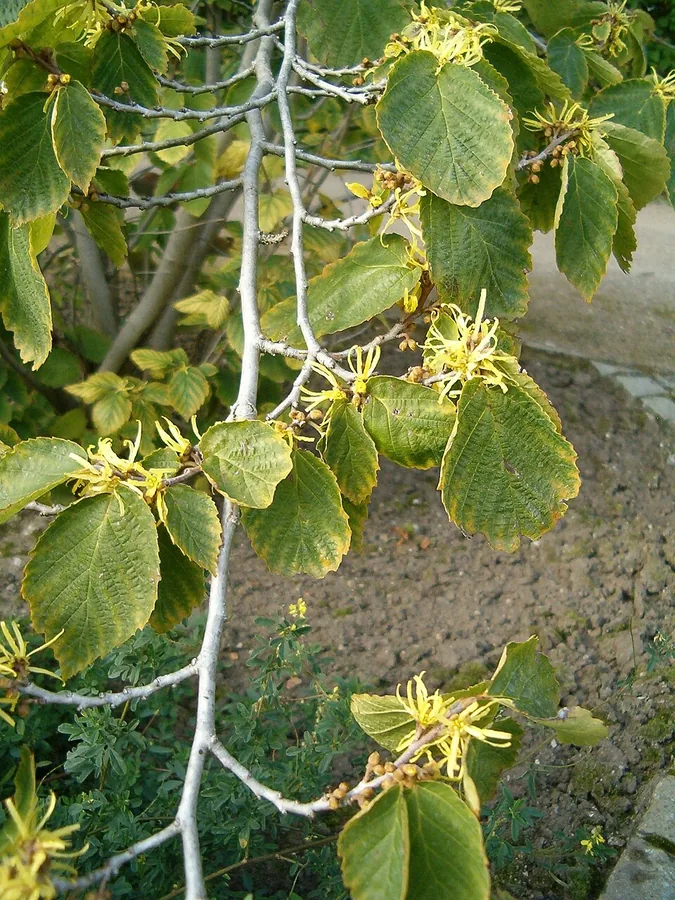
Witch hazel is distinctive for flowering at the close of the season rather than its height. A native of eastern North American woodland, it opens spidery yellow flowers from mid-October into December, frequently after leaf fall, when pollinator competition is low. The flowers release a clean, sweet fragrance carried on cold air, and the shrub is hardy enough to withstand winter minima of -35°F (-37°C).
In habit it develops into a large, multi-stemmed shrub or small tree, attaining 15 to 20 feet (4.5 to 6 m) in both height and spread with an open, vase-shaped form. Foliage assumes a warm yellow in autumn before abscission, and the bark and leaves yield the astringent witch hazel extract of the medicine cabinet, distilled for topical application.
Culturally this is an easy, undemanding species once established. It requires acidic, consistently moist soil and adequate light, and it tolerates cold, heavy clay, and deer browsing. Its one strict intolerance is drought, so a young plant must be irrigated through dry periods until its root system is deep enough to sustain it.
Care
The short version: full sun to partial shade, in moist, acidic, organically rich soil that is never allowed to dry out. Irrigate through dry spells, particularly while young, apply one feed in early spring, and allow room for the shrub to reach its full mature spread.
Light
Witch hazel performs best in full sun, where flowering is heaviest and autumn color develops most intensely. It accepts partial shade, but reduced light both diminishes bloom and, by limiting drying, predisposes the foliage to mildew.
Water
Maintain consistently moist soil, since this species has no drought tolerance. Irrigate every 5 to 10 days during dry spells, and monitor a young shrub through its first summers until the root system has extended deeply enough to draw its own water.
Soil
Plant into moist, acidic, organically rich soil with good drainage. A pH of 5.0 to 6.0 is optimal, and, unusually among shrubs, the species tolerates heavy clay, so a damp, dense site remains viable.
Temperature
Its cold-hardiness is exceptional among shrubs. Witch hazel endures the range from -35°F to 100°F (-37°C to 38°C), a tolerance that permits it to flower safely in late fall as neighboring plants enter dormancy.
Humidity
Ambient outdoor humidity is adequate, so no target value applies. Air movement is the operative factor rather than atmospheric moisture, because still, congested conditions allow powdery mildew to colonize the leaves.
Feeding
A single application suffices. Apply a balanced or acidic slow-release fertilizer in early spring, which releases nutrients gradually to carry the plant through the growing season.
Pruning
Pruning is largely unnecessary. Cut only to maintain form, and do so in early spring, bearing in mind that flowers are borne on old growth, so severe cutting sacrifices the following autumn's bloom.
Repotting
As a landscape shrub, witch hazel seldom requires repotting. If a young specimen is grown in a container, pot it on when roots begin circling or emerging from the drainage holes, or when top growth stalls despite adequate water and nutrition.
Size & spacing
Allow generous space. The shrub reaches 15 to 20 feet (4.5 to 6 m) in both height and spread, so site it well clear of structures and other plantings to let the open, vase-shaped framework develop unimpeded.
When to plant
Witch hazel flowers on its own phenological schedule, blooming in late fall while surrounding plants are dormant. Establish it in spring or fall so the roots can develop before the stresses of summer heat or deep winter, and expect the fragrant flowers from mid-October onward, often persisting on bare branches after the leaves have abscised.
Northern hemisphere
Southern hemisphere
Typical months for a temperate climate: start earlier in warm zones, later where spring frosts linger.
- Sow: Sow seed after warm then cold stratification; germination usually within a year.
- Plant: Spring or fall
- Harvest: Fragrant yellow flowers mid-October to December, often as or after leaves drop
Hardiness
USDA hardiness zones: 3–8
Temperature: down to -40°C
Troubleshooting
Witch hazel is notably free of serious problems, and nearly everything that appears is cosmetic rather than a threat to health. Most disorders present on the foliage in late summer. Identify the symptom below, then judge whether any intervention is actually warranted.
White fungal film advancing over the leaf surface
This is powdery mildew, a fungus that establishes where humidity is high, shade is deep, and air sits still. Because the pathogen depends on stagnant, sheltered conditions, thinning crowded stems to restore air movement removes the very environment it needs. Remove the most heavily colonized leaves, and keep irrigation off the foliage so surfaces dry quickly. On a vigorous shrub the infection is cosmetic and rarely reduces long-term health.
Fix:
- Improve air circulation by thinning crowded stems
- Remove and dispose of heavily infected leaves
- Avoid overhead watering
Cone-shaped or spiny outgrowths on the foliage
These structures are induced by witchhazel gall aphids, whose feeding stimulates the leaf tissue to grow around them and form a protective gall. Since the galls are the plant's own contained response and do not impair its function, the sound course is to leave them in place. Where appearance matters, excise and destroy the most heavily galled leaves; chemical intervention is seldom justified.
Fix:
- Tolerate damage, which is largely cosmetic
- Remove and destroy heavily galled leaves if desired
Irregular chewing damage along the leaf margins
Defoliating caterpillars and Japanese beetles are responsible for most of the chewing seen on witch hazel foliage. Because an established shrub carries far more leaf area than these insects can consume, its capacity to photosynthesize is unaffected, so light feeding warrants no treatment. Where populations remain low, handpicking removes the feeders before the damage accumulates.
Fix:
- Handpick beetles and caterpillars when populations are small
- Tolerate minor feeding, which rarely harms established plants
Toxicity
For households with animals the assessment is reassuring: witch hazel is safe around pets, livestock, and people. It is absent from the ASPCA toxic list, and ingestion of a small quantity produces no more than brief, mild gastrointestinal upset. Its bark and leaves are, in fact, the raw material for the familiar astringent skin toner, a preparation formulated for the skin rather than for consumption.
Safe for
People · Cats · Dogs · Horses · Rabbits · Livestock · Birds
Cats None
Cats face no toxic risk. Any reaction is limited to mild salivation or transient gastrointestinal upset if leaf material is ingested.
Dogs None
Dogs are equally unaffected. Ingested foliage produces at most brief, self-limiting stomach upset rather than true toxicity.
Horses Safe
Horses can graze in proximity without hazard, as the species contains no compound known to be toxic to equines.
Rabbits Safe
Rabbits tolerate the foliage well. Browsing on the leaves yields no harm beyond, at most, temporarily softened stool.
Livestock Safe
Cattle, goats, and sheep may browse the foliage safely, since it holds no principle poisonous to ruminants.
Birds Safe
Birds are at no risk, whether feeding on the seed or roosting within the branches.
People Safe
People are safe as well. The bark and leaves are distilled into the astringent skin toner, a topical preparation intended for external use rather than ingestion.
No special handling required; ingestion of any plant material may cause mild, transient gastrointestinal upset.
Varieties
The straight species predominates in cultivation, but a small number of selections merit attention for their stature or floral color. The following are the cultivars most often encountered.
Harvest Moon
A vase-shaped selection that attains 15 to 20 feet in height and bears clear lemon-yellow flowers.
Little Suzie
A dwarf cultivar restricted to roughly 4 to 6 feet, carrying soft yellow flowers on a compact habit.
Mohonk Red
A pigmented selection notable for reddish-toned flowers that depart from the yellow typical of the species.
How to propagate
Witch hazel propagates slowly and with difficulty, which accounts for the price of nursery stock. No method is rapid, so select the one whose demands match your available time and patience.
SeedDemanding
Sow after warm then cold stratification · Up to or more than a year due to double dormancy
Seed propagation is exacting because the seed exhibits double dormancy, a combined embryo and coat dormancy that must be broken in sequence. Supply roughly 60 to 90 days of warm stratification near 60°F (16°C) to satisfy the first requirement, then follow with 90 to 120 days of cold near 40°F (4°C) to release the second. Even with both cues met, germination commonly extends up to a year.
LayeringModerate
Growing season · One or more seasons
Layering succeeds because a stem in contact with moist soil forms adventitious roots while still supplied by the parent. During the growing season, bend a low branch to the ground and pin it by trench or simple layering; over a season or more it develops an independent root system, after which it can be severed and lifted.
GraftingDemanding
Late summer · One or more seasons
Named cultivars are propagated almost exclusively by T-grafting onto Hamamelis virginiana rootstock in late summer, with the graft union requiring a season or more to fuse fully. Nurseries default to grafting because softwood cuttings of witch hazel root poorly and seldom establish, making vegetative increase by cutting unreliable.
Myths
Witch hazel is named for witchcraft or magic.
The name has no connection to sorcery. It derives from the Old English 'wych', meaning pliant or bendable, a reference to the supple forked branches of the shrub. Those flexible branches were historically cut as divining rods for dowsing water, and it is this practice of 'witching' for water, not any occult association, from which the folklore descends.