Ornamental · Asteraceae
Common Sneezeweed
Helenium autumnale
Give it full sun and damp soil, cut it back in June, and sneezeweed sets the late border ablaze.
Full sun
Every 2–4 days
USDA 3–8
3–5 ft · 0.9–1.5 m
Overview
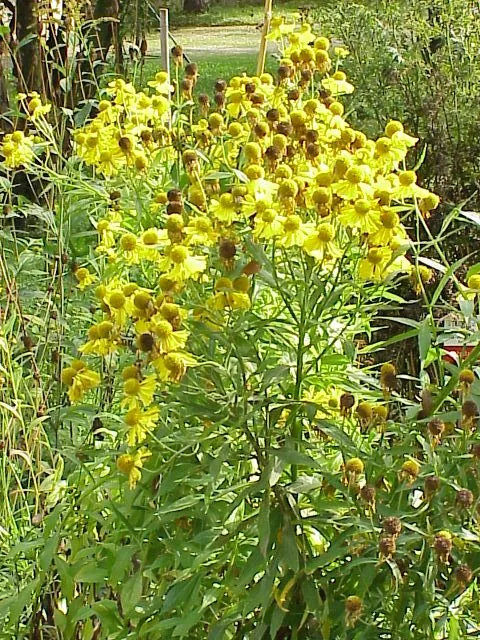
Helenium autumnale carries the late border, opening its ray-flowered daisies in warm yellow, orange, bronze, and red as the season turns. A North American composite of wet meadows and streambanks, it belongs to the aster family and supports late-flying bees and butterflies when little else is in flower. Its common name misleads almost everyone, because it references no allergy despite the sneezeweed label.
This is a tall, clump-forming perennial that attains 3 to 5 feet (91 to 152 cm) under favorable conditions. Its cold tolerance is exceptional, extending to zone 3, and its single non-negotiable requirement is soil moisture, since the species evolved in ground that does not dry. Sited in a damp, sunny position, the clump expands and performs more strongly each season.
Height management is the one cultural task to anticipate. In rich soil the internodes elongate, the stems weaken, and the plant lodges after storms. A cutback in early June holds it shorter and bushier so it stands unaided, and this single operation separates a compact, self-supporting stand from a sprawling one.
Care
The short version: full sun and soil that stays reliably moist, never dry. Cut the plant back by half in early June for sturdy stems, feed it lightly if at all, and divide the clump every few years.
Light
Site sneezeweed in full sun, no less than six hours daily, which the plant needs to flower fully and support its own height. It accepts light shade, but under too much of it the stems etiolate, lean, and set fewer flowers.
Water
As a wet-meadow species, it demands soil kept moist to wet and never allowed to dry, because its root system is not adapted to drought. Irrigate every two to four days, and more frequently under heat or in fast-draining sandy soil. Drought is the single condition it will not tolerate.
Soil
Grow it in average to rich, moisture-retentive soil, including heavy clay, amended with abundant organic matter to hold water. The only substrate it rejects is dry ground, which makes a low, damp site or a rain-garden margin ideal.
Temperature
Cold hardiness is unusually deep, with survival to -40°F (-40°C) in zone 3, and the plant withstands summer heat provided the roots remain wet. That functional range from -40°F to 100°F (-40°C to 38°C) underlies its adaptability across much of the continent.
Humidity
Ambient outdoor humidity is not itself limiting, so no target value applies. What governs foliar health is air movement, since humid, still air within a crowded canopy is precisely the condition under which mildew and rust establish.
Feeding
Fertilize minimally or not at all. A light dressing of balanced fertilizer or compost in spring suffices, and excess nitrogen is counterproductive, driving the weak, elongated growth that lodges and requires staking.
Pruning
The essential operation is the early June cutback, removing roughly half the plant at least six weeks before flowering to force shorter, bushier, structurally sound stems. Deadhead spent inflorescences through the season to extend bloom, and stake the tallest stems if they still lean.
Repotting
Sneezeweed grows in the ground rather than a container, but the clump still requires renewal. Divide it every three to four years in spring, because the crown center dies out and turns woody while the peripheral growth remains vigorous.
Size & spacing
Expect a mature clump 3 to 5 feet (91 to 152 cm) tall and 2 to 3 feet (61 to 91 cm) wide. Allocate that footprint per plant so air moves through the stand and the foliage dries quickly.
When to plant
The species runs on a long, cool-tolerant cycle. Sow indoors in late winter or transplant divisions after the last frost, apply the June cutback to the stems, and the inflorescences hold the border from late summer into fall.
Northern hemisphere
Southern hemisphere
Typical months for a temperate climate: start earlier in warm zones, later where spring frosts linger.
- Sow: Late winter to early spring, about 6-8 weeks before last frost; seed benefits from cold stratification.
- Plant: After last spring frost when soil has warmed.
- Harvest: Late summer to fall (August to October).
Hardiness
USDA hardiness zones: 3–8
Temperature: down to -40°C
Troubleshooting
Nearly every sneezeweed problem resolves to one of two conditions: foliage that stays wet and stems that grow too tall. Persistent leaf moisture in crowded stands invites the foliar fungi, while rich soil and a missed cutback produce lodging. Identify the pattern below, then intervene before it advances.
Weak stems lodging under their own height
Sneezeweed lodges when rich soil or surplus nitrogen drives fast, elongated growth that outpaces stem strength, and the tall shoots then sprawl under rain or wind. The reliable countermeasure is the early June cutback, which removes the top half of the plant so it rebranches from lower nodes into a shorter, wider, self-supporting frame. Support any remaining tall stems with stakes and hold fertilizer well below what encourages that surge.
Fix:
- Cut plants back by half in early June to encourage sturdier branching
- Stake or provide support for tall stems
- Reduce fertilizer, especially nitrogen
White powdery film across the foliage
That whitish bloom is powdery mildew, a fungus that colonizes foliage once crowding and stagnant air raise the humidity at the leaf surface. Reduce that microclimate by thinning and spacing the clumps so air passes through the canopy, and irrigate at the crown rather than overhead so leaves stay dry. Strip the most infected foliage, and apply a labeled fungicide only where the disease continues to advance.
Fix:
- Improve air circulation by thinning and spacing plants
- Remove and discard affected foliage
- Avoid overhead watering and water at the base
- Apply a labeled fungicide if severe
Dark lesions developing on the leaves
Prolonged leaf wetness is the trigger for fungal leaf spot, since the spores need a film of moisture to germinate and infect. Lesions open as brown to black flecks, at times bordered by a yellow halo, and coalesce as the season goes on. Excise and destroy affected leaves, keep irrigation off the canopy, and clear fallen debris in autumn to remove the overwintering inoculum.
Fix:
- Remove and destroy infected leaves
- Water at the base to keep foliage dry
- Improve spacing and airflow
- Apply a labeled fungicide if widespread
Orange pustules on the lower leaf surface
Raised orange, yellow, or brown pustules on the abaxial surface are the fruiting bodies of rust, a fungus that sporulates in damp, humid air and spreads from wet foliage. The upper surface usually carries matching yellow flecks over each pustule. Remove infected leaves as soon as they appear, open the stand to improve airflow, and stop wetting the canopy so the spores lose the moisture they need.
Fix:
- Remove affected leaves promptly
- Increase air circulation and reduce leaf wetness
- Apply a labeled fungicide if severe
Toxicity
Around animals and children, handle sneezeweed as ornamental rather than edible. Its tissues contain bitter sesquiterpene lactones, including helenalin, that irritate the digestive tract of pets and can poison grazing livestock consumed in quantity. The sap is a contact irritant as well, so no part of the plant is safe to ingest and gloves are advisable during cutback.
Toxic to
Cats · Dogs · Horses · Rabbits · Livestock · Birds · People
Cats Toxic
The foliage carries helenalin and other bitter sesquiterpene lactones that make it unsafe for a cat to chew. A light nibble commonly produces hypersalivation and loss of appetite, while a larger dose brings on vomiting and a listless, unsettled gut.
Dogs Toxic
Ingestion irritates a dog's gastrointestinal tract, so drooling and vomiting follow the bitter sap, usually with abdominal discomfort and lethargy behind them. The intense bitterness works as a deterrent, and most dogs reject the plant before consuming a meaningful amount.
Horses Toxic
Grazing can genuinely injure horses. The sesquiterpene lactones provoke hypersalivation, colic-like abdominal pain, weakness, and a dull, depressed demeanor, and cumulative intake over several days accounts for the most severe cases.
Rabbits Toxic
Exclude this species from the hutch and run without exception. The bitter, helenalin-bearing foliage can leave a rabbit drooling, anorexic, and weak, so it must never enter the forage supply.
Livestock Severe
Grazing animals, especially sheep, can develop chronic vomiting (spewing sickness), depression, weakness, coughing, and emaciation, which can be fatal if large amounts are eaten over days.
Birds Toxic
The toxin is distributed throughout the tissues, so poultry and pet birds should be kept off the plant entirely. A bird that pecks the bitter leaves or seed heads can become hypersalivating, subdued, and unwilling to feed.
People Caution
No part of the plant is edible, and the bitter foliage causes gastric upset if swallowed. The sap is also a contact irritant that can redden skin, so gloves are warranted during cutback and children should be kept from mouthing any part.
Wear gloves when handling or cutting back, as sap and foliage can irritate skin and mucous membranes. Keep pets and livestock from grazing the plant.
Helpline numbers

United States
ASPCA Animal Poison Control: (888) 426-4435 (fee applies)
Poison Control: (800) 222-1222



Canada
Poison Centres: 1-844-764-7669
Varieties
Breeding has yielded shorter, sturdier, more intensely colored selections than the wild type. The following are the cultivars most often offered in the trade.
Mardi Gras
A compact selection that produces orange, yellow, and red bicolor florets over an extended late-summer-to-fall bloom period.
Moerheim Beauty
An established cultivar noted for its copper-toned, bronze-red daisy flowers.
Salud Embers
A compact, densely branched red-and-yellow selection whose sturdy stems stand without appreciable staking.
Companions
Plant near
Asters: Share the same moist soil, full sun, and late-season bloom period for a coordinated fall display.
Joe-Pye weed: A native that thrives in the same moist meadow conditions and complements sneezeweed in rain gardens and borders.
Ornamental grasses: Provide support and contrasting texture for tall sneezeweed stems in naturalized plantings.
How to propagate
Three methods increase sneezeweed, and the appropriate one depends on your objective: rapid plants, inexpensive plants, or genetically identical copies of a named selection.
DivisionEasy
Spring, every 2-3 years · One growing season
Division is the simplest method of increase and doubles as a vigor treatment for aging clumps. Lift a clump in spring, separate it, and replant the healthy outer divisions, which reestablish and fill in over one growing season. Repeating it every two or three years also forestalls the dieback that hollows out the crown.
SeedModerate
Late winter to early spring (sow indoors) or fall outdoors · Blooms typically in the second year from seed
Seed propagation is slower and has specific requirements. Surface-sow it because germination is light-dependent, and provide cold stratification to break dormancy, whether sown indoors in late winter or outdoors in fall. Seedlings generally flower in their second year, and named cultivars do not reproduce true from seed.
Stem cuttingsModerate
Late spring to early summer · Several weeks to root, established by end of season
Cuttings are the method to reproduce a named cultivar with fidelity. Take basal shoots from soft new growth in late spring or early summer; they root over several weeks and establish by season's end.
Myths
Sneezeweed triggers hay fever and makes you sneeze from its pollen.
The common name records a historical use of the dried, powdered leaves as a sneeze-inducing snuff, not any airborne exposure. As an insect-pollinated composite, it produces heavy, sticky pollen that is not shed into the air. It is not a meaningful airborne allergen.