Ornamental · Asteraceae
Joe Pye Weed
Eutrochium purpureum
Sited in full sun with reliably moist soil, Joe Pye weed commands the late-season border amid clouds of foraging pollinators.
Full sun
USDA 4–9
5–7 ft · 1.5–2.2 m
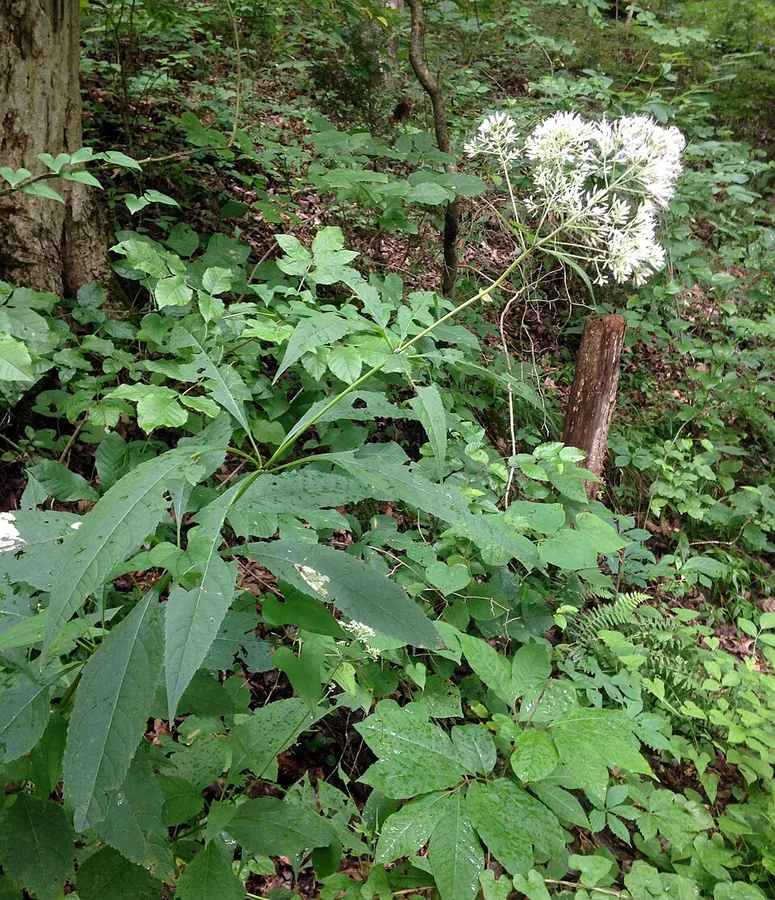
Overview
Joe Pye weed is a tall herbaceous perennial native to eastern North America, well suited to the rear of a sunny, moist border. Between midsummer and early fall it produces broad domed clusters of dusky mauve-pink flowers atop stems reaching 5 to 7 feet (150 to 215 cm), and those blooms are a dependable draw for butterflies and bees throughout the flowering period.
The common name misrepresents the plant. It is clump-forming and slow to spread, holding its footprint rather than colonizing, undemanding in cultivation, and increasing in stature each season. Its one firm requirement is soil moisture, which makes it a sound selection for a rain garden, a pond margin, or any consistently damp low ground.
As a member of the aster family it shares that family's capacity to sustain late-season pollinators at the point in the year when nectar sources elsewhere decline. Sited with room to develop and supplied with reliable moisture, it needs little further intervention.
Care
The short version: full sun and consistently moist, fertile soil. Irrigate through any dry spell, since drought is the sole condition it will not tolerate, and cut the spent stems to the ground in late winter.
Light
Flowering is best in full sun, and the plant tolerates partial shade, but the cost of low light is quickly apparent. Under insufficient light the stems elongate, lean, and flop rather than standing upright, since weak, drawn growth cannot support its own height.
Water
This is a moisture-demanding species that wants consistently damp to occasionally wet soil and has no drought tolerance. When the soil dries the leaf margins scorch, so deep watering during dry spells maintains the supply the foliage needs and sustains vigorous growth.
Soil
It grows in moist, fertile, humus-rich ground, whether clay, loam, or sand, and unlike many perennials it accepts wet sites. It is broadly adaptable to pH, performing across the range 5.5 to 8.0.
Humidity
Ambient outdoor humidity is not a limiting factor for this plant. The decisive variable is air movement around the foliage, because crowded, still air is what allows powdery mildew and rust to establish.
Feeding
In rich, moist ground the plant is largely self-sufficient and requires little to no supplemental feeding. On lean soils a light application of compost during the growing season supplies what is needed.
Pruning
Cut the spent stems to the ground in late winter or early spring to clear the crown for new shoots. A reduction of about half in early summer produces shorter, sturdier growth and lessens the tendency to flop.
Size & spacing
This is a large perennial, 5 to 7 feet (150 to 215 cm) in height and 2 to 4 feet (60 to 120 cm) in spread at maturity. Positioning it at the back of a border with generous spacing preserves the air movement that keeps the foliage healthy.
When to plant
Joe Pye weed follows the warm-season cycle of a hardy herbaceous perennial. Plants are set out after the last spring frost, develop over the growing season, and flower from July into September before dying back for winter.
Northern hemisphere
Southern hemisphere
Typical months for a temperate climate: start earlier in warm zones, later where spring frosts linger.
- Sow: Sow seed after about 3 months cold-moist stratification; germination is slow and rates are low
- Plant: After last frost in spring
- Harvest: Blooms July to September (summer to early fall)
Hardiness
USDA hardiness zones: 4–9
Temperature: down to -34°C
Troubleshooting
Most disorders in Joe Pye weed reduce to one of two conditions: soil that has dried below its tolerance, or stagnant air within a crowded planting. Both register first on the foliage. Identify the symptom below and correct the underlying condition rather than treating the surface sign.
Brown, crisp edges along the leaves
Browned, crisped margins are classic leaf scorch, the visible result of soil moisture falling below what the plant can draw on. Because Joe Pye weed is intolerant of drought, the leaf edges, farthest from the vascular supply, desiccate first in fast-draining or sun-baked ground. Deep watering through dry spells and a moisture-holding mulch address the cause, and a permanently drier site is best corrected by relocation to a rain garden or pond margin.
Fix:
- Water deeply during dry periods
- Mulch to retain soil moisture
- Relocate to a moister site such as a rain garden or pond margin
Chalky white coating developing over the leaf surfaces
A powdery white bloom on the foliage is powdery mildew, a fungal disease favored by the humid, still air of a crowded planting. Adequate spacing restores the air movement that keeps leaf surfaces from staying wet long enough for infection, and watering at the base rather than overhead denies the fungus that moisture. Removing the worst foliage reduces the spore load, and the damage remains largely cosmetic.
Fix:
- Improve air circulation by spacing plants
- Avoid overhead watering
- Remove affected foliage
Tall stems that stretch, lean, and flop
Legginess and flopping trace to insufficient light, which drives the stems to elongate toward the source and leaves them too weak to bear their own height. Full sun produces the shorter, stouter growth that stands unaided. A cutback of about half in early summer triggers denser, lower branching for the same effect, and staking supports any remaining tall stems.
Fix:
- Site in full sun
- Cut plants back by about half in early summer to encourage sturdier, shorter growth
- Stake tall stems if needed
Orange to brown pustules studding the lower leaf surface
Raised orange-to-brown pustules on the lower leaf surface are the spore-bearing structures of rust, a fungus that, like powdery mildew, establishes in damp, stagnant air. Prompt removal of infected leaves lowers the inoculum before it spreads. Opening the planting for air movement and keeping the foliage dry deprive the spores of the conditions they need to germinate.
Fix:
- Remove and dispose of affected leaves
- Improve air circulation
- Avoid overhead watering
Toxicity
For households that keep animals, the record is reassuring: approved horticultural sources do not list Joe Pye weed as toxic to pets, livestock, or people. It is a valued pollinator plant and safe to grow where cats, dogs, horses, and grazing animals are present.
Safe for
People · Cats · Dogs · Horses · Rabbits · Livestock · Birds
Cats None
No toxicity to cats appears in the horticultural record. An exploratory nibble carries no known risk, though ingesting a large quantity of any plant can produce a transient, mild gastric upset.
Dogs None
The record documents no toxic effect in dogs. A dog that mouths a stem or leaf faces no established hazard.
Horses Safe
The species is safe for horses, carrying no compounds known to harm them where it occurs in pasture or border.
Rabbits Safe
Rabbits may browse the foliage without recorded consequence, as no toxins are attributed to the plant.
Livestock Safe
Grazing cattle, goats, and sheep are unaffected. No incidents of livestock poisoning are on record.
Birds Safe
Birds face no hazard from the plant. Its flowers are a documented draw for butterflies and bees, and the species presents no threat to backyard or wild birds.
People Safe
No toxicity to people is documented, and the plant is regarded as a safe garden ornamental. It is not, however, cultivated as an edible, so consumption serves no purpose.
Varieties
The name Joe Pye weed covers several species and selections that separate chiefly on stature and stem character. The following are the ones worth distinguishing.
Eutrochium maculatum (Spotted Joe-Pye weed)
It is identified by its purple-spotted, solid-pith stems and flat-topped inflorescences, and its cold hardiness extends to zone 3 while it tolerates consistently wet ground.
'Gateway'
This is a more compact spotted Joe-Pye selection whose large dusky-pink flower clusters make it a notable draw for pollinators.
'Little Red'
A reduced-stature form of E. purpureum reaching roughly 3 to 4 feet, which suits it to a smaller garden setting.
Eutrochium fistulosum (Hollow Joe-Pye weed)
The largest of the group, distinguished by hollow lower stems and a substantial nectar yield on plants that can attain 10 feet.
How to propagate
Joe Pye weed can be raised from seed, the slower route, or increased by dividing an established clump, which is the method most growers prefer.
DivisionEasy
Fall as the plant goes dormant, or early spring · One growing season
Division is the most reliable method of increase for Joe Pye weed. Lift an established clump as it enters dormancy in fall, or in early spring, separate it into sections, and each division roots in and reaches full size within a single growing season.
SeedModerate
After about 3 months cold-moist stratification · Slow; germination rates are low
Seed propagation is markedly slower. The seed requires approximately 3 months of cold, moist stratification to overcome dormancy, after which germination remains uneven and low. Where speed matters, stem cuttings taken in late spring root readily and yield genetically identical plants.
Myths
Joe Pye weed behaves as an invasive that colonizes and dominates a planting.
The common name overstates its behavior. As a clump-forming native perennial, it increases slowly and holds its position, which is precisely why horticulturists cultivate it as a well-behaved ornamental and pollinator magnet rather than manage it as a weed.
Continuous saturation in swampy soil is essential to its survival.
Its preference for moisture does not amount to a requirement for saturated ground. It performs well in an ordinary bed provided the soil remains evenly moist and adequately drained, and it withstands the occasional wet interval. Drought is the single condition it cannot tolerate.