Shrub · Grossulariaceae
Gooseberry
Ribes uva-crispa
A cold-hardy fruiting shrub that performs on cool conditions, an open shape, and steady moisture.
Full sun
Every 5–7 days
USDA 3–8
3–5 ft · 0.9–1.5 m
Overview
The gooseberry is a thorny, deciduous fruiting shrub cultivated for centuries in temperate gardens for its tart-sweet berries. Taxonomically it sits within the genus Ribes alongside the currants, and its defining horticultural trait is cold tolerance: the bush withstands winter lows of -22°F (-30°C), well beyond the range of most cultivated fruit.
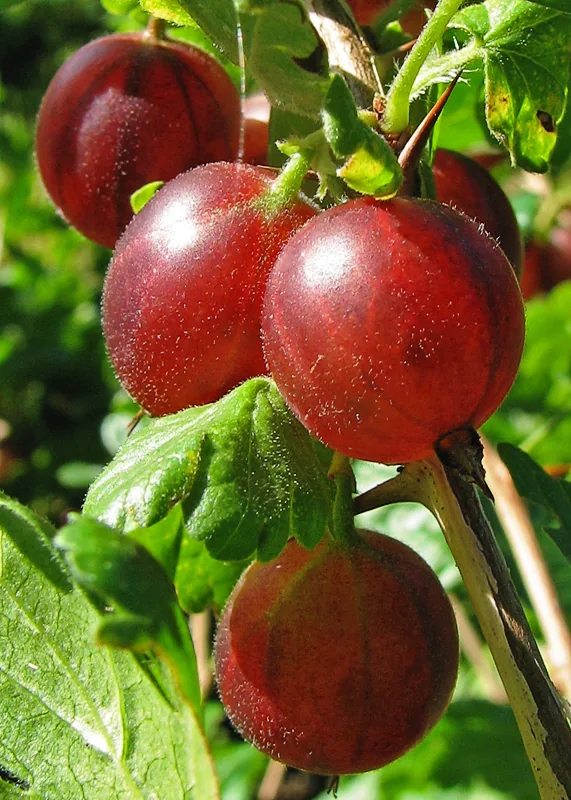
Mature plants form a rounded framework roughly 3 to 5 feet (90 to 150 cm) across, with arching canes that fruit on spurs borne on two- and three-year-old wood. Berry color spans green through red according to cultivar. Most selections are spined, though breeding has yielded near-thornless clones such as Captivator and Pixwell where handling is a concern.
The species is undemanding but has clear physiological preferences. It performs on cool roots, even moisture, and free air movement through an open canopy, and it declines under heat and drought stress. With correct siting and disciplined annual pruning, a single bush remains productive for well over a decade.
Care
The short version: full sun to partial shade in a cool, moist position, rich well-drained soil, roughly an inch of water per week, and a hard annual prune in late winter to hold the center open.
Light
Gooseberries accept full sun to partial shade, and light afternoon shade is beneficial in warm-summer regions. As cool-climate plants they respond to a fully exposed, baking site with heat stress and sunscald rather than improved cropping.
Water
Supply about 1 inch of water per week through the growing season and avoid moisture deficit while the fruit is sizing, since drought stress at that stage reduces yield. Mulching conserves soil moisture and keeps the root zone cool, which the species requires.
Soil
Establish the bush in fertile, well-drained loam enriched with organic matter. A pH of 6.0 to 7.0 is optimal, and sharp drainage is essential because the roots are intolerant of waterlogging.
Temperature
This is a markedly hardy shrub, tolerant across -22°F to 86°F (-30°C to 30°C). It requires winter chilling to fruit well and is more productive under cool summers than hot ones.
Humidity
Ambient humidity of 40% to 70% is unremarkable and needs no management outdoors. The operative factor is air movement through the bush, because prolonged leaf wetness in stagnant, humid air is precisely what enables powdery mildew.
Feeding
Apply nutrients once in early spring ahead of bud break, using a balanced fertilizer or composted manure. Supplement with nitrogen only where growth is demonstrably weak, since excess nitrogen produces the soft, mildew-prone tissue you want to avoid.
Pruning
Prune annually while the plant is dormant in late winter. Maintain an open-centered form, remove canes over 3 years old together with any low, crowded, or damaged growth, and retain the spurs on 2- and 3-year-old wood on which the crop is borne.
Repotting
Field bushes are not repotted, but a containerized specimen requires a larger container every 2 to 3 years. Roots circling the pot, reduced leaf size, slowed growth, and water passing straight through all signal that the plant is pot-bound.
Size & spacing
A mature bush attains 3 to 5 feet (90 to 150 cm) in height with a comparable spread. Allowing that spacing preserves air movement through the canopy, which suppresses the humid conditions foliar disease requires.
When to plant
Being a woody perennial, the gooseberry is established once and cropped for years. Plant it in early spring as soon as the soil is workable, or in late fall during dormancy. Flowering occurs in early spring, and the fruit ripens through June and July.
Northern hemisphere
Southern hemisphere
Typical months for a temperate climate: start earlier in warm zones, later where spring frosts linger.
- Plant: early spring as soon as soil is workable, or in late fall while dormant
- Harvest: blooms early spring; berries harvested June to July
Hardiness
USDA hardiness zones: 3–8
Temperature: down to -40°C
Troubleshooting
Almost all gooseberry disorders present on the foliage, arising either from fungi that exploit stagnant, humid air or from larvae feeding out of the bush interior. Early recognition, combined with the open architecture a well-pruned plant provides, limits most of them. Identify the pattern below, then intervene before it advances.
Powdery white bloom over shoot tips and developing fruit
The white bloom on soft tips and young fruit indicates American gooseberry mildew, a fungus that colonizes tender tissue when stagnant air and lush, nitrogen-fed growth give it the humid microclimate it needs. Left alone, the mycelium matures from white felt to a brown, corky crust that renders the berries unusable. Opening the canopy by pruning removes both the shelter and the succulent shoots the pathogen favors, and mildew-resistant stock such as Invicta or Captivator denies it a host outright.
Fix:
- Prune to open the canopy and improve airflow
- Remove and destroy infected shoots and berries
- Apply sulfur or an approved fungicide on a protectant schedule
- Replant with mildew-resistant cultivars such as Invicta or Captivator
Orange-yellow pustules beneath foliage preceding early leaf drop
Orange-yellow pustules on the lower leaf surface are the summer spore stage of white pine blister rust, a fungus that cannot complete its cycle without an alternate host, and Ribes fills that role. Heavy colonization drains the leaves and can force them off ahead of schedule, weakening the bush. Because the pathogen must shuttle between the two hosts, removing infected bushes, planting resistant cultivars, and keeping gooseberries clear of eastern white pine each break a required link in its life cycle.
Fix:
- Remove and destroy heavily infected Ribes
- Plant immune or resistant cultivars
- Keep bushes well away from eastern white pine
Rapid defoliation down to bare stems in days
Sudden defoliation down to bare stems is the work of the imported currantworm, the larval stage of the gooseberry sawfly. The green, dark-spotted larvae begin feeding low in the bush interior and radiate outward, so an unchecked brood can strip the plant within days. Handpicking clears light infestations, insecticidal soap or spinosad controls young larvae, and inspecting the lower interior leaves early in spring catches the first generation before it spreads.
Fix:
- Handpick larvae
- Apply insecticidal soap or spinosad to young larvae
- Inspect lower interior leaves in early spring for first feeding
Brown foliar lesions with basal defoliation by midsummer
Small brown to angular lesions that yellow the foliage point to fungal leaf spot, whose inoculum persists over winter in fallen leaves and reinfects the lowest canopy first as spring splashes it upward. The bush defoliates from the base up by midsummer, which is unsightly but rarely lethal. Removing the overwintered leaf litter cuts the source of new spores, pruning for airflow shortens leaf wetness, and an approved fungicide is warranted only where defoliation runs severe.
Fix:
- Rake and destroy fallen leaves
- Improve air circulation by pruning
- Apply an approved fungicide if defoliation is severe
Toxicity
For animal-keeping households the assessment is straightforward: gooseberry is not toxic. The foliage and ripe berries are safe for pets, livestock, and people, and the fruit is well worth eating. The single consideration is the sharp spines on the stems, a mechanical hazard rather than a toxicological one.
Safe for
People · Cats · Dogs · Horses · Rabbits · Livestock · Birds
Cats None
No part of the bush contains a compound that will poison a cat. The only hazard is mechanical: the sharp spines on the stems can lacerate a probing nose or paw.
Dogs None
Foliage and berries are non-toxic, so a dog can ingest them without any systemic effect. The risk that remains is the thorns, which warrant steering a chewer or digger away from the canes.
Horses Safe
The plant carries no toxin that a horse's system reacts to, so an incidental mouthful of foliage is metabolized without incident. The prickly stems are the element to keep away from a soft muzzle.
Rabbits Safe
Both foliage and ripe fruit are digestible and non-toxic to rabbits, and the berries serve as a sound occasional supplement. The one caveat is the spines on the woody stems.
Livestock Safe
Cattle, goats, and sheep can browse around the bush with no toxicological consequence. The thorny canes present a physical nuisance rather than a poisoning risk.
Birds Safe
Birds consume the berries without harm and frequently harvest a ripening crop before the grower does. Nothing in the tissue is toxic to them, leaving only the bristly stems to negotiate.
People Safe
The ripe berries are edible raw or cooked, and no part of the plant contains a poison of concern. The sole precaution is gloves during picking and pruning, since the spines are the only real hazard.
Most gooseberry bushes carry sharp spines or thorns on the stems and at the nodes that can prick skin and pets; the hazard is physical, not chemical. Wear gloves when pruning and harvesting.
Varieties
Named gooseberry cultivars are distinguished chiefly by berry color, degree of spination, and disease resistance. The selections below are the most horticulturally significant.
Captivator
An American-European hybrid whose near-absence of thorns and reliable powdery mildew resistance pair with sweet red dessert-quality berries.
Invicta
A productive green European cultivar selected principally for its exceptional resistance to powdery mildew.
Hinnonmaki Red
A Finnish selection bred for cold hardiness, combining sweet-tart red berries with dependable disease tolerance.
Pixwell
An American variety notable for extreme hardiness, near-thornless canes, and pink-blushed fruit.
Companions
Gooseberries do best beside plants that deter pests or feed the soil, and worst near the white pines that share their worst disease.
Plant near
Chives and other alliums: Their strong scent can help deter some foliage pests around the bush.
Comfrey: Deep roots draw up nutrients and the cut leaves make a useful potassium-rich mulch for fruiting shrubs.
Keep apart
Eastern white pine: Five-needle pines are the other host of white pine blister rust, so planting them nearby spreads the disease between the two.
How to propagate
Gooseberries propagate readily by vegetative means, and three methods are available depending on the propagator's patience and the size of the stock plant.
Stem cuttingsModerate
Late autumn while dormant · Roots over one season; bushes bear fruit in 1-3 years
Collect 8 to 12 inch hardwood cuttings from the current season's wood in late autumn during dormancy, and insert them two-thirds of their length into moist soil. Callus and root formation occur over the following season, after which the young bush enters production within 1 to 3 years.
LayeringEasy
Spring to summer · Rooted by the following spring
The most reliable method is layering, which roots a shoot while it still draws on the parent. Bend a low outer shoot to the soil anytime from spring through summer, pin and bury a section, and by the following spring it has rooted sufficiently to be severed.
DivisionModerate
Dormant season · One season
An established clump may be divided during dormancy. Lift the plant and separate the suckering growth into sections, each retaining functional roots and shoots, and the divisions reestablish over a single season.
Myths
Gooseberry cultivation is prohibited across all of the United States.
The federal prohibition was rescinded in 1966, so no blanket national ban exists. Legality now turns on your own state and county rules, and many jurisdictions permit rust-resistant cultivars.
Sweet gooseberry fruit requires prolonged heat and unshaded, blazing sunlight.
As cool-climate plants, they fruit well in partial shade and do not require extreme heat. Siting them in a hot, dry position induces sunscald and physiological stress rather than higher sugar content.