Shrub · Grossulariaceae
Currant
Ribes rubrum
Cold-hardy and reliably productive, the currant carries tart berries on a renewable framework of canes.
Full sun
Every 5–7 days
USDA 3–7
3–6 ft · 0.9–1.8 m
Overview
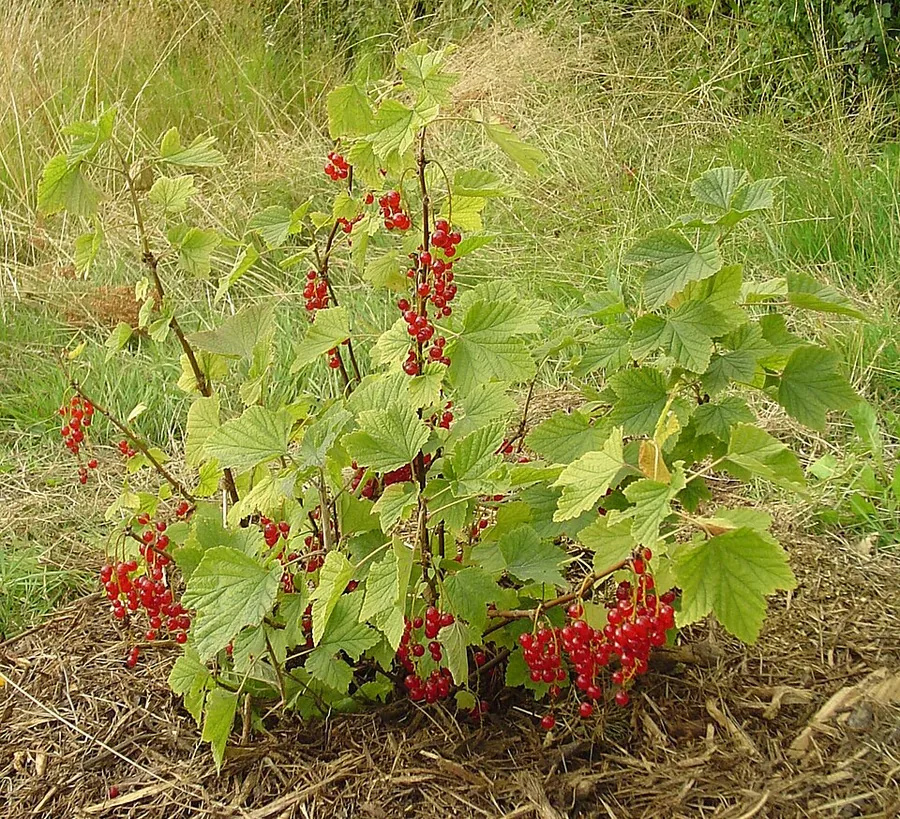
The currant is a small deciduous shrub cultivated for the clusters of glossy berries borne in early summer. Taxonomically it belongs to the genus Ribes, the same group as the gooseberry, and the garden types resolve into the bright red and pale white forms of Ribes rubrum and the darker, more aromatic black currant, Ribes nigrum. Because the fresh fruit is markedly acidic, most of the crop is processed into jam, jelly, juice, or pie filling.
Cold tolerance is the defining trait. The plant withstands winter temperatures down to -40°F (-40°C) and fruits dependably in the cool, short summers of USDA zones 3 to 7, conditions under which less hardy fruit underperforms. Mature size remains modest at 3 to 6 feet (90 to 180 cm), the shrub accepts considerable shade, and it persists for many years once established.
One epidemiological constraint governs siting. Currants are an alternate host for white pine blister rust, a disease whose life cycle requires both a Ribes and a five-needle white pine, which is why certain states still restrict planting, with black currant the most heavily regulated. Confirm local statutes, separate the bushes from white pines to break the cycle, and the currant proves one of the most forgiving fruits available to a beginner.
Care
The short version: full sun to part shade, rich well-drained soil held evenly moist at roughly an inch of water a week, and an annual late-winter prune that retains young wood and removes the spent canes that no longer fruit.
Light
Full sun drives the heaviest, best-ripened crop, yet the currant tolerates partial sun and even partial shade more readily than most fruit. In hot-summer regions, light afternoon shade is protective, since it moderates soil temperature and spares the shallow root system.
Water
Supply about 1 inch of water a week and avoid moisture stress during fruit set, when the developing berries are most vulnerable. The roots are shallow and fibrous, so a mulch layer is functional rather than decorative: it conserves moisture and keeps the soil cool over those near-surface roots.
Soil
The ideal medium is rich, well-drained loam amended with abundant organic matter, which supports the fibrous roots while shedding excess water. A slightly acidic pH of 6.0 to 6.5 is optimal for nutrient availability.
Temperature
This is a markedly cold-hardy shrub, enduring winter lows of -40°F (-40°C) and summer highs to about 86°F (30°C). Fruit quality is best where summers remain cool, consistent with the plant's temperate adaptation.
Humidity
Average humidity of 40% to 60% is adequate, and the absolute figure matters less than air movement. Free circulation through the canopy is what suppresses disease, because stagnant, humid growth is the microclimate in which mildew and rust establish.
Feeding
Apply one feeding per year, in late fall or early spring, as a few shovelfuls of composted manure or a balanced nitrogen source per plant. Broadcast it around the bush rather than into the planting hole, where concentrated fertilizer can scorch the roots by osmotic injury.
Pruning
Prune annually in late winter while the plant is dormant, timing that exploits the dormant carbohydrate reserves. Fruit is borne on 1-, 2-, and 3-year-old wood, so retain 3 to 4 canes of each age class and excise wood older than 3 years, which has passed its productive span, to keep the bush self-renewing.
Repotting
Field culture is the norm, so repotting is rarely required. A container specimen should be potted up every 2 to 3 years during dormancy, and earlier if roots begin circling or the substrate dries too rapidly, both signs the volume is now limiting.
Size & spacing
A mature bush attains 3 to 6 feet (90 to 180 cm) in height with a spread of 3 to 5 feet (90 to 150 cm). Spacing at that interval is a disease-management decision as much as a layout one, since it preserves the airflow that limits fungal infection.
When to plant
Currant phenology tracks a cool-season cycle. Establish dormant stock in late fall or early spring, expect greenish flowers through April and May, and harvest the ripening berries across June and July.
Northern hemisphere
Southern hemisphere
Typical months for a temperate climate: start earlier in warm zones, later where spring frosts linger.
- Plant: Late fall or early spring while plants are dormant, using 1- or 2-year-old stock
- Harvest: Greenish flowers in spring (April to May); berries ripen June to July
Hardiness
USDA hardiness zones: 3–7
Temperature: down to -40°C
Troubleshooting
Currant disorders concentrate on the foliage and canes, where symptoms surface early enough to act on. The few problems below are worth knowing in detail, because the right response depends on identifying the agent correctly. Read the symptom, confirm the cause, then intervene while the measure still changes the outcome.
Orange pustules on leaf undersides with early defoliation
Yellow-orange pustules on the leaf undersides accompanied by premature leaf drop are diagnostic of white pine blister rust, for which Ribes is the alternate host. The pathogen completes its life cycle only on five-needle white pines, so an infected bush serves as the bridge that delivers the rust to those pines. Remove and destroy heavily infected plants, separate currants from white pines, and select resistant or immune cultivars.
Fix:
- Remove and destroy heavily infected Ribes plants
- Plant rust-resistant or immune cultivars
- Keep currants away from white pines
White powdery growth on leaves and shoot tips
A white to gray powdery layer on leaf surfaces and shoot tips, often with distorted growth, indicates powdery mildew. The fungus colonizes crowded, shaded tissue, so opening the canopy by pruning restores the air movement that checks it, and removing the worst-affected tips eliminates the active inoculum. A labeled fungicide is justified only where infection becomes severe.
Fix:
- Prune to open the canopy for airflow
- Remove and destroy infected shoot tips
- Apply a labeled fungicide only if infection is severe
Individual canes wilting from a tunneled center
When one cane wilts and dies back while the rest of the bush remains healthy, the currant borer, the larva of a clearwing moth, is the likely agent. Cutting a dying cane lengthwise reveals the hollow, tunneled channel the larva excavates. Prune the infested canes to ground level and destroy them, and renew the bush by removing aging wood each year, since the older canes are the habitat the borer prefers.
Fix:
- Prune out and destroy infested canes to the ground
Red, blistered puckering on spring foliage
Red or yellow blistering raised on the upper leaf surface is the visible effect of the currant aphid feeding on the underside, where small colonies cluster along the veins. Targeting those undersides with insecticidal soap or horticultural oil contacts the insects directly, and conserving predators such as ladybugs provides ongoing biological control. The damage is cosmetic, so early scouting and treatment are usually sufficient.
Fix:
- Spray insecticidal soap or horticultural oil on undersides
- Encourage beneficial predators such as ladybugs
Toxicity
The verdict on the true garden currant is straightforward: it is non-toxic across the board. The berries are an edible crop, and neither fruit nor foliage poses a hazard to pets, livestock, or people. The single caveat lies elsewhere, because the dried 'currants' sold for baking are in fact small raisins, and grapes and raisins are toxic to dogs, so those products warrant care.
Safe for
People · Cats · Dogs · Horses · Rabbits · Livestock · Birds
Cats Safe
The true Ribes currant is non-toxic to cats. Most cats disregard the shrub in any case, and an occasional nibbled leaf is harmless.
Dogs Safe
The living plant and its fresh berries are safe for dogs. A dog that consumes a large quantity of fruit may develop transient loose stool, but no more serious effect.
Horses Safe
Horses may browse the foliage without consequence, as no part of the currant bush is poisonous to them.
Rabbits Safe
Rabbits can take the leaves and fruit safely. Treats should remain limited, since excess sweet fruit can disturb a small digestive tract.
Livestock Safe
Cattle, goats, and sheep are unaffected by the plant and may graze around it without risk.
Birds Safe
Birds are strongly attracted to ripe currants, and the fruit is wholesome for them. Netting is advisable if any of the crop is to be retained.
People Safe
For people the berries are a legitimate food crop, consumed fresh or processed into jams, jellies, and juice, with no associated hazard.
No special handling needed for the living Ribes shrub or its fresh berries.
Varieties
The cultivated currants fall into red, white, and black types, supplemented by a few named cultivars worth distinguishing. The selections below are the ones most often encountered.
Black currant (Ribes nigrum)
A close relative grown for its aromatic, musky black berries, it is appreciably more susceptible to white pine blister rust than red currant, which is why several US states restrict or ban it outright.
White currant
A pale, translucent form of Ribes rubrum whose flavor is sweeter and milder than that of the red type.
Red Lake
A heavy-cropping red currant that presents its bright fruit in long clusters known as strigs and is planted more widely than nearly any other cultivar.
Titania
A vigorous black-currant type reaching roughly 6 feet that carries notably better disease resistance than most.
Companions
Currants get along with their fellow Ribes but should be kept clear of white pines, which they trade a serious disease with.
Plant near
Gooseberry (Ribes uva-crispa): A fellow Ribes with the same cool-climate, partial-shade-tolerant culture, so it grows easily alongside currants under matching care.
Keep apart
Eastern white pine (Pinus strobus): Ribes is the alternate host for white pine blister rust; planting currants near 5-needle white pines spreads the disease to the pines.
How to propagate
Currants propagate readily by vegetative means, and because both methods are clonal, the resulting plants are genetically identical to the parent.
Stem cuttingsEasy
Take dormant hardwood cuttings in late winter; semi-hardwood cuttings can be taken mid-July to first freeze · Roots form within one growing season; a transplantable plant in 1 to 2 years
Cuttings are the standard method and yield clones true to the parent. Take 8 to 10 inch lengths of mature, dormant wood in late winter, or softer semi-hardwood material from mid-July to the first freeze. Rooting occurs within a single growing season, and the plants are transplantable in 1 to 2 years.
LayeringEasy
Spring through summer · Rooted layers ready to sever the following dormant season
Layering is simpler still and exploits the cane's capacity to root from buried tissue. Bend a low outer branch to the ground and pin it any time from spring through summer, and it forms roots at the point of soil contact. Sever the rooted layer from the parent the following dormant season.
Myths
Currants are dangerous to dogs because dried currants are toxic.
The confusion is purely nomenclatural. The dried 'Zante currants' sold for baking are raisins produced from tiny Corinth grapes, and those genuinely harm dogs. The garden currants of the genus Ribes, red, white, and black, are an unrelated plant and are safe.
Growing any currant is illegal in the United States.
The federal prohibition, originally enacted to slow white pine blister rust, was rescinded in 1966. Regulation now rests with individual states, and black currant (Ribes nigrum) attracts the most restrictions because it hosts the rust more readily than the red or white forms.