Tree · Pinaceae
Eastern White Pine
Pinus strobus
A fast-growing, soft-wooded conifer, eastern white pine forms a five-needled evergreen framework where acidic, well-drained ground gives its roots room.
Full sun
Every 7–14 days
USDA 3–8
50–80 ft · 15.2–24.4 m
Overview
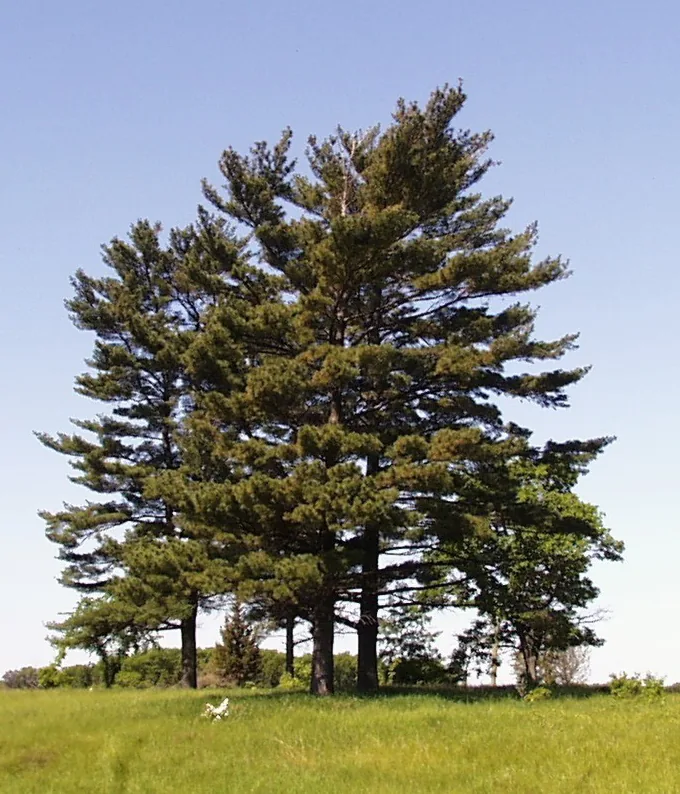
Eastern white pine is the soft-needled white pine of the northern forest, distinguished by bluish-green needles borne five to a bundle, a hallmark of the white pine group. Rapid height growth paired with a long lifespan lets old trees exceed 100 feet over the course of centuries. In the landscape that vigor makes it useful as a screen, a windbreak, or a large specimen.
Its physiology favors moist, acidic, well-drained soil under full sun to light shade. Roots perform poorly in heavy, saturated, or compacted ground because oxygen exchange fails there, and the foliage is injured by road salt and airborne pollutants, so open rural or suburban sites suit it. Cold hardiness runs from zone 3 to zone 8, with tolerance to -40°F (-40°C).
Two structural realities govern its management. The low-density wood is prone to storm and ice breakage, and the dominant terminal leader is the preferred target of the tree's key pest and its most serious disease. Site it away from buildings, walks, and roads, allow the root system full spread, and the balance of its care is modest.
Care
The short version: site it in full sun to part shade on moist, acidic, well-drained soil, irrigate while young to keep root growth steady, and give it open ground clear of salt and roadways.
Light
Growth is strongest in full sun, though the tree carries an open, layered crown under partial shade as well. Deep shade reduces available light below what the canopy needs, so the crown thins and the form weakens.
Water
Young trees need consistently moist, well-drained soil, so irrigate through dry spells until the root system is established and self-supporting. After establishment the tree is fairly drought tolerant, but it will not withstand wet, compacted, or poorly drained soil, where oxygen-starved roots decline. An interval near every 7 to 14 days suits the early years, adjusted to rainfall.
Soil
The species is adapted to moist, fertile, acidic loam or sandy soil with free drainage. A pH of 4.5 to 6.0 matches its nutrient chemistry, and alkaline or heavy ground impairs uptake and root function.
Temperature
It tolerates a broad thermal range, from -40°F to 95°F (-40°C to 35°C), consistent with hardiness zones 3 to 8. Extreme cold is well within its limits, while combined heat and drought on a marginal site imposes the real physiological stress.
Humidity
Ambient outdoor humidity meets its needs, so no target value applies. Air movement is the operative factor, because stagnant, humid air prolongs needle wetness and favors infection by blister rust and other fungi.
Feeding
On adequate native soil an established tree seldom requires supplemental nutrients. Apply a balanced or slow-release acidic tree fertilizer in spring only where growth is demonstrably poor, and then at low rates to avoid excess.
Pruning
Keep intervention minimal, pruning in late winter to remove dead, damaged, or weevil-killed leaders and to train a single central leader. Avoid heavy shearing, which disrupts the natural whorled, layered architecture.
Repotting
not applicable as a landscape tree
Size & spacing
This is a large-statured tree, typically 50 to 80 feet (15 to 24 m) tall with a spread of 20 to 40 feet (6 to 12 m), and mature specimens exceed 100 feet. Allocate that full footprint and keep it clear of buildings, walks, and roads.
When to plant
As a conifer it sets no flowers, so timing turns on establishment rather than bloom. Plant in spring or fall while soils are cool and moist to reduce transplant stress, and start seed in late winter after cold stratification breaks dormancy. Pollen sheds in late spring, and the slender cones require a second year to mature.
Northern hemisphere
Southern hemisphere
Typical months for a temperate climate: start earlier in warm zones, later where spring frosts linger.
- Sow: Late winter after cold stratification of seed
- Plant: Spring or fall
- Harvest: Non-flowering conifer; sheds pollen in late spring and produces slender 4-8 in cones that mature in the second year
Hardiness
USDA hardiness zones: 3–8
Temperature: down to -40°C
Troubleshooting
Most disorders register first on the needles or the terminal leader, and the damaging ones trace to an unsuitable site or a nearby alternate host. Reading these early signs allows pruning or resiting before damage becomes lethal. Match the symptom below to its cause, then intervene while control is still effective.
Yellowing needles over swollen, resin-oozing branch cankers
These signs indicate white pine blister rust, the most destructive disease of the species, lethal once a canker girdles the main stem and cuts off vascular flow. The pathogen is heteroecious and cannot complete its cycle without a nearby Ribes host, the currants and gooseberries. Excise infected branches at least 4 inches into sound wood below the canker, eliminate accessible Ribes, and open the canopy so foliage dries faster.
Fix:
- Prune out infected branches at least 4 in into healthy wood below the canker
- Remove or avoid planting near currants and gooseberries (Ribes)
- Improve air circulation to reduce needle wetness
- Plant rust-resistant stock where available
Terminal leader collapses into a drooping shepherd's crook
The cause is the white pine weevil, whose larvae mine and girdle the terminal leader, killing the top and often producing a forked or crooked stem. Remove and destroy the infested leader before adults emerge in mid-July to break the generation, then train a lateral branch upward as the replacement leader. Growing the tree beneath a light overstory measurably reduces attack rates.
Fix:
- Prune out and destroy infested leaders before adult weevils emerge in mid-July
- Train a side branch up as a new central leader
- Apply registered insecticide to terminals in early spring where infestations are chronic
Crown thins progressively with no single causal pest
This pattern reflects white pine decline, a stress complex rather than a discrete pathogen. It develops on unsuitable sites where compacted, waterlogged, droughty, or alkaline soil conflicts with the tree's requirement for moist, acidic, well-drained ground. Relieve the underlying stress by improving drainage, mulching, and irrigating through drought, and exclude traffic and grade changes from the root zone.
Fix:
- Improve drainage and avoid soil compaction over the root zone
- Mulch and water during drought to relieve stress
- Avoid disturbing roots and grade changes near the trunk
Needle tips scorch on the side facing a roadway
Eastern white pine has low tolerance for road salt and air pollution, and tip burn nearest a road is the diagnostic clue. De-icing salt delivered as spray or runoff is the primary agent, with sulfur dioxide and ozone contributing in urban settings. Because the sensitivity is inherent, correct placement is the true remedy: keep the tree back from salted roads, walks, and drives, and leach accumulated salt with deep spring irrigation.
Fix:
- Avoid planting near roads, walks, or driveways treated with de-icing salt
- Leach salts from soil with deep irrigation in spring
- Site away from sources of sulfur dioxide and ozone
Toxicity
Eastern white pine is not a documented toxicity risk to pets, birds, or people, and it lacks the isocupressic acid that makes certain pines abortifacient in cattle. The measured caution applies to grazing horses and livestock, where sustained needle consumption is best avoided, particularly in pregnant cattle. The practical nuisance is the resinous sap, which adheres stubbornly to fur, skin, and fabric.
Toxic to
Horses · Livestock
Safe for
People · Cats · Dogs · Rabbits · Birds
Horses Caution
Although this is not the abortifacient pine, grazing horses are still better directed to other forage. Treat sustained needle intake as a minor caution and provide suitable feed in its place.
Livestock Caution
Eastern white pine is separate from ponderosa and lodgepole, the pines linked to needle-induced abortion, yet pregnant cattle should still be excluded from grazing the needles as a precaution. Maintain cattle, sheep, and goats on appropriate feed and fence them from fallen branches.
Cats None
Eastern white pine presents no toxic hazard to cats. A cat that chews a soft needle may show transient drooling or mild gastrointestinal upset, and the resinous sap lodged in the coat is the more likely complaint.
Dogs None
The tree carries no poisoning risk for dogs. Ingesting needles produces at most a brief digestive upset, leaving the adhesive sap, rather than any toxin, as the real inconvenience.
Rabbits Safe
White pine is non-toxic to rabbits. The needles offer little nutritionally and the resin is unpalatable, so rabbits generally avoid browsing it without intervention.
Birds Safe
Birds face no hazard from this tree. They shelter and nest within the dense canopy and extract seed from the cones without adverse effect.
People Safe
Eastern white pine poses no poisoning risk to people. The needles have a long history of use as a vitamin-rich infusion, though the sap is messy and best kept off skin and clothing.
The soft needles and sap are at most a mild mechanical or gastrointestinal irritant if chewed; sticky sap can be hard to remove from fur. Eastern white pine is a very large landscape tree, not a houseplant.
Helpline numbers

United States
ASPCA Animal Poison Control: (888) 426-4435 (fee applies)

United Kingdom
Animal PoisonLine: 01202 509000 (fee applies)

Australia
Animal Poisons Helpline: 1300 869 738
Varieties
The species dominates plantings, but selection has produced a few named forms that hold a smaller size or a distinct habit. The following are the ones worth recognizing.
Pendula
A weeping selection whose elongated branches cascade and drape to ground level.
Nana
The dwarf, slow-growing mounded clones of the Nana Group remain compact enough for a confined garden.
Fastigiata
A narrow, columnar form that attains roughly 40 feet (12 m) in height while holding to about 8 feet (2.4 m) in width.
How to propagate
Propagate the species from seed and the named forms by grafting. Seed is slow but straightforward, while grafting is faster yet technically demanding.
SeedModerate
Sow stratified seed in spring; cones mature in the second autumn · Several years to establish; slow the first year or two then fast
Seed is the standard method for producing the true species. Supply a cold, moist stratification through winter to satisfy the seed's dormancy requirement, then sow in spring after chilling is complete. Expect slow early development, since a seedling takes several years to establish and grows little for the first year or two before accelerating into its characteristic fast phase.
GraftingDemanding
Late winter under glass · 1-2 seasons
Named cultivars such as Pendula, Nana, and Fastigiata do not reproduce true from seed, so growers graft them to preserve the weeping, dwarf, or columnar habit. The operation is performed in late winter under glass, and the union typically requires about one to two seasons to knit and establish. The technique is exacting, which explains why grafted cultivars command higher prices than seedling trees.
Myths
Every pine induces abortion in cattle, so eastern white pine endangers livestock.
Pine needle abortion is caused by isocupressic acid, a compound present in ponderosa pine, lodgepole pine, and a few related conifers but absent from eastern white pine. Eastern white pine is not among the abortifacient pines. Sound husbandry still keeps pregnant cattle off the needles as a precaution.
Eastern white pine and ponderosa pine are effectively the same tree.
They are distinct species that differ even in close morphology, since eastern white pine bears soft, flexible bluish-green needles in bundles of five. Their toxicology diverges as well: ponderosa is a hard yellow pine implicated in cattle abortion, whereas eastern white pine is not.