Tree · Pinaceae
Dwarf Alberta Spruce
Picea glauca
A slow, densely conical evergreen whose health hinges on full sun, steady moisture, and moving air.
Full sun
Every 7–14 days
USDA 3–6
10–13 ft · 3–4 m
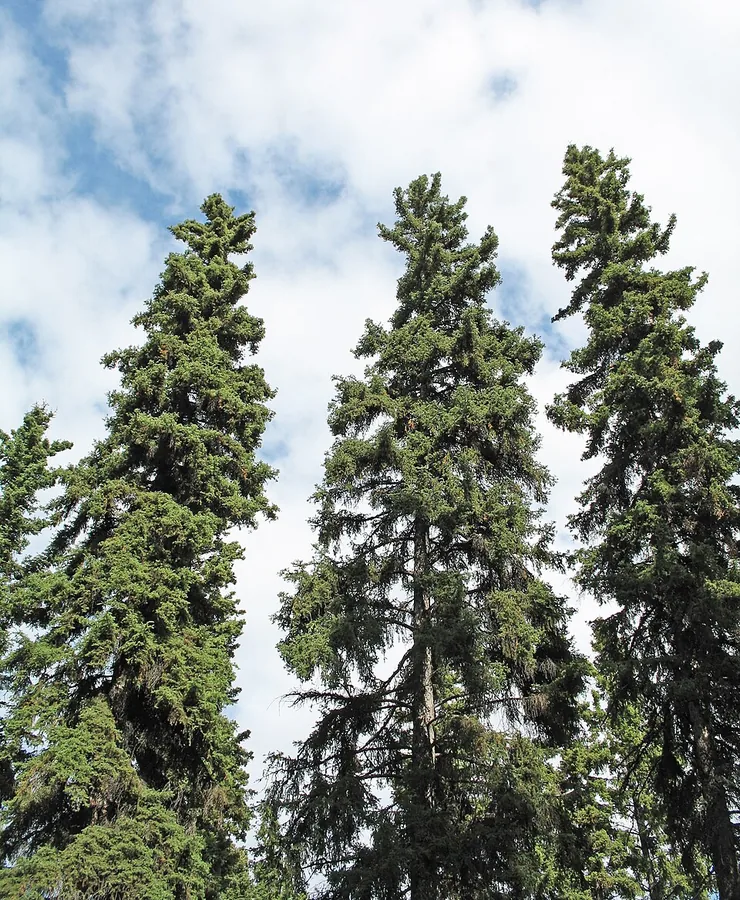
Overview
Dwarf Alberta spruce is the compact, conical evergreen used to frame entries and anchor foundation plantings. It originated as a bud sport of the white spruce, a naturally dwarfed mutation propagated ever since for its dense, near-symmetrical pyramid of fine green needles. Its self-maintaining form, requiring no shearing to keep its outline, accounts for much of its landscape value.
Its cold tolerance is the basis of its range, performing across hardiness zones 3 to 6 and withstanding temperatures to -40°F (-40°C). Growth proceeds only a couple of inches a year, so a specimen remains visually small for many years before its dimensions register as a tree. That slow accumulation of size is what keeps it proportionate in a modest yard or a large container.
Two cultural factors govern its performance. Full sun and active air movement matter most, because hot, stagnant, dusty microclimates favor the spruce spider mite, the pest most capable of degrading the interior canopy. Paired with consistent soil moisture, those conditions let it hold its clean architecture for years with minimal intervention.
Care
The short version: full sun, soil kept moist but well-drained, and free air movement. Deep-water during drought and before winter, apply a light spring feed, and monitor for spider mites through hot, stagnant weather.
Light
Site it in full sun to achieve the densest, healthiest growth and the tightest form. It tolerates partial shade, but reduced light yields thinner, more open growth, and shade combined with weak airflow is precisely the microclimate that allows spider mites to establish.
Water
Maintain evenly moist, well-drained soil, irrigating roughly every 7 to 14 days and more frequently under drought. A deep soak before the ground freezes in late fall is the single most effective measure against winter burn, since it charges the root zone before uptake stops. Dry foliage and good airflow also suppress mite buildup.
Soil
Grow it in moist, well-drained loam in the acidic to neutral range, a pH of 6.0 to 7.0. It will not tolerate saturated ground, so amend heavy clay to improve drainage or plant on a raised position.
Temperature
This is a markedly cold-hardy conifer, functioning from -40°F to 95°F (-40°C to 35°C). It endures severe cold far more readily than prolonged hot, dry heat, which imposes the physiological stress that predisposes it to mite injury.
Humidity
Ambient outdoor humidity is adequate, so no target value applies. Air circulation is the more consequential variable, because stagnant, humid air at the needle surface elevates the risk of both pest and disease pressure.
Feeding
Apply a light feed in spring using a balanced or acidifying slow-release evergreen fertilizer. A single seasonal application suffices for so slow a grower, and excess nutrition confers no benefit.
Pruning
Pruning requirements are minimal. Remove dead or mite-damaged wood, and as soon as a vigorous, large-needled shoot reverts to the wild white spruce form, cut it back below its point of origin before it overtakes the canopy.
Repotting
In containers, repot every 2 to 3 years into fresh medium. Roots circling or emerging from the drainage holes, water passing straight through, and growth that slows with dieback all indicate the plant has outgrown its volume.
Size & spacing
Over many years it reaches roughly 10 to 13 feet (3 to 4 m) in height with a 7 to 10 foot (2.1 to 3 m) spread. Allot open ground and clearance for air movement, both to accommodate its mature dimensions and to limit mite pressure.
When to plant
There is no sowing window, because the dwarf form is propagated from cuttings or grafts rather than seed. Establish young plants in spring or early fall, when soil is workable and moderate temperatures let the root system anchor before the stress of summer heat or hard frost.
Northern hemisphere
Southern hemisphere
Typical months for a temperate climate: start earlier in warm zones, later where spring frosts linger.
- Plant: spring or early fall
Hardiness
USDA hardiness zones: 3–6
Temperature: down to -40°C
Troubleshooting
Most failures register first in the foliage and the silhouette. Browning needles point to either spider mites or winter burn, while an abruptly coarse limb signals reversion of the dwarf form. Identify the symptom below and intervene early, since a stressed conifer regains vigor slowly.
Inner foliage stippling and bronzing under fine webbing
The cause is the spruce spider mite (Oligonychus ununguis), a cool-season feeder that punctures needle cells and drains their contents, which reads first as stippling and then as bronzing on the older interior growth. It builds fastest on plants already taxed by hot, dry, dusty sites with poor air movement, since drought stress weakens the foliage it feeds on. Confirm it by tapping a branch over white paper to dislodge crawlers, dislodge populations with a forceful water spray, and treat with insecticidal soap or horticultural oil while deep watering and improved airflow restore the plant's vigor.
Fix:
- Wash foliage with a strong water spray weekly to bi-weekly to dislodge mites
- Apply insecticidal soap or horticultural oil to affected foliage
- Apply a dormant oil spray in mid-winter to kill overwintering eggs
- Reduce plant stress with deep watering and improved air circulation
Windward-side needle scorch surfacing in late winter
The disorder is winter burn, a desiccation injury rather than a pathogen. Frozen soil halts root uptake while late-winter sun and wind continue to draw moisture from the needles through transpiration, so the foliage on the exposed south or southwest face dries and browns while sheltered growth stays green. Replenish soil moisture with a deep soak in late fall before the ground freezes, and intercept the drying wind on young or exposed plants with a burlap screen through their first few winters.
Fix:
- Water deeply in late fall before the ground freezes
- Provide a windbreak or burlap screen on the exposed side
- Site away from drying winter wind and reflected heat
A vigorous coarse limb overtaking the dwarf habit
What you are seeing is reversion, because the 'Conica' is a bud sport of the full-size white spruce and a shoot can return to the parent's vigorous genetics, frequently after a stress event. The reverted growth betrays itself by longer needles, accelerated extension, and a coarser texture set against the compact dwarf foliage. Because that wild-type vigor will outcompete and eventually displace the dwarf form, excise the shoot cleanly below its point of origin as soon as it appears.
Fix:
- Prune the reverted shoot off cleanly below where it emerges as soon as it is noticed
- Remove repeatedly reverting plants if they cannot be kept in character
Toxicity
For households with animals, the verdict is favorable: dwarf Alberta spruce is not toxic. It is absent from the ASPCA's list of poisonous plants, and no constituent of the needles or wood is known to harm cats, dogs, or other species. The only real hazard is mechanical, the sharp, stiff needles, which can irritate a curious mouth or provoke mild stomach upset if chewed.
Safe for
People · Cats · Dogs · Horses · Rabbits · Livestock · Birds
Cats None
Non-toxic to cats. Any drooling or regurgitation that follows chewing reflects mechanical irritation from the stiff needles rather than a toxic response.
Dogs None
Non-toxic to dogs. A mouthful of sharp needles may produce mild gastrointestinal upset, which is the limit of the concern.
Horses Safe
Safe near horses, since the foliage contains no compound that would poison a grazing animal.
Rabbits Safe
Safe for rabbits, and the coarse, stiff needles deter meaningful browsing in any case.
Livestock Safe
No poisoning risk to cattle, goats, or sheep is associated with this spruce.
Birds Safe
Safe for birds, which use spruce for shelter and perching without exposure to any toxic constituent.
People Safe
Not toxic to people. No part is intended for consumption, and the only physical hazard is puncture from the sharp needles.
No special toxicity precautions needed; discourage pets from chewing sharp evergreen needles.
Varieties
Trade material is dominated by the typical 'Conica', but several named clones diverge in size, coloration, or density. The following selections are the ones worth recognizing.
Jean's Dilly
Extends even more slowly than 'Conica', adding only 2 to 4 inches a year toward roughly 5 feet, with very short, slightly twisted needles held in a tight cone.
Rainbow's End
Flushes creamy yellow new growth in early summer against the light-green older foliage, producing a distinct two-tone, variegated effect.
Pixie
Presents as a more compact, denser miniature of the 'Conica' form suited to the smallest sites.
Sander's Blue
A 'Conica' sport with soft blue-green needles that retains the conical habit but ultimately enlarges, reaching around 20 feet.
How to propagate
Seed propagation is unsuitable here, because seedlings revert to the full-size white spruce. Both viable methods are slow and exacting, which is why the plant reaches gardens through nurseries far more often than through home propagation.
Stem cuttingsDemanding
Late summer to fall (semi-hardwood) · Several months to over a year to root
Because seed-grown progeny revert to the full-size white spruce, the 'Conica' is propagated vegetatively from cuttings to preserve the dwarf genotype. Take semi-hardwood cuttings from late summer into fall, and anticipate slow rhizogenesis, with rooting requiring anywhere from several months to more than a year.
GraftingDemanding
Late winter onto white spruce rootstock · One or more seasons
Grafting offers the most reliable reproduction of the dwarf form, uniting the scion with vigorous white spruce rootstock in late winter. The graft union needs a season or more to knit and stabilize before the young plant is grown on.
Myths
Dwarf Alberta spruce stays tiny forever.
The label describes a slow growth rate, not a fixed mature size. Across several decades it attains roughly 10 to 13 feet, which makes it a small tree on a long timeline rather than a permanent dwarf.