Tree · Pinaceae
Scots Pine
Pinus sylvestris
Adapted to poor, dry, acidic ground, Scots pine trades rich soil for full sun and sharp drainage.
Full sun
Every 7–14 days
USDA 2–7
30–60 ft · 9.1–18.3 m
Overview
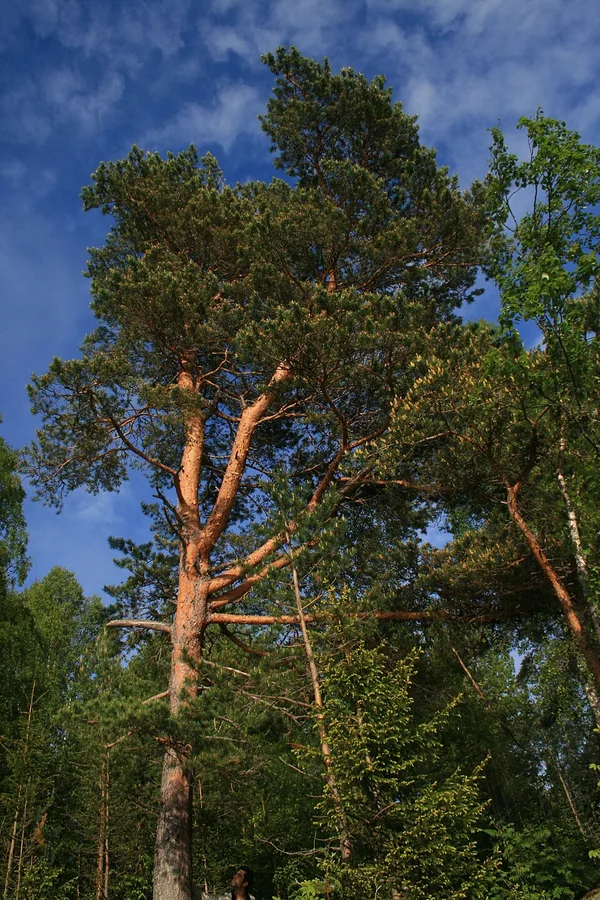
Scots pine ranks among the most widely planted conifers on Earth, a two-needled species recognized by flaking orange-red bark that stands out sharply through winter. Its evergreen needles emerge in twisted blue-green pairs, and the crown opens and grows irregular with age, which gives mature specimens their characteristic windswept silhouette. A member of the Pinaceae family, it is native across Europe and Asia and has a long record in North American landscapes and Christmas-tree production.
Its value lies in low demand. Growth is fast, cold tolerance reaches -40°F (-40°C), and the root system exploits dry, sandy, and nutrient-poor substrates that limit less adaptable trees. That adaptability explains its former dominance in yards and plantations.
The limiting factor is pest and disease pressure. Pine wilt disease has removed it from the trade across much of the Midwest, and tip blight together with several insects can compound stress on an already weakened tree. Sited beyond established wilt and kept in vigor, it is a long-lived species.
Care
The short version: site Scots pine in full sun with well-drained sandy or loamy, moderately acidic soil, and keep water minimal once the root system is established. Fertilize seldom, confine pruning to dry weather, and allow the spacing a large tree requires.
Light
Scots pine demands full sun and carries almost no shade tolerance. Deprived of light beneath taller neighbors, a tree elongates and thins as it stretches for the canopy, producing weak, leggy growth.
Water
Once established the species is drought tolerant and subsists largely on rainfall, even on dry, sandy sites where its roots forage effectively. Irrigation matters only while a young tree is extending roots, so water through dry spells at that stage, roughly a deep soak every 7 to 14 days, then withdraw supplemental water.
Soil
The species performs in well-drained sandy or loamy soil and tolerates poor, dry ground that would starve more demanding trees. It favors acidity in the range of pH 4.5 to 7.0 yet accepts slightly alkaline soil, which broadens the sites where it can be grown.
Temperature
Cold hardiness is exceptional. The tree withstands -40°F to 95°F (-40°C to 35°C), and that lower limit is precisely why its range extends into zone 2.
Humidity
Ambient outdoor humidity is adequate, so there is no target to maintain. Air circulation is the more important variable, because still, humid conditions promote infection by the tip blight fungi that affect this pine.
Feeding
As a light feeder, Scots pine rarely benefits from fertilizer, and established trees generally require none. Apply a single light balanced feeding in spring only when growth is genuinely poor, since a species adapted to lean soils gains little from more.
Pruning
Restrict pruning to the minimum. Remove dead, damaged, or diseased branches in dry weather only, because the Diplodia tip blight fungus disperses spores in wet conditions and fresh cuts then become infection courts; the species does tolerate shearing when grown as a Christmas tree.
Repotting
Scots pine is a landscape tree and is seldom container-grown for long. In a pot, roots circling the drainage holes, stalled new growth, and water passing straight through all indicate that the root system has outgrown the volume and needs open ground.
Size & spacing
This is a large tree, reaching 30 to 60 feet (9 to 18 meters) in height and 30 to 40 feet (9 to 12 meters) in spread. Allow that footprint at planting, well clear of structures and other trees, so the crown can develop symmetrically in full sun.
When to plant
Hardy through zones 2 through 7, Scots pine is planted for establishment rather than for a harvest date. Set it out in spring or fall, when soil is workable and rainfall dependable, so the roots extend before the physiological stress of summer heat or deep winter cold.
Northern hemisphere
Southern hemisphere
Typical months for a temperate climate: start earlier in warm zones, later where spring frosts linger.
- Plant: spring or fall
- Harvest: Non-flowering conifer; produces gray to light brown cones about 3 in long. Often harvested as a Christmas tree.
Hardiness
USDA hardiness zones: 2–7
Temperature: down to -46°C
Troubleshooting
The needles and the elongating candles are where Scots pine trouble becomes visible, and the most damaging agents are insect vectors and fungal pathogens. The practical skill is distinguishing a lethal problem such as pine wilt from a manageable one, then intervening while control is still effective. Compare your symptoms with the entries below.
Whole-branch browning and death within a single growing season
The near-certain diagnosis is pine wilt disease, in which a microscopic pinewood nematode is carried between trees by pine sawyer beetles. The needles shift from gray-green to a dull yellow-brown, and a cut trunk yields little resin. No cure exists, so a confirmed tree must be felled and then burned, buried, or chipped before the beetles disperse to neighboring pines.
Fix:
- No cure exists once a tree is infected
- Promptly remove and destroy (burn, bury, or chip) dead and dying trees to eliminate beetle breeding sites
- Do not leave cut pine wood on site, as it harbors the beetle vector
Pitch masses at the whorls and branches breaking at the crotch
The sticky masses mark the Zimmerman pine moth, whose larvae mine beneath the bark at the junctions where branches meet the trunk. That feeding weakens the crotch, so a limb or the leader can break at a whorl. Prune out and destroy the infested wood, keep the tree vigorous, and where the insect is established apply a trunk spray in mid-April and again in mid-August to intercept the larvae before they enter the bark.
Fix:
- Prune out and destroy infested, broken, or dying branches
- Maintain tree vigor with proper siting and watering
- Apply a registered insecticide trunk spray in mid-April and again in mid-August to target larvae before they bore in
White scale-like specks that scrape from the needles
These are pine needle scale, armored insects that fix onto the needles and feed on sap, and heavy populations bleach and thin the foliage as feeding removes it. Target the crawlers, the reddish nymphs emerging in late spring, with horticultural oil or insecticidal soap, and treat the second generation in midsummer. Prune out and destroy any branches that have become encrusted.
Fix:
- Treat crawlers (tiny reddish nymphs) with horticultural oil or an insecticidal soap in late spring
- Repeat for the second generation in midsummer
- Prune out and destroy heavily encrusted branches
Gregarious larvae stripping the previous year's needles in spring
The agent is the European pine sawfly, whose grayish-green larvae feed in dense groups on older needles while leaving the current growth intact. Hand-pick or prune out the colonies and destroy them, or dislodge the larvae with a strong stream of water. If defoliation is heavy, apply an insecticide labeled for sawflies, because Bt has no effect on sawfly larvae.
Fix:
- Hand-pick or prune out clusters of larvae and destroy them
- Knock larvae off with a strong stream of water
- Apply an insecticide labeled for sawflies if defoliation is heavy (Bt does not work on sawflies)
Brown, stunted new candles at the branch tips
This is Diplodia tip blight, a fungus that kills the elongating candles and leaves short brown needles bearing minute black fruiting bodies, and prolonged wet weather can add Dothistroma needle blight. Prune and burn the infected twigs and cones in dry weather only, and disinfect pruners with 10 percent bleach between cuts to avoid moving spores. Where the disease recurs annually, apply fungicide from bud break through candle elongation.
Fix:
- Prune and destroy infected twigs, branches, and cones during dry weather only
- Sterilize pruners with 10 percent bleach between cuts
- Apply fungicide at bud break, half candle elongation, and full candle elongation where the disease is chronic
Toxicity
For pet owners the record is reassuring: Scots pine is a true pine and not poisonous to cats, dogs, horses, or livestock. The only real hazards are mechanical, the sharp needles that can prick an exploring mouth and the resinous sap that can irritate skin or leave a stain.
Safe for
People · Cats · Dogs · Horses · Rabbits · Livestock · Birds
Cats Safe
Scots pine is non-toxic to cats. The only genuine concern is the sharp needles, which can prick the mouth, and ingestion of a small amount of foliage may produce brief vomiting before the animal recovers.
Dogs Safe
A dog can mouth the needles without risk of poisoning. The sticky sap and rigid needles may cause minor mechanical irritation, and a large volume of ingested foliage can cause a transient digestive upset.
Horses Safe
Horses are unaffected by Scots pine, in contrast to ponderosa pine and several relatives. Nothing warrants monitoring beyond the physical scratch of the needles.
Rabbits Safe
The needles and bark contain no toxin harmful to rabbits, and pine is sometimes provided as a gnawing branch. Confirm that any wood originates from untreated, unsprayed trees.
Livestock Safe
Cattle, goats, and sheep can browse Scots pine without the pine-needle abortion associated with ponderosa pine. In practice, grazing stock tend to avoid the prickly foliage regardless.
Birds Safe
Scots pine presents no toxic risk to birds. Many species use the dense crown for cover and extract the seeds directly from the cones.
People Safe
Scots pine poses no poisoning hazard to people, and its inner bark and needles have a long documented use in teas. The needles are sharp, so supervise contact by young children.
Sharp needles and sticky sap can cause mild mechanical irritation; sap may stain. No special handling required beyond normal care.
Varieties
The straight species accounts for most Scots pine in cultivation, with a few selected forms grown for particular characteristics. The following clones are the ones worth knowing.
Fastigiata
A narrow, columnar selection with strongly upright growth, suited to sites that call for a tall vertical accent in limited space.
Watereri
A slow dwarf that matures near 10 to 12 feet, distinguished by stiff, twisted blue-gray needles above bark that exfoliates in orange-tinged scales.
Glauca
Selected for foliage color, it carries deep blue-green needles that represent the bluest cast among common Scots pines.
How to propagate
Propagation is overwhelmingly by seed, with grafting reserved for named selections that do not reproduce true to type.
SeedModerate
Sow stratified seed in spring. · 2 to 3 years to a sturdy sapling
Seed accounts for essentially all Scots pine in production. The cones require two years to mature, and the seed needs a cold, moist period to break dormancy, so it is sown in spring after stratification. Expect 2 to 3 years for a seedling to develop into a sturdy sapling.
GraftingDemanding
Late winter, onto seedling rootstock · 1 to 2 years
Named forms such as Fastigiata and Watereri do not come true from seed and are therefore grafted. The operation is performed in late winter onto seedling rootstock, and a compatible union consolidates over the following 1 to 2 years.
Myths
Scots pine needles cause abortion in pregnant animals.
Pine-needle abortion is a documented syndrome, but it is confined to ponderosa pine and a few relatives whose isocupressic acid affects pregnant cattle, not cats, dogs, or horses. Scots pine is not among the implicated species, and the ASPCA classifies ponderosa pine itself as non-toxic to dogs and cats.
Scots pine is an invasive species that should never be planted in North America.
The USDA Forest Service rates the tree noninvasive in North America, notwithstanding its naturalization in parts of the Northeast and Great Lakes. Its decline in the trade traces to pine wilt and other pests rather than to any invasive tendency.