Tree · Pinaceae
Eastern Hemlock
Tsuga canadensis
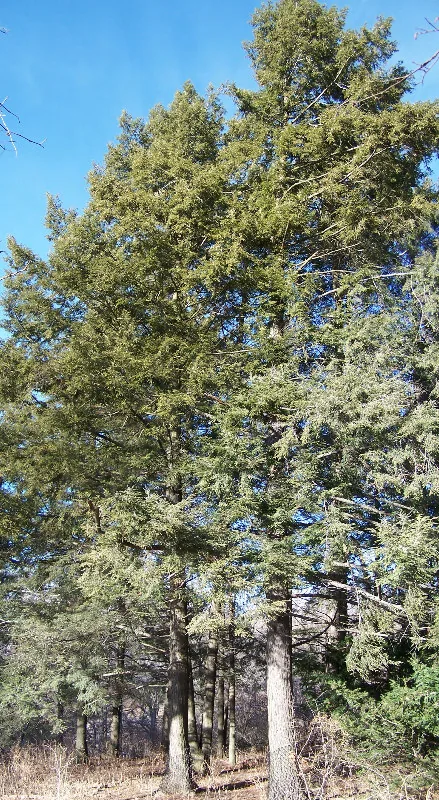
Sited in cool, moist shade, eastern hemlock develops into a soft, feathery evergreen that persists for generations.
Partial shade
Every 3–7 days
USDA 3–7
40–70 ft · 12.2–21.3 m
Overview
Eastern hemlock is a slow-growing evergreen conifer of the cool forests of eastern North America, where individual trees can persist for centuries. Short, flat needles and small brown cones clothe a crown that holds a soft, feathery, pyramidal form, a habit that distinguishes it from the stiffer pines and spruces. Unmanaged it reaches forest height, yet it responds well to shearing, which accounts for its long use as a hedge.
Its defining requirement is cool, moist shade. As one of the most shade-tolerant conifers in cultivation, it grows steadily beneath a taller canopy where less tolerant evergreens thin and stall, a tolerance that lets it regenerate under closed forest. The corresponding weakness is low stress tolerance, because heat, drought, drying wind, road salt, and urban air all degrade it, so a sheltered north-facing or woodland exposure outperforms an open, sunny lawn.
One threat governs its long-term management. The hemlock woolly adelgid, a small invasive insect, has destroyed extensive stands of wild hemlock across the eastern states, and a cultivated tree is equally susceptible. Placed in suitable conditions and monitored for the pest, however, the species is undemanding and provides a dense, evergreen screen year-round.
Care
The short version: site it in cool partial shade, hold the rich acidic soil evenly moist so it never dries, and inspect the needles each year for woolly adelgid.
Light
Hemlock performs best in partial to full shade and ranks among the few conifers that grow well beneath a taller canopy. It admits some direct sun, but an open, hot exposure bleaches and thins the foliage as the tissue desiccates, so a cool, sheltered position is the safer choice.
Water
Maintain consistently moist soil and never allow it to dry out, because the shallow root system has no drought reserve and a prolonged dry spell can be lethal. Water deeply during dry weather so moisture reaches the full root zone, and mulch to slow evaporation and hold that moisture in place.
Soil
Site it in cool, moist, acidic, well-drained ground, whether loam, sand, or clay, since drainage matters more than texture here. A pH of 5.0 to 6.0 is optimal. The limiting factors are soil that dries out, which starves the roots, and soil that stays warm and waterlogged, which suffocates them.
Temperature
The species is cold-hardy to -40°F (-40°C) and withstands summer heat to roughly 95°F (35°C). The injury comes from dry, exposed heat that drives transpiration past the roots' capacity to resupply, rather than from temperature alone, so cool air and shade matter more than the absolute reading.
Humidity
Ambient outdoor humidity suffices, and no target figure applies. The tree favors a cool, moist setting over a hot, drying one because lower evaporative demand reduces water stress, and a sheltered woodland edge keeps the surrounding air gentle.
Feeding
Apply a light early-spring feeding with a balanced or acidifying tree fertilizer, the acidifying form helping hold the low soil pH the species prefers. As a slow grower with modest nutrient demand, it needs only the single seasonal application, and excess fertilizer does more harm than benefit.
Pruning
Hemlock tolerates shearing better than most conifers, which is what makes it serviceable as a hedge or screen. Trim formal hedges in late spring to early summer, after the flush of new growth has hardened. Grown as a specimen it requires almost no pruning and is shown to best advantage in its natural feathery form.
Repotting
As a landscape tree rather than a container subject, it is rarely repotted. Where a dwarf form is grown in a pot, pot it up only when roots circle the container, new growth stalls, or water runs straight through the soil, each a sign the root mass has outgrown its volume.
Size & spacing
A mature forest tree attains 40 to 70 feet (12 to 21 m) in height and 25 to 35 feet (7.5 to 10.5 m) in spread, so a specimen requires generous allocation. Dwarf cultivars remain far more compact and are appropriate for beds and rockeries.
When to plant
Eastern hemlock is hardy through zones 3 to 7 and is established by transplanting rather than by rapid sowing. Plant young trees in spring or early fall while the soil remains cool and moist, conditions that favor root establishment, and where seed is used, allow a long cold stratification first, since germination is slow.
Northern hemisphere
Southern hemisphere
Typical months for a temperate climate: start earlier in warm zones, later where spring frosts linger.
- Sow: Sow stratified seed in late winter; seed needs about 100 days of moist chilling before sowing
- Plant: spring or early fall
- Harvest: Non-flowering conifer; tiny brown cones about 2 cm long mature in autumn
Hardiness
USDA hardiness zones: 3–7
Temperature: down to -40°C
Troubleshooting
Most hemlock disorders register in the needles, either as pests feeding on the undersides or as browning produced by a site that is too hot and dry. Detecting the woolly adelgid early is what makes the tree recoverable. Match the symptom below, then intervene before canopy thinning advances.
White woolly masses at needle bases with progressive canopy decline
The cottony white masses lodged at the needle bases are the protective wax of the hemlock woolly adelgid, an invasive sap-sucking insect that drains the tree at the twig and so starves the canopy, which is why an untreated specimen declines and dies over a few years. The insect has decimated wild eastern hemlock across the region. A registered systemic insecticide moves through the vascular tissue to reach the feeding sites, and applied as a soil drench or injection from late September into October it tracks the insect's active period. Engage a certified arborist for a large, high-value tree where injection is warranted.
Fix:
- Apply a registered systemic insecticide (soil drench/injection or basal bark) per label, most effectively late September through October
- Treat high-value landscape trees preventively and re-treat on the label interval
- Consult a certified arborist for large trees needing soil injection
Armored scales on needle undersides driving yellowing and thinning
Yellowing and thinning trace to elongate hemlock scale, whose narrow waxy covers shield the insects as they feed on the needle undersides and pull resources from the foliage. Horticultural oil works on contact when the unprotected young crawlers are active, while a systemic insecticide carries through the foliage, so timing either to crawler emergence is what gives control. Removing heavily crusted branches cuts the resident population, and a well-watered tree withstands a light infestation because vigor offsets the feeding loss.
Fix:
- Apply horticultural oil or a registered systemic insecticide timed to crawler emergence
- Prune out and destroy heavily infested branches
Stippled bronzing and fine webbing intensifying in hot dry weather
A dull, stippled bronze cast with faint webbing indicates spider mites, whose feeding ruptures the needle cells and so produces the flecking, and their populations build fastest in hot, dry weather. Tap a branch over white paper to confirm the moving mites. A forceful water spray dislodges them physically, and horticultural oil or a miticide follows for a heavy case. Improved watering and afternoon shade lower the heat and moisture stress that favors the mites in the first place.
Fix:
- Spray foliage with water to dislodge mites
- Apply horticultural oil or miticide if severe
- Improve watering and provide afternoon shade
Needle scorch and canopy thinning on hot, exposed, dry sites
Browning needles and a thinning canopy on a sunny, windy, or salt-splashed site reflect drought and scorch rather than a pest, because hemlock is physiologically intolerant of hot, dry, exposed conditions and loses water faster than its shallow roots replace it. Deep watering through dry weather restores that balance, mulch keeps the root zone cool and conserves soil moisture, and shelter from afternoon sun, drying wind, and road salt removes the desiccating load. The durable correction is to establish the tree in a cool, moist, shaded site from the outset.
Fix:
- Water deeply and regularly during dry periods
- Apply mulch to keep roots cool and moist
- Provide shelter from wind, afternoon sun, and road salt
Toxicity
For households with pets and children, the verdict is favorable: the eastern hemlock conifer is not poisonous. The ASPCA lists it as non-toxic to cats, dogs, and horses, and no part of the tree poses a hazard on chewing or handling. Take care not to conflate it with poison hemlock, an unrelated herbaceous weed addressed in the myths below.
Safe for
People · Cats · Dogs · Horses · Rabbits · Livestock · Birds
Cats None
The ASPCA classifies this conifer as non-toxic to cats, so no toxic response follows from a curious nibble on the needles.
Dogs None
No toxic compound affects dogs that chew the foliage or a fallen cone, though the bulk of any large mouthful can produce a transient, mechanical stomach upset as it would with any plant.
Horses Safe
Horses face no poisoning risk and can browse near an eastern hemlock, since the tissue contains no toxin.
Rabbits Safe
The needles hold no toxic principle, so a rabbit, wild or pet, that nibbles the lower branches is unaffected.
Livestock Safe
Cattle, goats, and sheep can graze around the tree without risk, as no part of it contains a toxin.
Birds Safe
Birds are unaffected, and many species use hemlocks for shelter and forage while the seeds serve as a natural food source.
People Safe
No part of the tree is poisonous to people. This is the harmless conifer and not the deadly poison hemlock herb, an unrelated plant that shares only the common name.
No special handling precautions for toxicity; foliage is harmless.
Varieties
Apart from the full-size forest tree, breeders have selected dwarf and weeping cultivars suited to a small garden or rockery. These selections are the forms most often offered in the nursery trade.
'Pendula' (Sargent's weeping hemlock)
A low, mounding weeping selection whose branches cascade to the ground and develop far greater width than height.
'Jeddeloh'
A slow-growing dwarf shrub with a characteristic dished, nest-shaped depression at the center, well suited to small gardens and foundation plantings.
'Cole's Prostrate'
A prostrate dwarf that spreads flat across rock and slope rather than developing an upright leader.
How to propagate
Eastern hemlock propagates from seed or from cuttings, neither of them rapid, and the named garden cultivars are produced almost exclusively from cuttings to retain their characteristics.
SeedModerate
Collect seed from cones just beginning to open; sow after stratification in late winter to spring · Slow; several months to germinate and years to establish
Seed propagation depends on breaking dormancy. The seed requires roughly 100 days of moist chilling through winter, the cold stratification that signals winter has passed, before sowing in late winter to spring, and without it germination does not proceed. Emergence then takes months and establishment takes years, but the seedlings carry exceptional shade tolerance, outperforming nearly every other young conifer beneath a closed canopy.
Stem cuttingsDemanding
Late fall to winter using semi-hardwood cuttings · Several months to root; rooting can be slow and erratic
Vegetative cuttings preserve the genotype of the named dwarf and weeping forms, which seed does not reproduce true. Collect semi-hardwood cuttings from late fall into winter and treat them with rooting hormone to improve the strike rate. Even so, rooting is slow and erratic, frequently spanning several months, which makes this the more demanding route reserved for the patient propagator.
Myths
The hemlock tree is the deadly poison hemlock that killed Socrates, so it is dangerous to grow.
Eastern hemlock is a harmless evergreen conifer in the pine family, Pinaceae, and contains no poisonous part. The toxin that killed Socrates came from poison hemlock, an unrelated herbaceous weed in the carrot and parsley family, and water hemlock is a third toxic species from that same family. The conifer and the toxic herbs are related only by a coincidental shared common name.