Tree · Pinaceae
Colorado Blue Spruce
Picea pungens
Site it for full sun, cool air, and well-drained ground, and Picea pungens holds its silver color for decades.
Full sun
Every 7–14 days
USDA 2–7
30–60 ft · 9.1–18.3 m
Overview
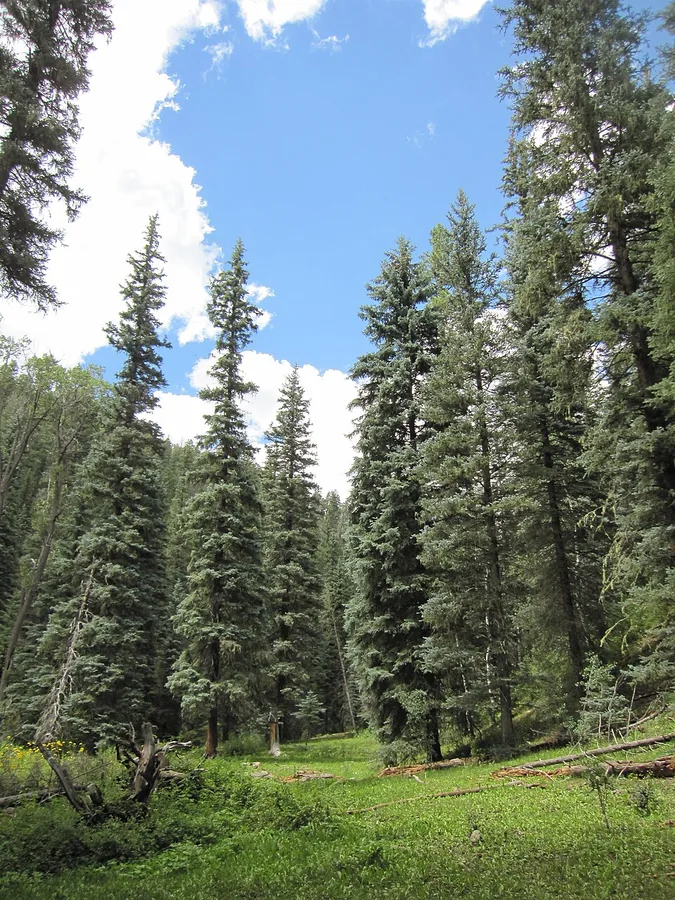
The Colorado blue spruce draws the eye through silvery-blue needles and a strict pyramidal habit. Its native range is the cool, dry central Rocky Mountains, a setting of crisp air and sharp drainage. That provenance dictates its requirements, because a tree adapted to montane conditions performs best where they are reproduced.
Picea pungens is a slow-growing evergreen that invests in longevity rather than speed. Unchecked it exceeds 60 feet in height and 20 feet in basal spread, which suits it to specimen or windbreak use rather than a confined planting. The needles terminate in genuinely sharp points, and that rigid, spined foliage is what discourages most browsing animals.
Cold hardiness is its strength, rated from zone 2 to zone 7, so it endures winters that damage less adapted trees. Its limiting factor is the combination of heat and humidity. In a humid southern garden the canopy thins and lower branches are shed, because warm, moist air both stresses the tree and favors foliar pathogens, so a cool, open site preserves both vigor and form.
Care
The short version: full sun, cool air, and rich, well-drained soil that never stays saturated. Water deeply during establishment, allow room for the mature spread, and otherwise intervene rarely.
Light
Provide full sun, on the order of 6 or more hours daily, since maximum light yields the densest canopy and the most intense blue. Some afternoon shade is tolerated and is in fact beneficial in hot regions, where it limits heat load, but in deep shade the tree grows sparse and the coloration fades.
Water
Keep young trees evenly moist through deep watering, since the developing root system has limited reach, yet avoid saturation, because standing water is among the few conditions that kill this species outright. An established spruce becomes fairly drought tolerant as its roots extend, though a deep soak through prolonged drought conserves vigor.
Soil
Favor rich, moist, well-drained loam, while recognizing that the species adapts to most textures provided water drains freely. It performs across a pH of 5.5 to 7.0. The decisive constraint is persistent wetness, which deprives the roots of oxygen and induces rot.
Temperature
This montane tree withstands extreme cold, from roughly -51°F (-46°C) to about 86°F (30°C). The operative limit is heat rather than cold. Sustained warmth and humidity raise physiological stress and predispose the tree to the foliar and canker diseases that shorten its life in warm climates.
Humidity
The species is adapted to dry, airy conditions and resents the stagnant moisture of a humid setting. Still, damp air around the foliage is precisely what allows needle-cast fungi to germinate and establish, so an open, well-ventilated site suppresses infection.
Feeding
An established tree in adequate soil rarely needs feeding, because a conifer of this growth rate has modest nutrient demand. Apply a balanced slow-release tree fertilizer in spring only where a soil test confirms a genuine deficiency. Routine annual feeding is unnecessary and offers no benefit to this species.
Pruning
Limit pruning and never cut the central leader, the dominant shoot that maintains apical control and the pyramidal form. Remove only dead, diseased, or damaged wood, and confine the work to late winter or dry weather, since fresh wounds in wet conditions are entry points for Cytospora canker.
Repotting
This is a landscape tree, so repotting rarely comes up beyond transferring a young nursery specimen to its permanent ground position. In a container, roots circling the pot or extending through the drainage holes indicate that the root system has outgrown its volume and the tree should be planted out.
Size & spacing
Account for substantial mature dimensions of 30 to 60 feet (9 to 18 m) in height and 10 to 20 feet (3 to 6 m) in basal spread. Allocate that footprint at planting and maintain clearance from buildings, walks, and power lines, since the root flare and lower limbs will eventually occupy the full width.
When to plant
As an evergreen there is no crop to time, only the planting window that favors root establishment. Set it out in spring once the soil has thawed, or in early fall while soil warmth still drives root growth ahead of winter. Avoid midsummer, when high transpiration outpaces what a newly planted, limited root system can supply.
Northern hemisphere
Southern hemisphere
Typical months for a temperate climate: start earlier in warm zones, later where spring frosts linger.
- Plant: Spring or early fall
- Harvest: Non-flowering; grown for evergreen foliage and pyramidal form
Hardiness
USDA hardiness zones: 2–7
Temperature: down to -46°C
Troubleshooting
Disorders of blue spruce usually register first in the foliage or as the dieback of a single branch, and most trace to heat, humidity, or impeded drainage. Early recognition matters because several of these problems advance through the canopy if left unchecked. Match the symptom below, then intervene while control is still effective.
Lower-branch dieback with a bluish-white resin crust along the bark
Scattered dieback of lower branches accompanied by a hard, bluish-white resin crust on the bark is Cytospora canker, an opportunist that attacks trees already weakened by drought or heat. The dried sap marks the canker at the base of a failing branch. No chemical cures it, so management is cultural: excise the dead wood in dry weather, disinfect tools between cuts to prevent spread, and relieve stress through watering and mulch.
Fix:
- Prune out and destroy infected branches during dry weather
- Disinfect pruning tools between cuts
- Repeat pruning over two consecutive seasons if needed
- Reduce stress with mulch and watering during drought
Oldest interior needles discoloring and shedding, thinning the lower canopy first
Browning and shedding of inner and older needles, advancing upward from the lowest branches, indicates needle cast, most often Rhizosphaera. Under a hand lens the diagnostic sign is rows of minute black fruiting bodies emerging from the needle stomata, absent on healthy foliage. Because the fungus persists in humid, still air, the response is to thin for airflow, keep the foliage dry, and protect new growth with a fungicide across at least two consecutive seasons.
Fix:
- Improve air circulation by spacing and selective thinning
- Avoid wetting the needles with overhead sprinklers
- Apply chlorothalonil, copper hydroxide, or mancozeb when new needles are about half their mature length, with a second application 3 to 4 weeks later, for at least two consecutive years
- Remove and destroy fallen infected needles
Terminal leader bending like a shepherd's crook as it dies
A leader that wilts into a shepherd's crook and dies back is the work of the white pine weevil, whose larvae tunnel within the terminal shoot and sever its vascular function. In spring the previous year's leader shows pinhead holes exuding sap. Removing the infested leader below the larval galleries before adult emergence reduces the local population, after which a single straight lateral can be trained as the replacement leader.
Fix:
- Prune out and destroy the infested dead leader below the larval damage in summer before adults emerge
- Train a single straight side branch to become the new leader
- Apply a labeled insecticide to the leader in early spring where weevil pressure is high
Stippling and bronzing on the needles beneath fine silk webbing
Stippled, bronzed needles beneath fine webbing point to the spruce spider mite, a cool-season pest whose feeding removes cell contents and dulls the foliage. Tapping a branch over white paper dislodges the moving mites for confirmation. Because broad-spectrum insecticides kill the mite's predators and worsen outbreaks, control relies on a forceful water spray and horticultural oil applied while the mites are active in the cool of spring and fall.
Fix:
- Hose down foliage with a strong stream of water to dislodge mites
- Apply horticultural oil or a labeled miticide when mites are active in cool spring and fall
- Avoid broad-spectrum insecticides that kill mite predators
Toxicity
For households with pets or children, the relevant point is that blue spruce is not poisonous. The genuine hazard is mechanical: the needles end in sharp points that can abrade skin or injure a small child near the eyes. Ingestion of a small amount of foliage may cause transient gastrointestinal upset in a pet, but nothing beyond that.
Safe for
People · Cats · Dogs · Horses · Rabbits · Livestock · Birds
Cats None
Not poisonous to cats. A cat that consumes a mouthful of needles may drool or vomit briefly, with no lasting effect.
Dogs None
Safe for dogs. The sharp needles present a mechanical hazard rather than a toxic one, though a large quantity can produce transient stomach upset.
Horses None
No toxin affects horses here. The stiff, prickly needles are unpalatable to graze and pose no real risk.
Rabbits None
Harmless to rabbits, and the bristly foliage is rarely attractive enough for most to nibble.
Livestock None
Cattle, goats, and sheep can browse near it without poisoning, and the sharp needles generally deter them in any case.
Birds None
Birds face no danger from it. Many in fact use its dense, prickly branches for shelter and nesting.
People None
Not toxic to people. The only concern is the needle tips, sharp enough to scratch skin or injure a small child near the eyes.
The needles are stiff, sharp, and bristly and can mechanically poke or scratch skin and eyes, and the species has been noted to cause injury to toddlers from its sharp leaf tips; this is physical irritation, not a poisoning. Chewing on needles may cause mild mouth or stomach irritation in pets.
Varieties
Garden blue spruce are predominantly named cultivars, each selected for a defined trait of color, habit, or ultimate size. A few dominate the trade, spanning the range from full-stature trees to dwarfs suited to rock gardens.
Hoopsii
Hoopsii is a dense, pyramidal selection valued for the most intense silvery-blue needles in the group, reaching roughly 30 to 50 feet at maturity.
Fat Albert
Fat Albert forms a broad, full pyramid restrained to 8 to 15 feet, a scale that suits its bright blue foliage to smaller landscapes.
Baby Blue
Baby Blue is a semi-dwarf of even, conical habit to about 15 to 20 feet, carrying densely set silvery blue-gray foliage.
Montgomery
Montgomery is a slow dwarf that develops a broad cone or globe only 2 to 3 feet across over many years, which fits it to rock gardens and foundation plantings.
How to propagate
Blue spruce is increased by seed or by grafting, and the method follows whether the blue coloration must be preserved. Seed is straightforward but slow and unpredictable in color, while grafting is exacting but fixes the parent's traits.
SeedModerate
Sow stratified seed in spring · Several years to reach landscape size
The species can be raised from seed, though germination is slow and a seedling needs several years to attain landscape size. Sowing in spring after a period of cold, moist stratification breaks dormancy and improves emergence. Note that seedlings segregate for color, so the characteristic blue is not reliably inherited.
GraftingDemanding
Late winter onto seedling rootstock · Several years
The named blue cultivars such as Hoopsii and Fat Albert do not come true from seed and are therefore grafted to preserve their traits. The graft is made in late winter onto seedling rootstock, and the union still requires several years to establish. Because the technique demands precision, it is better suited to an experienced propagator than a beginner.
Myths
The Colorado blue spruce is a durable, long-persisting conifer that succeeds in virtually any North American climate.
The species is endemic to the cool, dry central Rocky Mountains and performs poorly outside that climate. Through the humid East and Midwest the canopy thins and lower branches are lost as needle casts and Cytospora canker establish in the favorable moisture, and several extension programs no longer recommend it for those regions.