Tree · Pinaceae
Douglas Fir
Pseudotsuga menziesii
Provide room, deep moist soil, and decades of patience, and the Douglas fir develops into one of the tallest trees in the forest.
Full sun
Every 7–14 days
USDA 4–6
39–79 ft · 12–24 m
Overview
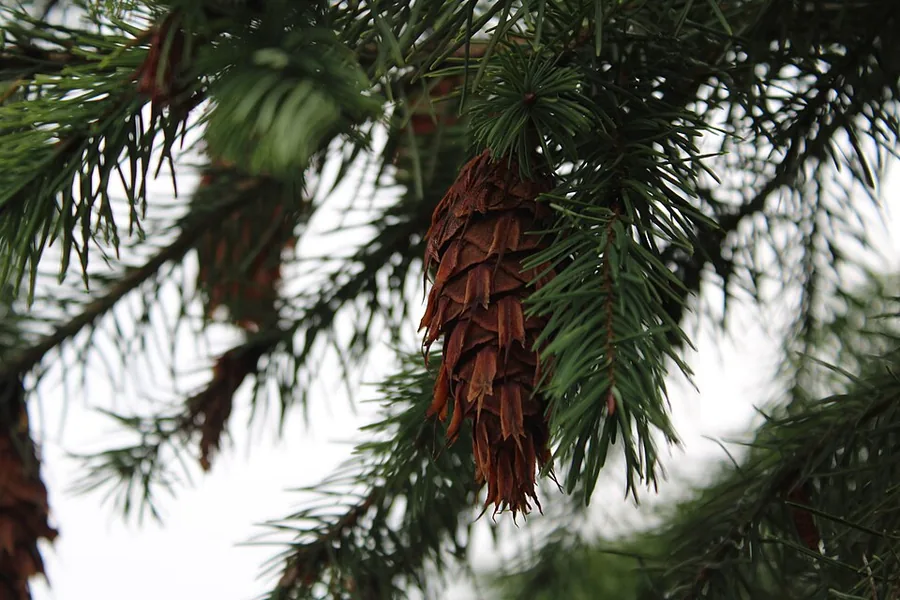
The Douglas fir ranks among the giants of western North America, a fast-growing conifer that exceeds 80 feet (24 m) under cultivation and reaches far greater heights in the wild. The common name misleads, because the species is not a true fir but a distinct evergreen, recognized by its soft flat needles and pendent cones whose papery bracts protrude like small mouse tails. It serves the Pacific Northwest as its classic Christmas tree and underpins much of the regional timber industry.
Two principal forms enter cultivation, and choosing between them governs long-term success. The coast type grows rapidly and tall and favors the mild, moist climate west of the mountains, whereas the Rocky Mountain blue form runs smaller and bluer and tolerates severe cold to zone 4. Provenance matters more here than in almost any comparable tree, since a seed source mismatched to the local climate predisposes the tree to disease.
This is a tree of space and time rather than a quick screen. It demands deep, moist, well-drained soil and full sun and resents drought, compaction, and waterlogged roots in equal measure. Sited well clear of the house and allowed to develop, it becomes a landmark tree that outlasts the person who planted it.
Care
The short version: full sun, deep and consistently moist acidic-to-neutral soil with free drainage, and generous space, because the tree can attain 40 to 80 feet in cultivation.
Light
Provide a Douglas fir with full sun to achieve the densest, best-formed growth. It tolerates partial shade, particularly when young, but a tree held in excessive shade grows thin and leggy because the foliage cannot photosynthesize enough to fill out.
Water
The species is intolerant of drought and requires soil kept deep and consistently moist yet never waterlogged. Irrigate young trees on a regular schedule until established, every 7 to 14 days as weather dictates, and never allow a prolonged dry period to pass unwatered.
Soil
Establish it in deep, moist, organically rich loam with free drainage on the acidic to neutral end, between pH 4.5 to 7.2. It does not accept poorly drained or compacted ground, where reduced oxygen at the roots invites the root rots described below.
Temperature
Douglas fir withstands a wide thermal range, from -29°F to 90°F (-34°C to 32°C) depending on the form planted. The Rocky Mountain type endures the most severe cold, to zone 4, which extends the species into colder regions than the coast form can occupy.
Humidity
Outdoor humidity follows the local climate and requires no adjustment. Air circulation matters far more than atmospheric moisture, since stagnant, crowded conditions keep foliage wet long enough for needle cast fungi to establish.
Feeding
Apply a balanced fertilizer or a conifer and evergreen formulation in spring. The objective is less to drive growth than to keep the tree unstressed, because adequate nutrition lowers its susceptibility to needle cast.
Pruning
Pruning is largely unnecessary. Remove only the dead, damaged, or diseased wood and leave the natural form intact, except where a Christmas tree is being sheared.
Repotting
As a forest tree rather than a container subject, it rarely needs repotting beyond the nursery phase. On a potted young tree, watch for roots circling the pot, stalled new growth, or substrate that dries out very fast, each indicating the roots have outgrown the container.
Size & spacing
The tree grows large and quickly, reaching 40 to 80 feet (12 to 24 m) in height with a spread of 12 to 20 feet (3.7 to 6 m). Site it well clear of buildings, power lines, and septic systems, and allow the open space a landmark tree requires.
When to plant
Douglas fir is a long-term planting rather than a seasonal crop. Stratify seed through late winter, plant young trees out in spring once hard frosts have passed, and expect no flowers, since this conifer reproduces by cones that ripen from late summer into fall.
Northern hemisphere
Southern hemisphere
Typical months for a temperate climate: start earlier in warm zones, later where spring frosts linger.
- Sow: Late winter after cold-moist stratification of seed for about 1-2 months.
- Plant: Spring, after the last hard frost, while trees are small and easy to transplant.
- Harvest: Non-flowering conifer; cones mature late summer to fall. No ornamental bloom.
Hardiness
USDA hardiness zones: 4–6
Temperature: down to -34°C
Troubleshooting
Most disorders of Douglas fir present either in the foliage or at the roots. The needle problems frequently trace to a seed source poorly matched to a wet climate, while the gravest threats develop unseen below ground. Identify the symptom below and respond early, because a stressed tree succumbs to disease far more readily than a vigorous one.
Chlorotic thinning crown with dieback signaling root disease
A chlorotic, thinning crown with progressive branch dieback usually reflects a failing root system rather than a foliar problem. Armillaria root rot can be confirmed by the thick white mycelial fans found between bark and wood at the root crown and the black, shoestring-like rhizomorphs it sends through the soil, while Phytophthora root rot darkens and rots the roots in chronically wet or compacted ground. Neither responds to a foliar spray once established, so management rests on correcting drainage, planting at the proper depth, and removing severely affected trees before replanting with a more resistant species.
Fix:
- Improve drainage and avoid overwatering or planting too deeply
- Remove and destroy severely infected trees including small roots
- Replant the site with more resistant species
Oldest needles discolor and shed while the crown thins
A crown reduced to its newest needles is the signature of needle cast, a foliar fungus that colonizes the oldest needles first and forces them off before their time. The two pathogens are separable on the needle itself: Swiss needle cast produces rows of minute black fruiting bodies on the undersides, whereas Rhabdocline marks second-year needles with reddish-brown blotches. Because both depend on prolonged leaf wetness, thinning crowded trees to dry the foliage faster, sustaining root moisture, and matching Pacific Coast seed sources to wet climates all reduce infection, the coastal provenance being far less susceptible than Rocky Mountain stock.
Fix:
- Improve air circulation by thinning crowded trees and increasing spacing
- Keep trees adequately watered and properly fertilized to reduce stress
- Apply a labeled fungicide at budbreak and as new needles expand where infection pressure is high
- Remove and dispose of heavily infected fallen needles
Defoliation from the upper crown downward in outbreak years
Bristly larvae feeding from the upper crown downward indicate the Douglas-fir tussock moth or western spruce budworm, defoliators capable of stripping a tree during outbreak years. Surveying the bark for egg masses before the spring hatch establishes the threat in advance, when control is still cheap. A Btk application timed to young larvae is effective, and in many cycles resident parasites and predators together with a naturally occurring wilt virus collapse the population within a season or two, ending the outbreak without further intervention.
Fix:
- Monitor for egg masses before spring hatch
- Apply Bacillus thuringiensis (Btk) or a labeled insecticide while larvae are young
- Allow natural enemies and the naturally occurring wilt virus to collapse outbreaks over a season or two
Woolly white masses with needles twisting and yellowing
The cottony white wax marks the Cooley spruce gall adelgid, a sap-feeding insect whose feeding distorts Douglas-fir needles rather than forming the cone-like galls it induces on its spruce host. Light infestations seldom warrant action, since resident natural enemies usually hold the population down. Where numbers climb, a dormant horticultural oil applied before budbreak smothers the overwintering stages, and siting new trees away from spruce removes the alternate host the insect needs to complete its cycle.
Fix:
- Tolerate light infestations; natural enemies often suppress populations
- Spray dormant-season horticultural oil or treat before budbreak
- Soil-applied imidacloprid can control populations on high-value trees
Toxicity
For households with pets and children, the assessment is favorable: Douglas fir is not toxic. Its long use as the traditional Christmas tree across much of the country rests on precisely this property. A pet that chews fallen needles may develop mild gastric upset, but the tree contains no poison of concern.
Safe for
People · Cats · Dogs · Horses · Rabbits · Livestock · Birds
Cats Safe
The tree carries no toxin that affects cats. A cat ingesting a few needles may show transient drooling or regurgitation, both mechanical rather than chemical effects.
Dogs Safe
Nothing in the foliage is poisonous to dogs. Chewing the stiff needles can produce mild gastric upset, so discouraging access to a shed branch remains sensible.
Horses Safe
Horses can graze near Douglas fir without risk. It is not among the pines implicated in mare abortion, and its needles carry no documented toxicity.
Rabbits Safe
The species presents no hazard to rabbits, and its bark and twigs serve as routine winter browse for wild populations.
Livestock Safe
Cattle, sheep, and goats browse Douglas fir without harm. In contrast to ponderosa pine, its needles are not associated with abortion in grazing livestock.
Birds Safe
The tree poses no threat to birds, which use its dense canopy for shelter and feed on the seeds enclosed within the cones.
People Safe
Douglas fir is safe around people. The young spring shoots are even infused into a citrus-flavored tea, though the rigid mature needles warrant keeping away from small children.
Eating needles can cause mild mouth/stomach irritation with possible vomiting, drooling, or diarrhea, and large quantities of sharp needles could rarely cause GI blockage.
Varieties
Most Douglas firs offered for sale are the straight species, yet a few named selections merit attention when a particular site or climate is in view.
var. glauca / 'Glauca' (Rocky Mountain blue Douglas-fir)
This is the smaller, blue-green Rocky Mountain provenance, hardy to zone 4 and decidedly more cold-tolerant than the coast type, though it grows more slowly and proves more prone to needle cast under wet conditions.
'Fastigiata'
A narrow, columnar selection whose strongly upright habit confines its width, suiting it to constrained sites the species would quickly overwhelm.
'Pendula'
A weeping cultivar whose branches cascade and trail, planted as an ornamental specimen purely for its architectural form.
How to propagate
Douglas fir is raised from seed for ordinary trees and by grafting for named cultivars, and neither method is rapid. Each requires roughly two years before yielding a plant ready for the landscape.
SeedModerate
Sow in spring after 1-2 months of cold-moist stratification. · 1-2 years to a transplantable seedling
Seed is the standard means of producing the species, and the seed enforces a winter chilling requirement. Supply 1 to 2 months of cold, moist stratification before a spring sowing, after which expect 1 to 2 years to reach a seedling of transplantable size. Establishing them while small is deliberate, since transplanting precedes deep extension of the taproot and so succeeds far more reliably.
GraftingDemanding
Late winter onto seedling rootstock. · 1-2 years
Grafting is the exacting method, reserved for named cultivars such as the weeping and columnar forms, which do not reproduce true from seed. The graft is worked in late winter onto a seedling rootstock, and a successful union still requires 1 to 2 years to develop into a dependable tree.
Myths
Douglas fir is a true fir, like the firs in the genus Abies.
Botanically it belongs to no true fir genus at all. The hyphen in Douglas-fir signals the distinction, since the tree occupies its own genus, Pseudotsuga, a name translating to false hemlock. The cones settle the matter: true firs bear them upright and disintegrate them on the branch, whereas Douglas-fir cones hang downward and abscise intact, the papery three-pointed bracts protruding between the scales much like mouse tails.
Sources
- USDA Forest Service, Silvics of North America
- USDA Forest Service FEIS
- USDA Forest Service FEIS
- NC State Extension Gardener Plant Toolbox
- Pacific Northwest Pest Management Handbooks (OSU/WSU/UI Extension)
- Pacific Northwest Pest Management Handbooks (OSU/WSU/UI Extension)
- Colorado State University Extension
- Pacific Northwest Pest Management Handbooks (OSU/WSU/UI Extension)
- UC Statewide IPM Program (UC ANR)
- ASPCA
- Pet Poison Helpline
- Oregon State University Extension
- USDA NRCS Plant Fact Sheet