Ornamental · Berberidaceae
Barrenwort
Epimedium grandiflorum
Rhizomatous, deer-proof, and happy in dry shade, barrenwort colonizes the difficult ground beneath trees where little else persists.
Partial shade
Every 7–14 days
USDA 5–8
10–18 in · 25–46 cm
Overview
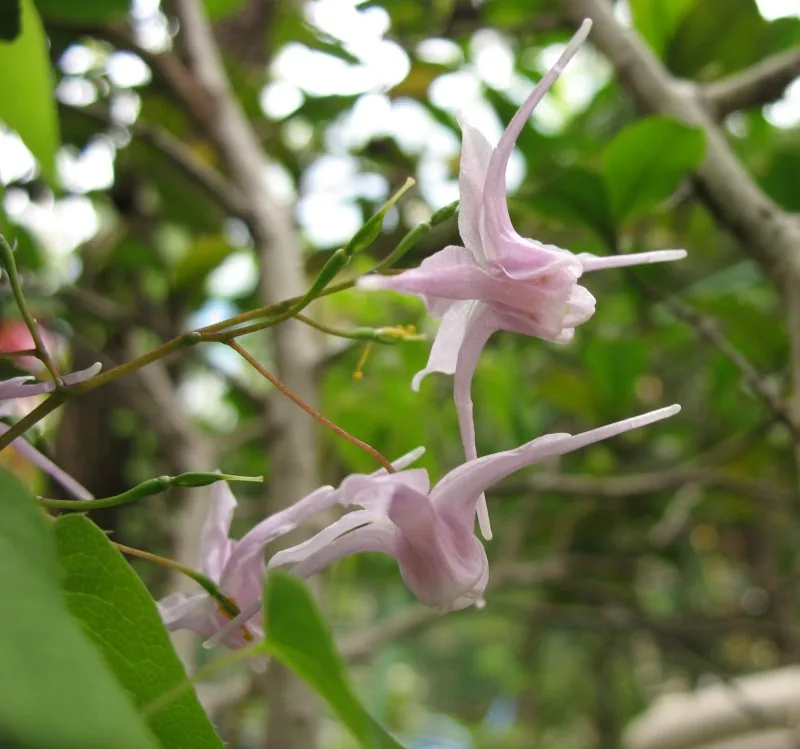
Barrenwort ranks among the most useful perennials for the shady, root-filled ground beneath trees and shrubs, where root competition defeats most other species. A member of the barberry family, it builds slow, restrained clumps of wiry stems and heart-shaped leaflets. Each spring it raises airy sprays of small spurred flowers, the spurs accounting for common names such as bishop's hat and fairy wings.
The foliage delivers the longer season of interest. New leaves frequently emerge with a red or bronze tint before maturing to green, and many selections retain their leaves well into winter. Shearing the spent old growth to ground level in late winter clears the way for the spring flush, so the flowers stand unobstructed above the fresh leaves.
Once established, barrenwort imposes minimal demands. It resists browsing by deer and rabbits, withstands the dry shade cast by mature trees, and extends by rhizome to form a low, knitting groundcover. Allow a season or two for establishment, after which a planting persists and performs for decades.
Care
The short version: site it in part to full shade in loose, acidic, organically rich soil, irrigate it through establishment, and divide the clumps periodically to sustain vigor.
Light
Barrenwort performs best in part to full shade, the dappled light cast beneath a tree canopy or on a wall's north aspect. It tolerates limited morning sun, but hot afternoon sun scorches the leaf margins, an effect compounded when the soil is dry.
Water
Keep new plantings evenly moist through establishment, irrigating every 7 to 14 days as the top half of the profile dries. Once rooted, the rhizomes store sufficient moisture to carry the plant through dry shade and short droughts, though sunnier northern positions warrant additional summer water.
Soil
Provide loose, well-drained, organically rich loam on the acidic side, within a pH of 5.0 to 7.0. It objects to heavy, waterlogged ground and will not tolerate alkaline soil, so incorporate compost or leaf mold before planting to open the structure.
Temperature
This cold-hardy perennial endures roughly -20°F to 86°F (-29°C to 30°C). No winter protection is required anywhere in its range; the plant either goes dormant or holds weathered foliage through the cold.
Humidity
Ambient outdoor humidity is adequate and no target figure applies. The operative factor is steady soil moisture in the root zone rather than atmospheric humidity.
Feeding
Apply a light feed in spring as new growth emerges, using a balanced fertilizer or a top-dressing of compost or organic matter. It is a light feeder, so a single seasonal application suffices.
Pruning
Cut the old or winter-damaged foliage to the ground in late winter, immediately before new growth emerges, so the spring flowers are displayed without obstruction. Beyond that annual shearing, no further pruning is needed.
Repotting
Grown in the ground, lift and divide the clumps every 3 to 4 years in early spring or fall to maintain vigor. Reduced flowering, weakening growth, and a congested, crowded center signal that division is due.
Size & spacing
Mature plants reach about 10 to 18 inches (25 to 46 cm) in height and spread 12 to 24 inches (30 to 61 cm) wide. Spaced a foot or two apart, they close the intervening gaps over time into a continuous groundcover.
When to plant
Because barrenwort is hardy and slow to fault, the planting window is broad. Establish new plants in spring or fall while the soil remains cool and moist, then expect the delicate flowers from April into June, after which the foliage carries interest through the balance of the season.
Northern hemisphere
Southern hemisphere
Typical months for a temperate climate: start earlier in warm zones, later where spring frosts linger.
- Plant: Spring or fall
- Harvest: April to June (spring)
Hardiness
USDA hardiness zones: 5–8
Temperature: down to -29°C
Troubleshooting
Barrenwort is among the more trouble-free shade perennials, and the few disorders that occur present on the foliage. A small set of pests and one virus account for nearly every case. Identify the symptom below, then intervene before the problem propagates.
Mottled, streaked, or distorted foliage
Irregular yellow-green mottling indicates mosaic virus, which aphids transmit as they feed and move between plants. No cure exists once a clump is infected, so excavate and destroy badly affected plants rather than composting them, where the pathogen could persist. Suppress the aphid vectors on tender new growth, and refuse to divide from any plant showing the patterning, since the virus travels in the propagated tissue.
Fix:
- Remove and destroy severely infected plants since there is no cure for the virus
- Control aphid vectors to limit spread
- Avoid propagating from infected plants
Ragged holes eaten through the leaves
Irregular holes and slime trails point to slugs, nocturnal feeders that rasp the soft tissue under cover of darkness, while cleaner notches cut into the margins are the signature of vine weevils. Hand-collecting slugs after dusk catches them while they feed, and a ring of bait or a physical barrier intercepts the rest before they reach the foliage. Removing damp debris denies both pests the cool, moist refuge they shelter in by day.
Fix:
- Hand-pick slugs in the evening
- Use slug baits or barriers around clumps
- Remove debris that shelters pests
Scorched, browned margins on the leaves
Leaf scorch develops where the plant sits in hot afternoon sun, and a dry root zone amplifies the damage because the foliage cannot replace water lost to transpiration fast enough. Specimens grown in genuine shade remain unblemished, which confirms exposure as the driver. Relocate an affected clump into dappled or full shade, increase irrigation in sunnier positions, and mulch to slow evaporation from the soil surface.
Fix:
- Move or site plants in part to full shade
- Provide additional summer water in sunnier locations
- Mulch to conserve soil moisture
Toxicity
For households with pets and small children, the verdict is straightforward: barrenwort is not poisonous. It contains no compound that harms cats, dogs, horses, or livestock, and its young leaves are even eaten as a cooked green. It can be sited anywhere without concern over an exploratory nibble.
Safe for
People · Cats · Dogs · Horses · Rabbits · Livestock · Birds
Cats None
Barrenwort is safe for cats because it contains no toxic principle. An exploratory nibble produces no poisoning in felines.
Dogs None
Dogs may dig or chew at a planting with nothing to worry about, as no part of the plant holds a compound poisonous to them.
Horses None
The foliage is not toxic to horses, and a grazing animal that takes a mouthful suffers no ill effect from the plant.
Rabbits None
Rabbits generally avoid it, a useful trait rather than a hazard. The plant is rabbit-resistant and non-toxic, so an incidental bite causes no harm.
Livestock None
Cattle, goats, and sheep grazing nearby face no poisoning, since the plant carries no compound that disturbs ruminants.
Birds None
Birds that peck the leaves or forage around the clumps are in no danger from any part of the plant.
People None
The plant is non-toxic to people, and the young leaves are documented as eaten as a cooked green after soaking and boiling. Treat it as an ornamental unless you are familiar with that preparation.
No special handling precautions needed for a non-toxic ornamental groundcover.
Varieties
Hundreds of barrenwort selections are in cultivation, bred for flower color and leaf form. A handful recur across shade plantings and merit recognition by name.
Epimedium × rubrum
The red barrenwort bears crimson and pale-yellow bicolor flowers carried above spring foliage that emerges flushed with red.
Epimedium × youngianum Niveum
This snowy barrenwort holds a compact habit and produces pure white flowers, a precise choice for a shaded corner.
Epimedium × versicolor Sulphureum
A vigorous spreader bearing soft sulphur-yellow flowers, it commonly retains its foliage through mild winters.
Amber Queen
Amber Queen flowers across an extended period, presenting amber-yellow blooms on tall, conspicuously spurred stems.
Companions
Plant near
Hosta: Shares the same part-to-full-shade, moist, organically rich woodland conditions and contrasts in foliage texture.
Ferns: Thrives in the same shaded, humus-rich sites and complements the delicate barrenwort foliage.
Hellebore: Another shade-loving, deer-resistant perennial that pairs well in woodland borders with similar care needs.
How to propagate
Barrenwort increases readily by clump division. The crown separates into rooted sections, so lifting, dividing, and replanting yields several plants from one.
DivisionEasy
Early spring or fall · One to two growing seasons
Division is the reliable method for increasing barrenwort, since the rhizomatous crown separates cleanly into viable units. Lift an established clump in early spring or fall, cut the rhizome into sections that each retain healthy roots and dormant buds, and replant immediately so the divisions do not desiccate. Repeating this every 3 to 4 years renews vigor in the parent, and each division needs one to two growing seasons to root in fully before flowering freely.
Myths
Barrenwort is poisonous to cats and dogs.
Barrenwort does not appear on the ASPCA toxic plant list, and approved horticultural references record no toxicity in the genus. It functions as a deer- and rabbit-resistant shade groundcover, and its young foliage is even consumed as a cooked green. Barrenwort is safe to grow around pets and children.