Shrub · Berberidaceae
Heavenly Bamboo
Nandina domestica
Adaptable, drought-hardy, and red-leafed in winter, nandina performs almost anywhere, yet its cyanogenic berries endanger wildlife.
Full sun
Every 7–14 days
USDA 6–9
3–8 ft · 0.9–2.4 m
Overview
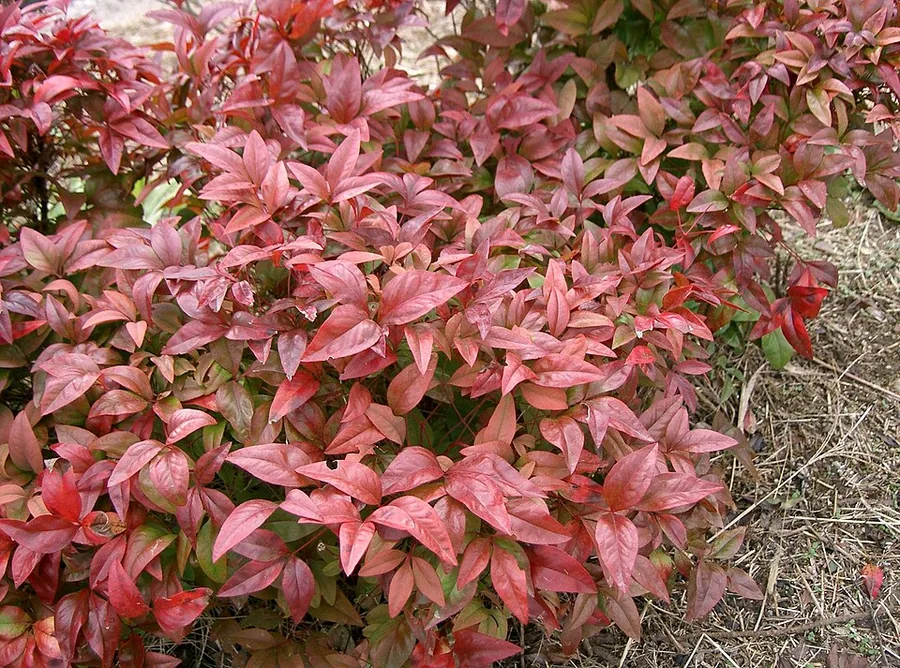
Despite the common name, heavenly bamboo shares nothing with bamboo beyond a passing resemblance. Nandina is an upright, cane-forming evergreen shrub in the barberry family, its airy compound leaves borne on slender stems that read as bamboo only from a distance. Cool temperatures trigger red and purple pigmentation in the foliage, and bright berries carry the display through midwinter.
Its cultural range is exceptionally broad. Once established, nandina withstands heat, drought, and poor soil, performs across the full gradient from full sun to deep shade, and endures cold to -9°F (-23°C). Pests and deer largely ignore it, a resilience that partly explains its wide uptake across southern gardens.
That same durability underlies its liability. The entire plant, and the berries in particular, contains cyanide-releasing compounds toxic to animals and people, and birds that gorge on the fruit can die outright. Nandina also escapes cultivation and becomes invasive across the Southeast, so siting and the decision to permit fruiting weigh as heavily as routine culture.
Care
The short version: establish it in full sun to part shade in nearly any well-drained soil, water through the first season and then withhold except in drought, and renew a few of the oldest canes each late winter to sustain density.
Light
Nandina performs across the entire light gradient, from full sun to deep shade. Sunlight drives the red and purple pigmentation of the winter foliage, however, so a deeply shaded plant grows adequately yet holds flat green color.
Water
Supply regular water through the first season while the root system establishes, then reduce irrigation. Once rooted the shrub is genuinely drought tolerant and needs water only during extended dry periods, on the order of every 7 to 14 days in heat.
Soil
The species adapts to clay, loam, or sand provided drainage is adequate. It tolerates an unusually broad pH span, from 5.0 to 8.5, so nearly any garden soil supports it without amendment.
Temperature
Cold hardiness extends to roughly -9°F (-23°C), and heat tolerance reaches 100°F (38°C). This wide thermal window is precisely why the shrub succeeds across USDA zones 6 to 9 without protection.
Humidity
Ambient outdoor air satisfies the plant, so no humidity target applies. It accepts humid southern summers and drier conditions with equal ease.
Feeding
Nandina is a low-demand feeder that requires very little nutrition. A single application of balanced slow-release shrub fertilizer in spring suffices, and many established plants perform well with none.
Pruning
Prune in late winter by cane, cutting individual stems to varying heights just above a node so new shoots break low and the shrub fills rather than thinning at the crown. Remove several of the thickest, oldest canes at the base each year to renew the plant, since flowers and fruit form on new growth.
Repotting
Grown chiefly as a landscape shrub, a container specimen benefits from a larger pot every 2 to 3 years. Repot when roots circle the pot, water runs straight through, or growth stalls.
Size & spacing
A mature shrub reaches 3 to 8 feet (91 to 244 cm) tall and 2 to 5 feet (61 to 152 cm) wide. Allocate spacing for that full spread, or plan to restrain it with regular cane pruning.
When to plant
Nandina transplants readily and is best set out in spring or fall, when soil is workable and temperatures are moderate enough to favor root establishment. Flowering follows in late spring, and the red berries mature in fall and persist through the cold months.
Northern hemisphere
Southern hemisphere
Typical months for a temperate climate: start earlier in warm zones, later where spring frosts linger.
- Plant: spring or fall
- Harvest: Flowers in late spring; bright red berries develop in fall and persist through winter.
Hardiness
USDA hardiness zones: 6–9
Temperature: down to -23°C
Troubleshooting
Nandina is among the most trouble-free shrubs in cultivation, and its few disorders trace almost entirely to pruning regime, light exposure, or its capacity to spread. Reading the early signs below lets you correct form, seasonal color, or unwanted recruitment before any of them progress.
Recruitment of volunteer seedlings beyond the parent plant
Seedlings appearing well away from the parent mark nandina's invasive behavior, which proceeds through two independent pathways. Birds consume the berries and deposit viable seed off-site, while the shrub also advances locally through rhizomes and root fragments that resprout. Removing the berry clusters before ripening cuts off avian dispersal, excavating every seedling and root fragment addresses the vegetative pathway, and substituting sterile, non-fruiting cultivars or native shrubs prevents recurrence.
Fix:
- Remove berry clusters before they ripen to limit bird dispersal
- Dig out seedlings and rhizomes, removing all root fragments
- Replace with sterile, non-fruiting cultivars or native alternatives
Woody, defoliated lower canes with foliage confined to the crown
Nandina grows from multiple canes, and older ones naturally shed their lower leaves and turn leggy as they age past a few unpruned seasons, a process deep shade accelerates because the plant abandons foliage that no longer earns its keep in low light. The correction is renewal pruning in late winter, removing roughly a third of the oldest, thickest canes at ground level and heading the remainder to staggered heights above a node so new shoots break lower down. Shifting a shaded container specimen into brighter light restores density for the same reason.
Fix:
- Cut about one-third of the oldest, thickest canes to the ground in late winter
- Head back remaining canes at varying heights just above a node to encourage branching
- Move container plants to a sunnier spot if heavily shaded
Foliage holding green tones rather than developing seasonal red
The purplish-red cast that nandina develops in autumn and winter depends on sun exposure, so a specimen sited in deep shade never accumulates that pigment and instead holds green or bluish-green foliage through the cold season. Relocating the shrub or thinning the overhead canopy raises the light it intercepts and returns the color. Full sun to light shade yields the deepest tones.
Fix:
- Relocate or plant in a position receiving more direct sun
- Thin overhead shade where practical
Toxicity
Regard the entire plant as poisonous. All tissues of nandina, and the berries above all, release cyanide when chewed or digested, and no quantity is safe for a pet, a child, or grazing livestock. The fruit is especially lethal to birds, so exclude animals and weigh carefully whether to allow the shrub to fruit.
Toxic to
Cats · Dogs · Horses · Rabbits · Livestock · Birds · People
Cats Severe
In a cat, cyanogenic glycosides liberated by chewing the leaves or berries produce weakness and ataxia within hours as the toxin blocks cellular oxygen use. Drooling, a heart rate that races then slows, seizures, and labored breathing follow, and each warrants immediate veterinary care.
Dogs Severe
A dog that chews the foliage or swallows berries stumbles, vomits, and fatigues quickly as released cyanide starves the tissues of usable oxygen. Tremors, collapse, and respiratory distress develop soon after, so any suspected ingestion is an emergency.
Horses Severe
Equine physiology tolerates cyanide poorly, and grazed nandina acts fast. Bright red mucous membranes from oxygen-saturated but unusable blood, accelerating respiration that shifts to gasping, muscle tremors, and sudden collapse indicate a rapidly fatal course without treatment.
Rabbits Severe
A rabbit's small body mass means even a modest ingestion delivers a consequential cyanide dose. Weakness, a hunched and unresponsive posture, respiratory difficulty, and swift deterioration follow, so the plant belongs well outside a rabbit's range.
Livestock Severe
Ruminants such as cattle, goats, and sheep that browse nandina can collapse rapidly, since fermentation in the gut accelerates cyanide release. Staggering, labored or gasping respiration, frothing, and collapse can appear with little preceding warning.
Birds Severe
Birds face the highest risk because winter foraging concentrates the exposure. Cedar waxwings and similar species that gorge on the berries die of acute cyanide toxicosis, and necropsy typically reveals internal hemorrhage with no premonitory signs; a heavy feeding can eliminate an entire flock.
People Caution
No part of nandina qualifies as food, and the berries are unsafe to consume. One or two swallowed berries seldom cause serious harm in an adult, but a child's lower body mass raises the risk substantially, so restrict access to the fruit and contact poison control after any ingestion.
Keep berries and foliage away from pets, children, and grazing animals; supervise pets around landscape plantings.
Helpline numbers

United States
ASPCA Animal Poison Control: (888) 426-4435 (fee applies)
Poison Control: (800) 222-1222



Canada
Poison Centres: 1-844-764-7669
Varieties
The nandina in commerce is chiefly a small set of named selections, several bred for reduced or absent fruiting, which curtails the worst of the species' invasive potential. The following are encountered most frequently.
Fire Power
A compact dwarf that develops intense red winter foliage and sets little or no viable fruit, which makes it the safe, non-invasive selection.
Gulf Stream
A dense mounding cultivar valued for pronounced red autumn and winter coloration that produces almost no fruit.
Harbour Dwarf
A low, spreading dwarf commonly mass-planted as a groundcover where restrained height is the objective.
Alba
An atypical form that bears creamy white berries in place of the species-typical bright red.
How to propagate
DivisionEasy
Late winter to early spring · One growing season
The most reliable method is to divide an established clump during late winter or early spring, lifting and separating rooted canes together with attached rhizome sections. Each division reestablishes over a single growing season.
Stem cuttingsModerate
Summer · Several weeks to a few months to root
Summer allows semi-hardwood cuttings taken from the current season's growth, which has firmed enough to root while remaining pliable. The method is slower and less dependable than division, with rooting spanning several weeks to a few months.
SeedModerate
Fall after fruit ripens · Slow; one or more years to germinate and reach size
Seed is viable but inefficient and generally inadvisable. Sown in fall as the fruit ripens, germination and subsequent sizing may extend a year or more. Since birds disperse that same viable seed and thereby drive the plant's invasiveness, seed propagation is discouraged anywhere nandina can escape cultivation.
Myths
Heavenly bamboo is a true bamboo.
Taxonomically the common name misleads. Nandina is not a bamboo at all; it is an upright, cane-forming evergreen shrub placed in the barberry family, Berberidaceae. Its slender canes and finely divided leaves merely produce a superficial resemblance to bamboo.
Nandina berries provide harmless winter forage for songbirds.
The fruit carries cyanogenic compounds, which makes it demonstrably unsafe. Species such as cedar waxwings that gorge on a large fruit cluster in winter can die of acute cyanide poisoning, so stripping the fruit is a direct wildlife-protection measure.
Sources
- ASPCA Animal Poison Control Center
- NC State Extension Gardener Plant Toolbox
- Clemson Cooperative Extension Home & Garden Information Center
- University of Florida IFAS Gardening Solutions
- USDA National Invasive Species Information Center
- NIH/NCBI PMC (Journal of Veterinary Diagnostic Investigation)
- Maryland Department of Agriculture