Ornamental · Berberidaceae
Mayapple
Podophyllum peltatum
A rhizomatous woodland native that unfurls its umbrella leaves in spring, then withdraws into dormancy by midsummer.
Full shade
Every 3–7 days
730–1825 days
USDA 3–8
Overview
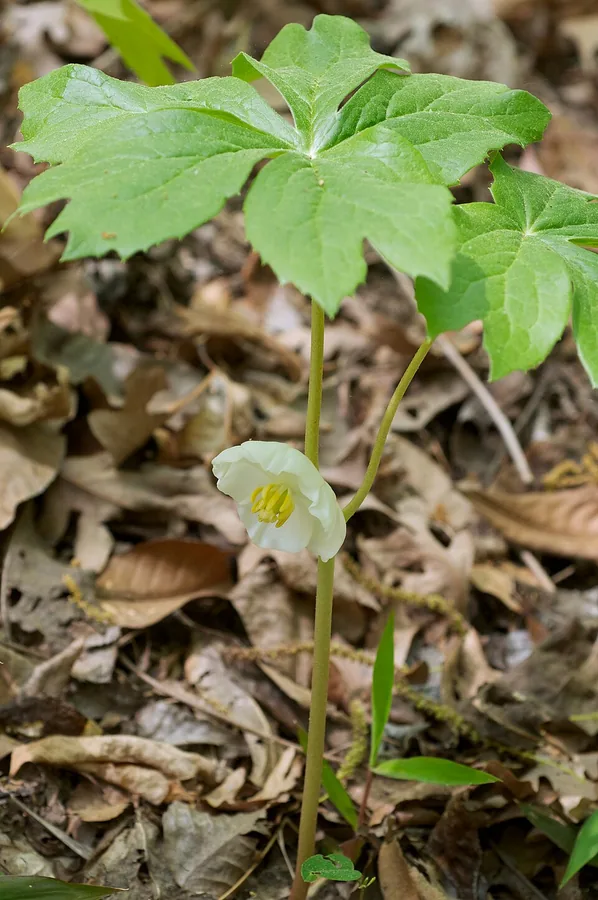
Mayapple occupies the shaded floor of eastern North American woodland, raising paired leaves that open on a single stalk like small green umbrellas. Its creeping underground rhizome extends laterally, which is why one plant develops over time into a spreading clonal colony across damp, wooded ground. As a true understory native, it is adapted to the low light beneath a high canopy where few other species compete.
A flowering stem carries two leaves and a solitary nodding white bloom set in the fork between them, positioned out of view unless observed from below. That flower yields one fruit that ripens to golden yellow in late summer, and this ripe pulp is the sole part of the plant that is safe to consume. All other tissue holds a potent toxin.
The defining trait is a compressed phenology. Mayapple emerges in spring, flowers, sets fruit, then dies back completely as summer heat advances, leaving bare ground until the following season. Understand that programmed gap and the species performs as a striking, low-maintenance groundcover for a suitably shaded site.
Care
The short version: site it in full to partial shade in moist, humus-rich, slightly acidic soil, maintain even moisture through spring, and allow it to enter dormancy and disappear on its own once summer heat sets in.
Light
As a true understory species, mayapple wants full to partial shade beneath a tree canopy, the light regime it evolved under. It accepts a little morning or dappled sun, but a hot, exposed position raises leaf temperature and water demand enough to force early dormancy and scorch the foliage.
Water
Supply steady, even moisture through spring while the foliage is active, since the plant is native to damp woodland soil. An established colony withstands some drought only because it can retreat into dormancy, so dry soil in an exposed site simply shortens the leaf season rather than damaging the rhizome.
Soil
Use moist, humus-rich soil with good drainage, from sandy to loamy, provided it is high in leaf mold and organic matter that hold moisture while admitting air. A slightly acidic pH of 5.0 to 6.0 reproduces the chemistry of the forest floor the species inhabits.
Temperature
Mayapple is markedly cold-hardy, surviving to roughly -29°F (-34°C), and tolerates heat to about 90°F (32°C), above which it withdraws into summer dormancy rather than sustaining damage. That envelope spans a broad range of temperate gardens.
Humidity
Ambient outdoor humidity is sufficient, so no percentage target applies. The species evolved in cool, moist woodland air, and the shade and damp soil that create those conditions matter far more than any measured reading.
Feeding
Adapted to lean forest soil, this native requires almost no supplementary nutrition. A spring top-dressing of leaf mold or compost supplies what it needs, whereas heavy fertilizer offers no benefit and is simply unnecessary.
Pruning
No pruning is warranted. The foliage yellows and dies back on its own as the plant enters summer dormancy, and the spent material can be left in place, so no fall cleanup is required.
Repotting
Mayapple is seldom potted or divided and generally remains undisturbed. Lift and split a colony only when it becomes crowded, vigor declines, flowering or fruiting drops off, or the rhizomes begin congesting at the soil surface.
Size & spacing
Each plant reaches a modest 12 to 18 inches (30 to 46 cm) in height and about 9 to 12 inches (23 to 30 cm) in spread, while the rhizome continues to extend laterally beyond the individual crown. Set divisions roughly one spread apart and allow them to knit into a colony over successive seasons.
When to plant
Mayapple follows a tight woodland phenology. Establish dormant rhizome divisions in fall or container plants in spring, expect the white bloom across April and May, and look for the ripe golden fruit in late summer before the foliage withdraws for the season.
Northern hemisphere
Southern hemisphere
Typical months for a temperate climate: start earlier in warm zones, later where spring frosts linger.
- Sow: Not typically sown indoors; seeds need cold stratification and are slow and erratic to germinate
- Plant: Plant dormant rhizome divisions in fall, or container plants in spring after frost
- Harvest: Blooms April to May; fruit ripens to golden yellow in late summer (August to September)
Hardiness
USDA hardiness zones: 3–8
Temperature: down to -40°C
Troubleshooting
As a resilient native, mayapple presents very few problems, and the symptom that appears most alarming is usually nothing more than the plant entering its programmed summer rest. Match the observed signs below before applying any treatment.
Yellow or orange pustules on the leaves
Those raised pustules point to rust, a fungal pathogen that establishes where foliage stays wet and a dense colony traps still, humid air. Strip and discard the infected leaves to remove spore sources, and thin the stand so moving air dries the surfaces the fungus needs. Because the plant defoliates into summer dormancy anyway, the pathogen has little tissue left to persist on.
Fix:
- Remove and dispose of affected leaves
- Improve air circulation by thinning crowded colonies
- Avoid overhead watering to keep foliage dry
Leaves yellow and vanish by midsummer
In nearly every case this is summer dormancy, the plant's programmed retreat rather than a disease. Mayapple withdraws resources into the rhizome as heat rises, which is why the underground storage organ stays firm and viable while the leaves collapse. Where an unshaded, drought-stressed site drives the retreat early, added shade and steadier moisture reduce the water deficit and extend the leaf season.
Fix:
- Do nothing; allow the plant to enter dormancy
- Mark colony location to avoid disturbing dormant rhizomes
- Maintain shade and soil moisture to delay decline in dry years
Toxicity
Regard mayapple as a poisonous plant. Every part except the fully ripe, golden-yellow fruit contains podophyllotoxin, a cytotoxic compound that produces severe vomiting, diarrhea, and systemic effects in people, pets, and livestock alike. Because the compound also injures skin and eyes on contact, wear gloves during any handling and keep children and animals clear of the leaves, stems, roots, and unripe green fruit.
Toxic to
Cats · Dogs · Horses · Rabbits · Livestock · Birds · People
Cats Severe
A cat that ingests any tissue other than the ripe fruit typically develops heavy vomiting and diarrhea, followed by lethargy and panting. Because podophyllotoxin is systemically cytotoxic, severe cases progress to nervous-system involvement, and sap contact leaves the skin or eyes reddened and ulcerated.
Dogs Severe
Dogs account for most poisonings because they excavate and gnaw the toxin-rich rhizome. The clinical picture runs from forceful vomiting, diarrhea, and lethargy to panting, and a large dose can advance to collapse or, uncommonly, coma.
Horses Severe
A horse grazing the leaves, roots, or green fruit shows violent colic-like pain, loose stools, and marked lethargy. Since the podophyllotoxin acts systemically rather than on the gut alone, the animal can deteriorate to the point of going down.
Rabbits Severe
The same podophyllotoxin dangerous to dogs and horses is proportionally worse in a rabbit's small body. Severe gastrointestinal distress and rapid weakness follow ingestion, so exclude mayapple from any area a browsing rabbit can reach.
Livestock Severe
Cattle, goats, and sheep that consume the foliage or roots in a wooded pasture develop heavy purging, dehydration, and a broader systemic collapse. The tissue is bitter, which deters casual grazing, yet hungry stock will still ingest it.
Birds Severe
Poultry and other birds are equally susceptible. Consuming the leaves, rhizome, or unripe fruit produces serious gastrointestinal irritation and a steep loss of condition, and the small body mass of a bird means a minimal dose reaches toxicity.
People Caution
Only the fully ripe, golden-yellow pulp is edible, and then in small quantity. Every other part, and the unripe green fruit, delivers severe vomiting, cramping, and systemic poisoning, so exclude children from the plant and permit no sampling of any other tissue.
Wear gloves when handling; sap can cause severe contact dermatitis and skin ulceration, and is especially hazardous to the eyes. Keep all plant parts and unripe fruit away from children and pets.
Helpline numbers

United States
ASPCA Animal Poison Control: (888) 426-4435 (fee applies)
Poison Control: (800) 222-1222



Canada
Poison Centres: 1-844-764-7669
Varieties
Mayapple is cultivated almost exclusively as the wild species, with a single recognized natural form worth noting.
Podophyllum peltatum f. deamii
Botanical references recognize this as a naturally occurring form segregated within the native eastern North American mayapple species.
How to propagate
Mayapple propagates itself through its spreading rhizome, and division accelerates that natural increase. Seed is possible but demands several years to a flowering plant.
DivisionModerate
Fall, when the plant is dormant · 1 to 2 growing seasons
Division is the most reliable method, working with the plant's natural rhizomatous spread into colonies. Lift and cut sections of the creeping rhizome in fall, while dormancy limits the shock of disturbance, then replant them. Each division needs 1 to 2 growing seasons to establish before it produces its own foliage and flowers.
SeedDemanding
Sow fresh seed in fall to allow natural cold stratification · Several years to reach flowering maturity
Seed propagation is a long exercise in patience. Sow fresh seed in fall so the winter cold provides the natural stratification the embryo requires to break dormancy; even then, germination is slow and erratic, and the seedling takes several years to reach flowering maturity. In suitably damp shade, the plant self-seeds without intervention.
Myths
Mayapple is edible because it produces an edible fruit.
Edibility is limited to the fully ripe, golden-yellow pulp. The rhizome, roots, leaves, stems, seeds, and every unripe green fruit contain podophyllotoxin and will sicken a person or animal severely. The ripe pulp is the only edible part; all remaining tissue is poisonous.